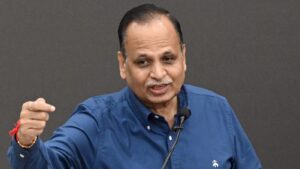
Increasing women’s representation in the judiciary is about the trust of nearly 650 million Indian mothers, sisters and daughters who must believe that the justice system understands their reality and will respond to them fairly, Chief Justice of India Surya Kant said on Sunday.

Addressing the First National Conference of Indian Women in Law on the theme “Half the Nation – Half the Judiciary,” the Indian Justice Commission said: “When half of India’s population looks to the institution charged with protecting constitutional rights and finds only a limited reflection of their own experience, the concern goes beyond statistics, but goes to the heart of institutional adequacy.”
“It is about the trust of nearly 650 million Indian mothers, sisters and daughters who must believe that the justice system understands their reality and will respond to them justly,” he said pertinently.
He recalled the words of the late Justice Fatima Beevi, the first female judge of the Supreme Court, who said: “You opened the door,” upon her appointment in October 1989. “More than three decades later, the responsibility rests on all of us is to ensure that the door you opened does not depend on individual exceptionalism. It must remain open not by circumstance, but by structure – sustained by institutional will rather than personal achievements,” the CJI said.
He stressed the need for more women’s representation on the judiciary, saying: “Women often bring distinct insights that shape how the law works in homes, workplaces and in everyday reality. Thus, their presence not only adds diversity to the judiciary; it deepens the Court’s engagement with the community it serves.”
He identified the Supreme Court colleges as one potential area for reform by urging them to expand selection to qualified women lawyers from that state who serve on the Supreme Court.
“The time to take measured action is not in the future, it is now,” he said. “Considering the appointment of suitable and worthy women to the Bar should not be the exception but the rule.” In case there are no suitable female candidates available within a particular age group, the CJI added, “I earnestly request the Supreme Court collegiums to widen their field of view and include women practicing advocates in the Supreme Court who belong to that state, for promotion.”
The event organized by Indian Women in Law (IWiL) and led by two senior advocates – Mahalakshmi Bhavani and Shobha Gupta – brought together women judges of the high courts to participate in a panel discussion alongside the Supreme Court and former Supreme Court judges on issues ranging from bridging the gender gap on the bench, having inclusive benches, and ways forward on concrete reforms.
Since this event coincided with International Women’s Day, the International Commission of Justice said that reform in this direction is not a one-day event but an ongoing process and its success should not be measured by the duration of the individual mandate of international justice institutions.
Recently, the Supreme Court bench recommended the appointment of Justice Lisa Gill of Punjab and Haryana High Court as Chief Justice of Andhra Pradesh High Court. The Center has approved her appointment, making her the third woman CJ at HC. While the P&H Supreme Court boasts of 18 women judges, with around a dozen women judges in the Bombay and Madras High Courts, the CJI said: “We must acknowledge that institutional intent is no longer enough – it must always be accompanied by institutional imagination.”
According to him, “Rising is not a simple or instant process. It requires taking care of the pipeline from its very source. If the pipeline is narrow at its source, the seat cannot be wide afterwards.” Recently, the CJI said that the institution is steadily strengthening as women constitute about 36.3% of the workforce of judicial officers at the district level.
On the judicial side, the Court heralded change in all Bar Councils by directing that at least 30% of seats be reserved for women’s rights defenders with a similar directive applying to bar association elections.
To justify the changes, the CJI said the legal profession had a working climate that imposed “disproportionately invisible costs on women” ranging from late-night briefings and inadequate facilities to unreported bias in the workplace and frequent questioning of authority.
“Every woman who takes her place on the bench sends a clear message to those who still face these obstacles: Your perseverance is not subtle, and it is not in vain. When a young lawyer sees another woman presiding over the court — not as an anomaly or anomaly, but as a matter of course — something changes in her psyche. Aspiration becomes palpable. Belonging becomes unmistakable,” the CJI said.
He urged male members of the Bar to recognize and accept the simple fact that women members are not seeking privileges but fair and adequate representation, which is long overdue. “Only when the profession itself internalizes this truth will the path to the bench become clearer,” he said.
“The story should not be that one individual got greater representation; it should be that the Supreme Court of India, and high courts across the country, have integrated justice into their processes. When that happens, representation will no longer depend on personalities or moments of design – it will remain embedded in the structure of the institution itself. This is how lasting change is created,” he said.