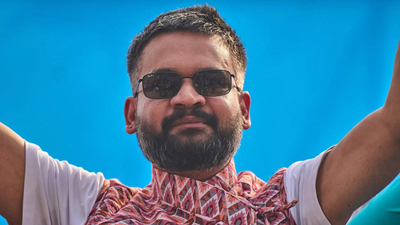
Balendra Shah (AP Photo)
His songs fueled the protest generation. Now the former Mayor of Kathmandu He confronts former Prime Minister Oli and asks voters to imagine him running the countryKATHMANDU: Everyone wants a selfie with Balendra Shah.In Jhapa district on Sunday, as Nepal prepared for its March 5 elections, a line curved along a dusty courtyard in the eastern plains.
A volunteer kept the line moving, only allowing about 10 seconds for each supporter — a handshake, a smile, a photo.
“I’m here to see Palin even though I have a fever,” said a seven-year-old girl. A middle-aged woman admitted that she left her heart examination halfway through. “Just for a picture.”
Nepal Ground Report: Why Balin Shah is sparking anger in this election in Nepal | I bear witness
In the middle of the crowd stood Palin – dark jacket, trimmed beard, black rectangular sunglasses. It’s a look so relevant to him that stores in Kathmandu have sold out of the frames he favors, and online retailers still sell them as “Balen Shah glasses.”
When the man — known simply as Palin — steps onto the campaign stage, the crowd often mirrors him wearing black T-shirts and dark shades. He takes off his sunglasses only briefly.
“Look at me,” he says. “I love you.” Palin, who turns 36 next month, is running in the Jabba 5 parliamentary elections against KP Sharma Oli, 74, a four-time prime minister who resigned five months ago after youth-led protests left 77 people dead. Jhapa-5 is located about 300 kilometers southeast of Kathmandu, near Nepal’s open border with India. Siliguri is located in West Bengal just across the border and serves as a major trade gateway to the region.
Oli leads the Communist Party of Nepal-Unified Marxist-Leninist, whose networks remain deeply rooted in this eastern constituency. Palin is running under the banner of the Rastriya Swatantra Party, which is only four years old. The contest pits a national candidate for the first time against one of Nepal’s most enduring political figures on the ground who has rarely favored outsiders.Balin was born in Kathmandu, the youngest of four siblings.
His father, Ram Narayan Shah, a government Ayurvedic practitioner who died last December, described him as “smart and simple” as a child who wrote poems — a habit that has continued. Balin studied civil engineering in Kathmandu and later completed his postgraduate studies in structural engineering in India. His early life suggested discipline rather than disorder.In 2013, he entered Raw Barz, Nepal’s most visible rap battle scene, and won.
His lyrics were sharp and harsh, targeting corruption, political stagnation, and the inheritance of power by the same characters. “He was more of a poet than a rapper,” one of the organizers said. “He talked about repressed people.”His songs traveled far beyond the underground. On a Discord forum last September where young protesters debated who should lead the country after Oli’s resignation, Palin’s name appeared more than 16,000 times, making him the most frequently mentioned figure in conversations about interim leadership.
Many Generation Z activists saw him as their preferred successor. But he declined the role, publicly supporting former Chief Justice Sushila Karki instead.
Palin built his following largely online, amassing millions of followers across platforms.“He speaks the language of our frustration,” said Srijan Karki, 23, a software developer. “Other leaders give long speeches. He makes direct statements.
Even when he’s angry, it seems real.In 2022, Palin, who ran as an independent, won the mayoralty of Kathmandu by 61,767 votes, defeating candidates from established parties. He ruled openly and confrontationally. Bulldozers demolished illegal structures, and waste collection in the Singha Durbar area – which houses the Prime Minister’s Office – was temporarily stopped in protest against what he called the central government’s inaction.When protests rocked Nepal in September 2025 and demonstrators clashed with security forces after a crackdown by the Oli government, anger spilled onto the streets. In November, Palin, still serving as mayor of Kathmandu, directed this outrage in a midnight Facebook post: “F*** America, F*** India, F*** China, F*** UML, F*** Congress, F*** RSP, F*** RPP, F*** Maobaadi. You all combined can’t do anything.” Two months later, he resigned as mayor and joined the RSP.
Palin does not regularly deal with the media. He rejected Oli’s call for a public debate, instead demanding that the former prime minister take responsibility for civilians killed during the protests. Instead, he relies on social media to communicate. Across platforms, he has built an unparalleled online audience in Nepal – 3.5 million followers on Facebook, 1 million Instagram followers on YouTube, and 400,000 on X. The September 2025 protests changed the political atmosphere in Nepal.
Unemployment, corruption and impunity poured into the streets of Nepalese youth, and Oli resigned. Palin did not officially lead the demonstrations, but he became closely associated with the tone of the demonstrations.Ayal Sah, 23, a first-time voter from Janakpur, traveled to see him speak after joining the RSP. “I can’t vote directly for Palin because he’s not running from our district,” Sah said. “But I will definitely vote for his party.”In the town of Damac in Jabba, Bibana Oli (25 years old), a migrant worker who returned from Kuwait to cast her vote, linked her future to the result. “How long I will continue working in Kuwait will depend on Palin’s victory,” she said. “And the jobs it creates.”