

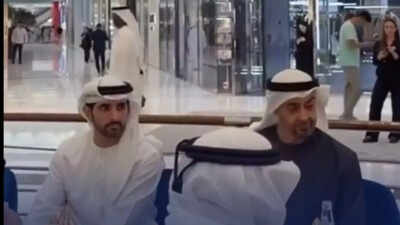
Amid the ongoing regional tensions in the Middle East due to the war between Iran, the United States and Israel, residents were in a constant state of concern for life and safety.In such a situation, the ruler of Dubai, Sheikh Mohammed bin Sayed Al Nahyan, reassured the public with a viral appearance as he broke his fast in a public mall in the city.
The President of the United Arab Emirates appeared at the Dubai Mall, where he was seen mingling with visitors, stopping to chat and even having coffee in a spontaneous and warm moment with visitors who were surprised by his presence, according to a report by Khaleej Times.
Loud explosions are heard in Abu Dhabi as Dubai faces a new drone attack | Iran goes to great lengths
On Tuesday, Sheikh Mohammed bin Rashid Al Maktoum, Vice President and Prime Minister of the UAE and Ruler of Dubai, appeared in public and ended his fast at the Majlis in Madinat Jumeirah, sitting alongside members of the public.
Social affirmation in times of distress
According to Dr. Jess Adam Troian, assistant professor of psychology at Heriot-Watt University in Dubai, such public appearances are powerful interventions in situations known as “social dilemmas.”According to research, leaders act as “belief managers” in such situations, shaping how the public responds in terms of panic buying or collective anxiety.When leaders appear calm and focused, they influence the public’s beliefs and reduce fear-driven actions.
“By appearing in public spaces such as shopping malls, UAE leaders signal stability, enhance confidence and discourage panic. Their calm demeanor helps shift the public focus from individual fear to collective resilience, and mitigate anti-social behaviors such as hoarding or hoarding.”Additionally, people are more likely to model their behavior, as these strategic tools help maintain order and morale.
Emotional scales of sensitivity
Other experts have also highlighted the importance of such measures.
Aseel Takeshi, acting dean of the College of Health Sciences and Psychology at Canadian University Dubai, added that humans often view their leaders as emotional “barometers” in uncertain situations.“For many, especially families and children, the sight of driving in a familiar place like a mall or the subway makes the abstract idea of ’national stability’ seem personal, local and close to home,” he added. Such appearances silently convey to residents that life can continue as usual.The United Arab Emirates announced the killing of three individuals in the war between Iran, the United States, and Israel. Numerous videos showing missiles intercepted in the sky and fragments falling in locations across the region have caused great concern and concern about security and livelihoods among residents.In addition, the airspace closure has left many foreign nationals stranded in the region without any information about when they will be able to return home, adding to the pressure.“At a time when many residents were searching for reassurance, seeing national leaders walking among the crowd, interacting warmly with families and dining in a crowded mall was a strong message that daily life in the UAE remains stable and safe,” explained Sébastien Bidault, General Manager of International SOS in the Middle East.