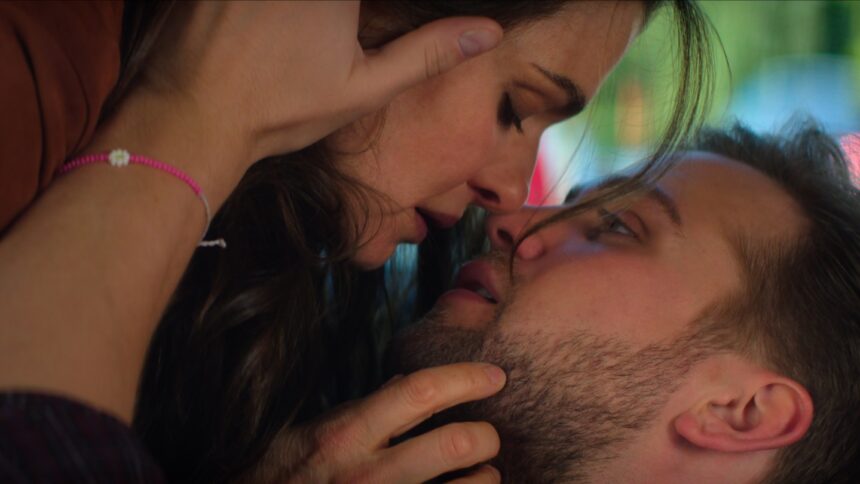
Near the end of Netflix Vladimirthe heroine, played by Rachel Weisz, has an idea about the love triangle she finds herself in. She realizes that her younger colleague, Vlad (Leo Woodall), has been telling himself one thing about flirting with mixed signals. Her philandering husband, John (John Slattery), was telling himself something else. They both looked at her only as a supporting player they The narratives they assume will unfold according to them they Plans.
But she warns that “there are forces beyond their control,” the most important of which is our unnamed heroine. She’s a heroine who’s as funny as she is deliberately narrow-minded and strangely compelling as she is repellent, and she has a voice that defines Julia May Jonas’s adaptation of her own novel—elevating it into something more complex than the feminist cancel culture thesis might seem at first glance, and far more prescient for it.
Vladimir
Bottom line Smart and energetic.
Broadcast date: Thursday, March 5 (Netflix)
ejaculate: Rachel Weisz, Leo Woodall, John Slattery, Jessica Henwick, Ellen Robertson, Matt Walsh, Kylie Carter, Tatyona Jones, Mallory Johnson
creator: Julia May Jonas
The background to her sexual obsession is a situation that takes place amidst cancel culture campus dramas like Netflix The chair and tar and After fishingYou must feel very familiar indeed. At a liberal arts institution, John, a former head of the English department, is accused of sleeping with his students. The women, most of whom were many years removed from graduation, say his behavior was an abuse of power. He insists they were all consenting adults — even his wife agreed to an open marriage — and therefore, he did nothing wrong.
In theory, our heroine, a creative writing professor, stands by her husband. She avoids talking about the situation when she can, and says “It was a different time” when she can’t. If anything, as she declares in an overly moralizing, fourth-wall-breaking, narrative way that narrative is more effective the less it is used, it offends her feminist sensibility that these female students are abdicating their own sexual agency in the affairs they choose to undertake. Not that she’s keen on saying that to her students, who would rather see John ousted and her stop doing “all the pro-wife stuff.”
But as John’s disciplinary hearing approaches, she finds herself as shocked as she is with an intense crush on Vlad, the accomplished author who has just been hired to teach at the college with his more reclusive wife, Cynthia (Jessica Henwick). Over the course of six weeks, or eight half-hour chapters, what begins as a girlish infatuation quickly spills over into the dark tableau that opens the directorial debut of Shari Springer Berman and Robert Pulcini: Vlad is tied unconscious to a chair, while his would-be lover complains to us in the foreground about her impotence as a woman in her fifties.
Weisz is well-suited to a role that relies on her knack for slippage, as seen in (among other things) her tricky double performance in the film Amazon. Dead rangers. while Vladimir Doing her best to make her character look polished and beautiful on the outside, covering her in deep reds and rich purples that accentuate the flush of her coquettish cheeks, she does no such favors for her inner self, which reveals her to be cruel, judgmental, selfish, and self-deceived. She had a frequent habit of insisting, as if hurt by this suggestion, that she “would do it.” never “Do” this or that terrible thing, just as the show provides evidence that she did exactly that in reality.
She also happens to be very intelligent, dropping quips like, “As George Bernard Shaw once said, ‘A strong ass is wasted on young men,'” making her funnier than annoying, but only just. Vladimir She is less interested in moral calculation than psychological anatomy, and thus has no particular interest in reprimanding her. But she doesn’t sugarcoat any of her transgressions as she resorts to desperate measures to get Vlad closer or save John’s neck. She registers every lie she tells herself about her motives or history with a conspicuously raised eyebrow.
It does not spare her any embarrassment as she falls into a deeper and deeper obsession. She will neglect her hapless adult daughter (Syd, played by Ellen Robertson), bail her out in John’s hour of need, and forego her professional duties. But she would never run out of interest in lavishing on every nuance of Vlad’s body (the curve of his thigh under the hem of his shorts, the feel of his neck where it disappeared under the collar of his shirt), or the energy to scrutinize every friendly, professional interaction for signs of his interest. She disappears into her graphic daydreams for moments that turn into hours that eventually turn, with the ferocity of a possessed woman, into the first draft of her long-awaited second novel.
For her, Vlad is a refuge, a mirror, a time machine, and a muse, although she prefers to think of him simply as “my love.” What she doesn’t particularly care about is seeing him as he is, with desires, needs, or identity that extend beyond her own. Woodall, among One day and White lotus He carves out quite a niche for himself playing objects of desire, and he underscores the point with Vlad’s penchant for casual ambiguity. Even when the actor flashes his golden-boy handsomeness to the camera, the character comes across as if he never imagined he might be the one watching him and not the person he’s watching.
A deliberately insular point of view can be made Vladimir Difficult hour. There’s no escaping the heroine’s headspace as she grows ever larger. We are never allowed to understand Vlad, Cynthia, or even John except to the extent that she allows herself, which is not much; Until the end, it is difficult to ascertain their true motives. And while the show’s lack of softness or sweetness makes sense, since it comes from the perspective of a woman who currently lacks both, the always arch tone undercuts almost every emotion except turbulent lust.
But it also makes the series special, right down to the suitably sinister, if somewhat surprising, ending. Jonas’s book concluded with a final blow that I found searing but also strangely anticlimactic. Her miniseries goes in a radically different direction, but she can’t shake the feeling that there are simply no places to go. However, for my money, the latter better preserves the story’s ultimate concept of desire not as a relationship between two people, but as a mechanism for exercising one’s relationship with oneself: the story ends when the protagonist’s use of Vladimir ends.
It’s not fun and it’s certainly not cute, but it feels sincere and perhaps — oh, let’s admit it — relatable. Dig into the heart of your deepest desire, Vladimir He argues, and you’ll find nothing more or less than your own face staring right back at you.