

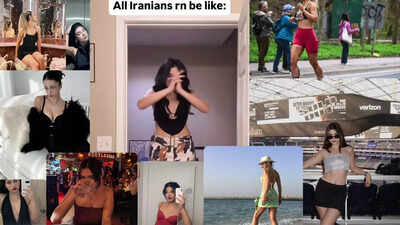
The YMCA dance, once considered a gay anthem before MAGA co-opted it, appears to have found new life with Iranians, in America and around the world. As a recent account wrote: “Iranian Americans across the country are dancing the Trump dance.
This prompted Melissa Wong to repeat: “Has anyone else noticed that the ‘Iranian women partying’ videos are all women dressed like sluts.”The tweet, like Dylan Thomas’ historic words, did not go quietly into the night. I raged. After nearly 8,500 tweets and quotes and more than 13,000 responses, the meme dance has turned into a referendum on authenticity, intervention, and the female body.
In order to understand why this moment exploded, we must first understand the climate in which it emerged.
The viral clips emerged during the US-Iran crisis in March 2026, when President Trump’s military strikes reportedly eliminated senior figures in the regime and sparked Iranian retaliation. The escalation coincided with the death of Ayatollah Ali Khamenei, a figure who for more than three decades embodied the ideological solidity of the Islamic Republic.
His death marked the end of an era defined by hard-line stances on mandatory veiling and state-enforced morality.
Iran-allied fighters attack northern Israel as the Israeli army invades Lebanon after a Hezbollah attack
For some, the strikes and Khamenei’s death represented a dangerous state of instability. For segments of the Iranian diaspora long opposed to the Islamic Republic, it was felt as the first tremors of a potential regime shift. The celebration, in this context, was not a trivial spectacle. It was a landmark release filled with uncertainty, sadness, anger, and cautious hope.One widely circulated video showed a young Iranian-American woman provocatively dancing what online observers dubbed the “Trump dance,” an adaptation of YMCA dances synonymous with campaign rallies.
She was wearing a crop top and shorts. She moved without apparent inhibition. To critics like Wong, a libertarian anti-interventionist voice and a skeptic of American military action abroad, the images seemed staged and unrepresentative.
Her doubts were framed as a question of authenticity. Were these women reflective of typical Iranian society, or were they algorithm-friendly plays?But authenticity, in this discussion, quickly becomes a proxy for humility.
Iranian women respond
The responses were not conciliatory.
- @Hellokittyi_ wrote: “Both pictures are of me. You see, Melissa, unlike you, we had to fight for our basic rights, so we value our freedom.”
- @lili__far responded bluntly: “Shut up, b****! Regards, a proud Persian girl.”*
- @shirin_yfr added: “Women wear the clothes they want because they can :)”
- “We call it,” @moonalinn concluded with clipped confidence.
option ‘. Now I cry about it hun.”
The language was sharp, but underneath there was composure. These were not women arguing about fashion. They were rejecting the premise that credibility should be sewn into the footnote.
For decades, the Islamic Republic has introduced mandatory hijab into law. Since the early 1980s, public dress codes have been enforced by the morality police. Poetry became ideological terrain. Sleeves became a symbol of obedience.
Women were stopped in the streets, reprimanded, fined, and detained. The state’s claim was straightforward: the female body reflects the moral order of the nation.
Ayatollah Ali Khamenei, who served as Supreme Leader from 1989 until his recent death, consistently positioned the hijab as a non-negotiable pillar of the republic’s identity. Even after the death of Mahsa Gina Amini in 2022, which sparked the “Women, Life and Freedom” protests and forced a clear recalibration in implementation, the legal structure remained intact.
The leagues changed in vision. Surveillance increased. The legal requirement has persisted.This is the long shadow it casts over these diaspora sections.Within Iran, women have historically been reprimanded for inadequate coverage. Outside Iran, they are now rebuked for insufficient modesty according to someone else’s cultural mold. Geography is changing. The organizing instinct continues.What makes this moment different is not the insult but the response to it.
The women in these videos are not seeking the approval of Western liberalism or the approval of conservative sensibilities. They inhabit a space deprived of many in the home. Celebration, for them, is multi-layered. It’s political. It’s my generation. Memory is set to music.With Khamenei’s departure, Iran stands at a symbolic inflection point. Institutions do not evaporate with one departure, and laws do not dissolve with one stroke.
However, symbols are important. The sight of diaspora women dancing in public, responding to moral policing with derision rather than respect, signals a reset of trust.What those viral clips ultimately revealed was neither decadence, nor propaganda, nor some elaborate performance of Western liberalism. They revealed the memory. The memory of moral police buses stopping on street corners. The memory of stopping, correcting and warning.
The memory of poetry is treated as taboo, and weaving is treated as ideology. For decades, the female body in Iran was not just a personal space; It was a general doctrine.
The state wrote its authority on sleeves and scarves.So, when diaspora women dance in crop tops and shorts to a downbeat anthem, they are not organizing a rebellion for the algorithm. They live in a freedom that many of their mothers carefully negotiated and many of their peers at home still navigate cautiously.
They move without the calm calculations that accompanied every step outside. The instinct to monitor them online mirrors the old instinct of ethics journals, which are only now digital.
Different fashions, same motive: measuring, judging, organizing.What bothers critics isn’t the choreography. It is the absence of fear. The YMCA rhythm will fade away. Meme will age. The geopolitical crisis will turn into another title. But the deeper transformation lies elsewhere. The generation that grew up under the watchful eye of the morality police learned to look back without flinching. Their bodies are no longer sites of state instructions or social suspicion. They are no longer paintings of someone else’s virtue, but rather expressions of choice.
Once choice is exercised rather than demanded, it becomes very difficult to police again.