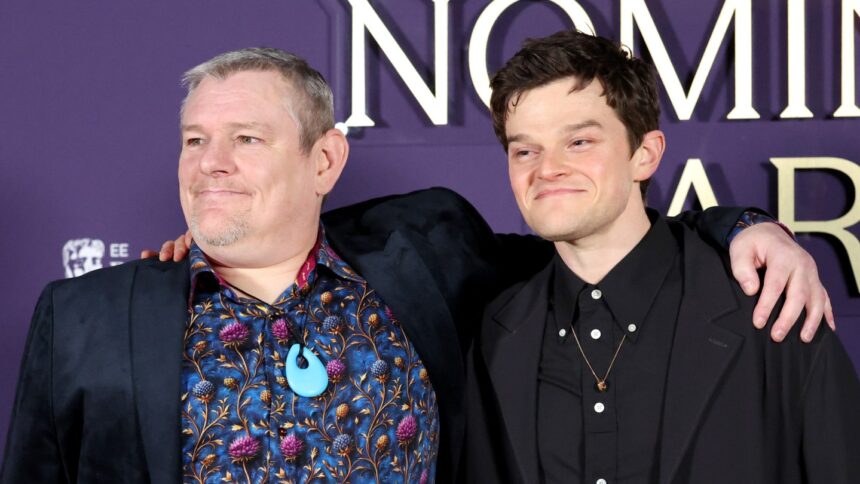
Controversy erupted among attendees at the BAFTA Film Awards and online after John Davidson, one of Tourette’s campaign organisers, was heard cursing throughout the show.
Davidson is the inspiration behind the BAFTA nomination I swear. Robert Aramayo, who played the Scotsman in Kirk Jones’ widely acclaimed film, won the BAFTA for Best Actor on Sunday night – beating Leonardo DiCaprio, Timothée Chalamet, Ethan Hawke and Michael B. Jordan.
The film follows the struggles of a man who grew up with Tourette Syndrome, a condition characterized by sudden, involuntary, repetitive movements or sounds. These are known as tics, and often manifest as outbursts such as loud cursing, which occurred several times during the first 20 minutes of the BAFTA ceremony with Davidson shouting, “Boring!” While the guests were briefed on some housekeeping rules before the show began, and “Bullshit!” When he asked people not to curse.
He also shouted, “Shut up,” as BAFTA chair Sarah Boot made her introductory remarks, and later elicited gasps when he said the N-word as Michael B. Jordan and Delroy Lindo presented the award for Best Visual Effects to Avatar: Fire and Ashes.
In keeping with the celebratory tone of the evening, Cumming interrupted his hosting several times during the screening to remind viewers: “You may have noticed some strong language in the background. This could be part of how Tourette’s syndrome manifests itself in some people as the film explores that experience,” referring to I swear. “Thank you for your understanding and help creating a respectful space for everyone.”
After Davidson left The ceremony, which took place at London’s Royal Festival Hall about 25 minutes after proceedings began – which Hollywood Reporter What he understood was of his own, and not the result of a request from BAFTA – Cumming said again: “Tourette’s syndrome is a disability and the tics you heard tonight are involuntary, which means the person with Tourette’s has no control over their language. We apologize if you felt offended tonight.”
Guests were also notified before the awards ceremony began that they might occasionally hear Davidson’s involuntary movements. A floor manager greeted him by saying, “John has Tourette’s Syndrome, so please be aware that you may hear some involuntary sounds or movements during the concert.”
BAFTA indicated THR to the BBC when asked for a statement about the incident. The broadcaster, which broadcast the show two hours late across the UK, did not immediately respond, although questions were raised behind the scenes about the decision not to delete Davidson’s swearing.
The incident sparked debate among the film community at the BAFTA Film Awards, with many Britons asserting that Tourette’s is severely misunderstood. Others, including those who live across the pond, were apparently less tolerant of Davidson’s outbursts. Some stressed that night that his language could have been emotionally arousing to the presenters.
SinnersProduction designer Hannah Beachler took to social media after the screening. “I keep trying to write about what happened at the BAFTA ceremony and I can’t find the words,” she wrote on X. She added about Davidson’s tics: “The situation is almost impossible, but it happened three times that night, and one of the three times was directed at myself on my way to dinner after the show.” “I understand and know deeply why this situation is impossible. I know we have to handle this with grace and keep moving forward. But what made the situation worse was the simple ‘if offended’ apology.”
Aramayo, who also won a BAFTA Rising Star award on Sunday, told the audience as he accepted the award: “John Davidson is the most remarkable man I have ever met. He is very collaborative in education and believes there is still a lot we need to learn about Tourette’s.”
“For people living with Tourette syndrome, we are around them helping them define their experience,” Aramayo said. “So, as the movie puts it, they need support and understanding.”
The discussion moved online, with some users commenting that Tourette’s syndrome was “debilitating” and “really terrible”.