Logo text
While the theatrical poster is by Adam McKay Step brothers Focusing on a studio portrait of the characters played by Will Ferrell and John C. Reilly, each of them boasting an uncannily bemused grin, the DVD cover highlighted the film’s less domesticated side: Dale (Reilly) pulling Brennan’s (Ferrell) hair out in a tableau that’s half drawn and half unrestrained violence, with each half-brother baring his teeth, one in agony and the other grinning at either effort or triumph.
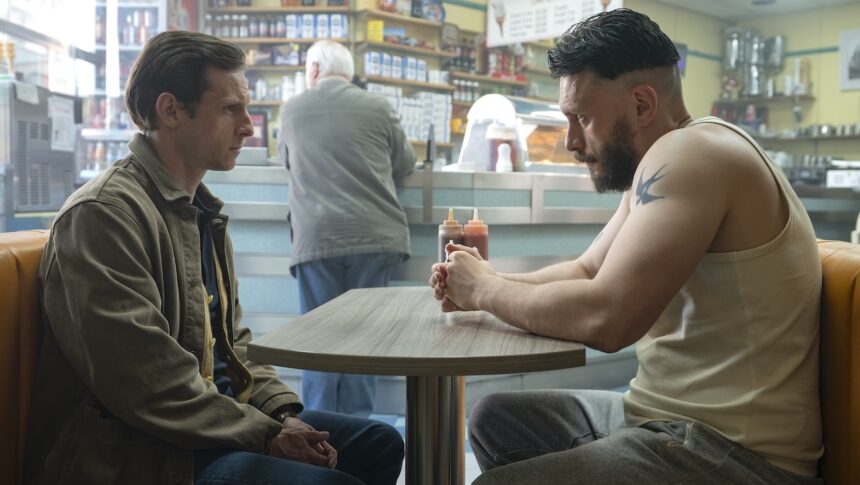
I can’t say for sure whether Richard Gadd and the HBO marketing department were intentionally simulating it Step brothers With an image of the main poster for the new Jad limited series, Half a man. In the poster, Robin (Jadd) has Niall (Jamie Bell) in trouble. It is a situation that is both intimate and competitive; At first glance, it could be the half-brothers fighting for fun, but one look into either man’s eyes makes it clear there’s no fun to be had. At least the series delivers Which He promises.
Half a man
Bottom line A deeply felt but monotonous exercise in trauma.
Broadcast date: 9 p.m. Thursday, April 23 (HBO)
ejaculate: Richard Judd, Jamie Bell, Stuart Campbell, Mitchell Robertson, Neve McIntosh, Marian McIvor, Charlie De Mello, Bilal Hasna
creator: Richard Judd
I wouldn’t put it past Gad to make his follow-up a Netflix awards juggernaut Reindeer baby As a nightmarish counterpoint to Step brothers – One is a slapstick comedy with disturbing melodrama just beneath the surface, the other a disturbing melodrama in which strange comedic (and not all that funny) notes appear at least unexpected moments.
I get the sense that Gad wants his work to sneak up on viewers, although after one of the most successful word-of-mouth stories of the modern streaming era — the one that transformed Gad from a largely unknown stand-up comedian into a multiple Emmy winner — the chances of a second stealth gambit are low. It doesn’t help in a while Half a man It has almost nothing in common with narrative Reindeer babyTheir thematic interests are similar and the weight they press on the viewer is similar. The result is a six-episode series that features many great performances and some compelling perspectives on toxic masculinity, trauma, and sexual violence — yes, it’s another one of those shows — but feels emotionally unrelenting for six straight hours.
I can see from a distance of a few days Half a man It’s a combination of elements that characterize the exciting and disgusting intersection of Judd Apatow and Sam Shepard, but if you asked me what the series was like when I was watching it, my only answer would be: “It’s… a lot.” It’s a show with a lot to recommend, but it’s an emotionally exhausting one that, in its final revelations, left me with little enthusiasm for recommendation.
The series begins with Niall’s jovial Scottish wedding. In the barn, Robin confronts Niall about… something. Their conversation is elusive, threatening, and filled with decades of secrets, some shared and others to be revealed over the next six hours. The threat of violence – sexual violence – looms, and in less than five minutes, several forms of assault will be committed, triggering a flashback.
Decades ago — referenced in the soundtrack selections more than anything else — Niall (Mitchell Robertson) is a socially awkward and frequently bullied teenager, whose eyes widen in horror when he hears that Robin (Stuart Campbell) is about to join his high school class. Robin spent two years in a juvenile detention center, and Niall doesn’t want him as a classmate. He certainly doesn’t want to share a room with him, but it turns out that Robin is moving in with Niall, because Niall’s mother (Neve Mackintosh, excellent) and Robin’s mother (Marian McIvor) are best friends, and locally rumored to be lovers (because they are).
Robin is everything Niall is not. He is tall, determined and very charismatic. He’s also dangerously out of control in ways that frighten the meek Niall—who dreams of becoming a writer and is clearly coming to terms with his budding homosexuality—but at the same time intrigues him. Robin takes action, while Niall prefers to be passive. Robin brings his own charm, while Niall naturally recedes into the wallpaper. Will Robin be the death of Niall, or will his overwhelming confidence be exactly what Niall needs to fulfill himself? Will Niall help Robin get his life in order or will he somehow destroy him?
It would be easy to look at the characters and the title of the show and think that Niall is the embodiment of ego, Robin is the embodiment of id, and that these two men together might help each other become a full man. But that’s not exactly what the title of the show suggests and that’s by no means what’s going on here.
Later episodes follow a similar structure, bookending with the events at Niall’s wedding and filling in the gaps in their journeys, which don’t quite go the way you expect. Except for that… man, they go pretty much exactly the way you’d expect them to. The show almost immediately settles into a rhythm where you know that anytime Robin shows up, it’s going to lead to screaming — a lot of screaming — and threats and violence, even when circumstances initially suggest otherwise.
A show like this really needs to keep the viewer off balance, never quite correctly predicting how positively or negatively Niall’s life will be affected by his “brother from another lover”. Instead, the mystery of the story should be enough to keep you curious or baffled. No form of traditional narrative appears here.
Even when expectations are reversed, as they sometimes happen midway through a season, it only amplifies the next emerging threat.
Even as the jumbled chronology results in cause and effect confusingly intermingling, Gad’s tendency to return to traumatic sexual violence as a precursor to adult personal and sexual development, while enormously satisfying, is psychologically unconvincing. I have also found this to be the case with Reindeer babywhere Gad’s need to provide answers requires him to impose cause and effect in circumstances that are not always perfectly connected.
Although Gad clearly wants to upend the good brother/bad brother, victim/perpetrator, and hero/villain binaries, it is the overarching narrative, not the attempt at subversion, that endures. The bones of the story, going back to Cain and Abel (or Jacob and Esau), are so familiar, as are the reversals, that it’s hard to find anything Gad does truly modern. The best he can achieve is to implement familiar rhythms in a serious and intense theatrical manner. There’s a scene or two where Niall and Robin are talking about each other that made me think of the Shepard scene The real west Or Willie Russell blood brothers, And I can respect the way Gad worked with those influences, but rarely were there moments that felt truly original or unexpected in the way that a lot of Reindeer baby an act. You are in a vice for six hours, with a lever that allows you to forget that he is responsible for tightening and increasing the pressure.
Gad is a horror movie, a ferocious force of nature and a perpetual misadventure waiting to happen. His voice comes from somewhere deep inside, tinged with menace and pain, and you can’t stop watching or listening to him. He and Campbell, who plays the role for most of the series, convey a similar sense of uncontrollable danger, though even when the script says otherwise, Robin never becomes anything but monstrous. It is easier in Campbell’s interpretation to see how Robin can be both dangerous and attractive at the same time, and more difficult in Gadd’s interpretation to see him as anything other than a wounded animal.
Robertson grounds both versions of Niall in sad misery, with Bale stepping in and giving the character notes of humor that don’t always seem appropriate to the story. I laughed out loud several times because of Bale’s acting choices, which is the rare release valve within the show that could have used more badly. Reindeer baby It wasn’t laughable, but deadly humor was still humor, and with occasional running times in the 30-minute range, the show had a tense, unexpected momentum. Reindeer baby Series directors Weronika Tovelska and Josephine Bornebusch also added visual diversity Half a man Directors Alexandra Brodsky and Ashraf Reybrook dig deeper and deeper into the gloom The spread is not mitigated by two or three seconds of people in skirts dancing festively as a framing device. Half a man It’s harsh, largely colorless, and doomed from start to finish.
More than anything, Reindeer baby I got a dose of warmth thanks to Nava Mau’s Teri, while the central love story was spot on Half a manwhich I won’t spoil, is too flimsy to be sweet. The love story is here to offer hope, but not too much and not for too long. And perhaps that’s the point of it – to plot a sequence between two inextricably linked characters, bound together for better or worse long before the opening wedding. I can respect the lines Gad draws between nature and nurture, destiny and self-determination, trauma and healing. I can’t say I found the revelations of those facts particularly interesting or revealing.