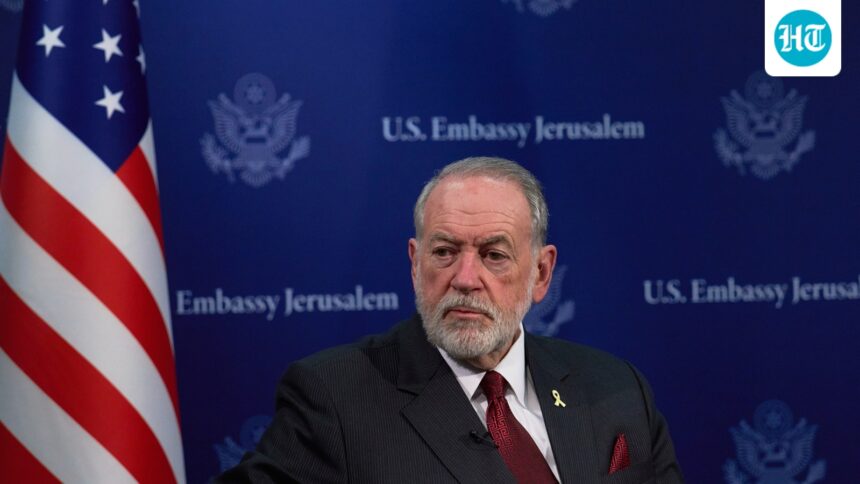
On Saturday, Arab and Islamic countries strongly criticized US Ambassador to Israel Mike Huckabee for his statements indicating that Israel’s claim to a large part of the Middle East is justified.

The backlash followed Huckabee’s comments in an interview with conservative commentator Tucker Carlson that aired on Friday.
Carlson pointed to the Biblical interpretation that Abraham’s descendants were promised the land extending from the Nile to the Euphrates and questioned whether Israel had a right to that land.
Huckabee responded that “it would be good if they took everything,” while adding that Israel does not seek territorial expansion and has a right to security within the territory it legitimately controls, according to a report by the Associated Press.
Huckabee has consistently opposed the two-state solution and has previously questioned the use of the term “Palestinians” to refer to Arab descendants of people who lived in British-controlled Palestine.
In Carlson’s interview, Huckabee appeared to soften Carlson’s expansive writing, saying he was “not sure we’d go that far,” while acknowledging it would involve “a big chunk of ground.”
Read also | Tucker Carlson Israel interview: Alleged ‘interrogation’ video sparks backlash amid arrest allegations; “A complete liar”
Criticism from Egypt, Jordan and Saudi Arabia
These comments sparked swift criticism from Egypt, Jordan, Saudi Arabia, the Organization of Islamic Cooperation and the Arab League.
In separate statements, they described the statements as extremist, provocative, and inconsistent with the declared American position.
The Saudi Foreign Ministry described the comments as “extremist rhetoric” and “unacceptable,” and urged the US State Department to clarify its position. The Egyptian Foreign Ministry described it as a “flagrant violation” of international law, saying that Israel “has no sovereignty over the occupied Palestinian territories or other Arab territories.”
The Arab League warned that such statements could inflame religious and national tensions.
There was no immediate response from Israel or the United States.
Since its establishment in 1948, Israel’s borders have changed through wars, ceasefires and peace agreements. In the 1967 war, Israel captured the West Bank and East Jerusalem from Jordan, Gaza and Sinai from Egypt, and the Golan Heights from Syria. Israel later returned Sinai under a peace agreement with Egypt and withdrew from Gaza in 2005.
Israel has tightened its control over the occupied West Bank in recent months, expanding settlement construction and legitimizing settlement outposts. US President Donald Trump said he would oppose any Israeli move to annex the region.
The Palestinians have long sought to establish an independent state in the West Bank and Gaza Strip with East Jerusalem as its capital, a goal supported by a large part of the international community.
Israel’s regional situation has also changed since the war on Gaza began. Under the ceasefire agreement, Israeli forces withdrew to buffer zones, but continued to control large parts of Gaza.