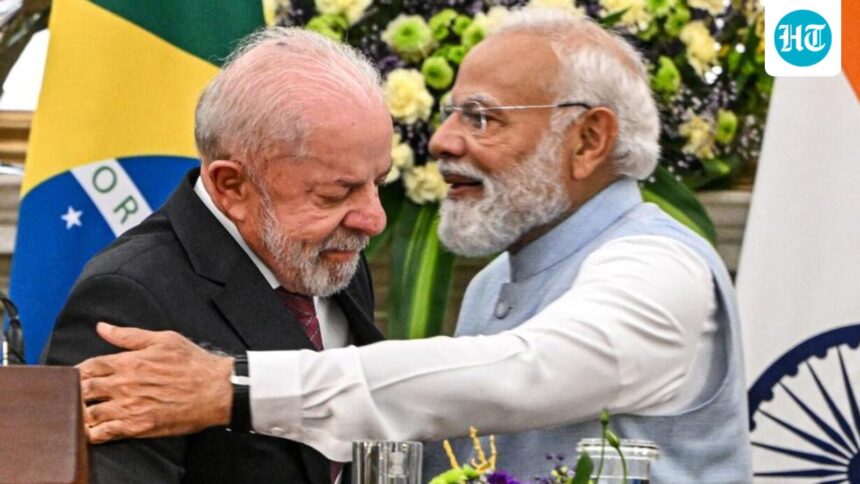
New Delhi: India and Brazil on Saturday agreed to double bilateral trade to $30 billion by 2030 and signed cooperation agreements on critical minerals and steel supply chain, as talks between Prime Minister Narendra Modi and Brazilian President Luiz Inacio Lula da Silva focused on strengthening multilateralism in an era of turmoil and uncertainty.

Lula, who is in India with a delegation of 300 business representatives, met Modi to review bilateral relations after his participation in the AI Impact Summit. He traveled to India nearly six months after revealing plans to visit the country to enhance cooperation to counter the impact of tariffs imposed by the Trump administration. India and Brazil were each subjected to 50% tariffs, among the highest rates in the world.
Modi and Lula also pledged to strengthen cooperation in areas such as defence, security, oil and gas, healthcare and digital public infrastructure while emphasizing the need for deeper strategic engagement to navigate the fragmented global environment.
“Brazil is India’s largest trading partner in Latin America. We are committed to taking bilateral trade to more than $20 billion in the next five years. Our trade is not just a number, it is a reflection of confidence,” Modi said in a joint media interaction after the talks.
Two-way trade exceeded $15 billion for the first time in 2025, representing a 25% growth compared to the 2024 figure. Although Modi and Lula set a bilateral trade target of $20 billion by 2030 during a meeting last July, they decided to boost it further. “The two leaders agreed that trade should at least double to $30 billion by 2030,” P Kumaran, secretary for eastern affairs in the Ministry of External Affairs, said at a press conference.
Kumaran said the two leaders also discussed US trade policy and the repercussions of the US Supreme Court ruling that repealed the sweeping tariffs imposed by President Donald Trump. He added: “The two leaders agreed that it is a fairly new development, and the two sides need to study the repercussions of this and wait for further developments from the American administration.”
Lula said India’s prowess in information technology, artificial intelligence, biotechnology and space has created new opportunities for cooperation. He said: “This translates our commitment to an agenda that puts technology at the service of comprehensive development. Increasing investments and cooperation in the field of renewable energy and vital minerals is the essence of the pioneering agreement we signed today.”
Modi described the agreement on rare earth elements as a “big step” towards building resilient supply chains and noted that cooperation in the field of defense is constantly increasing. “This is a great example of mutual trust and strategic coordination,” he said.
The Indian government is looking for new suppliers of rare earths to reduce dependence on China and support capacity expansion amid a global race for raw materials. Brazil is the second largest producer and exporter of iron ore, and possesses large reserves of the mineral important for the steel industry, demand for which is increasing in India amid rapid infrastructure expansion. Officials said that the bilateral cooperation is expected to focus on attracting investment in exploration, mining and steel sector infrastructure.
The two leaders discussed expanding the preferential trade agreement between India and Mercosur, with Modi saying this would deepen economic cooperation. Lula said the free trade agreement recently signed by India and the European Union “as a response to trade unilateralism” should spur efforts to expand the preferential trade agreement between India and Mercosur. “The turbulent global scenario requires our countries to strengthen and deepen our strategic dialogue,” Lula added.
Modi and Lula also explored the possibility of cooperation in healthcare and pharmaceuticals. “We will increase the supply of quality and affordable medicines from India to Brazil,” Modi said. Lula said India and Brazil have worked side by side for decades to “defend equal access to medicines,” especially generic medicines, and for health sovereignty in the World Health Organization.
In the fields of defense and aviation, the two sides discussed cooperation in the maintenance of their French-origin Scorpene submarines under a tripartite agreement between Mazagon Dock Shipbuilding Company Limited and the Indian and Brazilian navies. Modi called on Brazilian airline Embraer, which will set up an assembly line for its E175 regional jet in India, to set up a maintenance, repair and overhaul (MRO) facility.
Efforts to support global governance institutions and defense multilateralism also emerged in the talks, with Modi saying that the India-Brazil partnership on the global stage has been influential. “As democracies, we will continue to advance the priorities and aspirations of the Global South,” he said.
Lula added that India and Brazil are partners in building multilateral governance that is more just, peaceful and governed by international law. “We are not just the two largest democracies in the Global South,” he said. “This is a meeting between a digital superpower and a renewable energy superpower. We are both very diverse countries and we both stand for multilateralism and peace.”
Modi noted that India and Brazil agree that “terrorism and its supporters are enemies of all humanity,” while Lula said that Brazil “has disavowed the attacks in Kashmir” and that terrorism should not be linked to any religion or nationality. Lula added: “We support efforts to end the war in Ukraine. It is also urgent and important to alleviate the suffering of the Palestinian people.”
Besides MoUs for cooperation in rare earth minerals, critical minerals and mining for steel supply chain, India and Brazil have developed a joint action plan on digital partnership for the future, agreements for cooperation in the coastal sector, entrepreneurship and handicrafts for SMEs, and a memorandum of understanding between the Brazilian Health Regulatory Agency and the Central Drug Standards Control Organization of India.