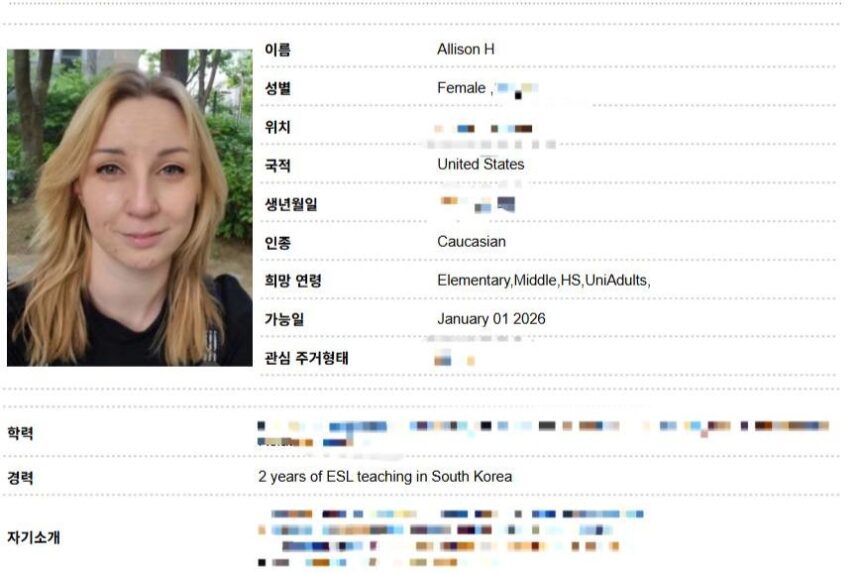

A screenshot of personal information belonging to Alison Hall, a 30-year-old American who teaches English in Korea, is displayed on the recruitment website. The information includes personal details such as her birthday and marital status. Copied from the recruitment website
In 2023, Allison Hall, a 30-year-old American who teaches English in Korea, discovers that her friends’ personal information has been posted online.
It was just the beginning.
The following year, Hall – who was then president of the Native Teachers’ Federation of the Korean Federation of Trade Unions – found similar posts revealing personal details of union members on a recruitment website. Private English academies in Korea often rely on these sites to recruit teachers.
However, teachers say their information can be accessed without logging in and can be easily downloaded, while lawyers say the practice may violate the Personal Information Protection Act.
To test the system, Hall registered using old information. Its details emerged the same day.
Last year, a friend told Hall that another recruiter had begun releasing more sensitive data about teachers. She repeated the test and published her information within a week.
“All my information has been published. My face, name, work experience, age, race, gender, home address, including room number. Everything has been revealed,” Hall told the Korea Times. “When I saw that, I froze in panic, and I felt a cold chill run through my veins.”
These cases highlight growing concerns that some websites run by recruitment companies in Korea are publicly disclosing foreign teachers’ personal data – often without clear consent – under the guise of standard industry practices.
On a recruiting site, anyone can browse teacher profiles that include photographs, educational history, dates of birth, work records, and even whether the teacher has a tattoo. In another recruiter’s web community, full access requires membership. However, even publicly visible thumbnails reveal names, current and desired salaries, and visa status. Some posts also include appearance-based remarks, such as “She looks pretty.”

A screenshot of a recruiter’s web community listing information about native English teachers, including visa type, educational background, and remarks such as “She looks nice.” Taken from the recruiter’s Naver café
When asked whether they obtained teachers’ consent before posting the information online, both agencies declined to give a clear answer, saying they would remove posts upon request.
One agency said the information was intended for English private school principals, describing the practice as a long-standing industry practice to facilitate recruitment between teachers and academies.
“We place their English teachers with hagwon managers, but they often check the website themselves before contacting us,” said an employee of one recruitment agency.
She added that there is no formal process for obtaining explicit consent — a gap that may make some teachers feel their privacy has been violated — but she said most sign up on the site themselves.
Hall reported one of the locations to authorities. The Korea Internet and Security Agency (KISA) is investigating the case and has ordered corrective measures.
“There appear to be violations, so we issued written administrative directives requiring reviews,” said a KISA investigator handling the case.
Another foreign teacher in Korea, who requested to remain anonymous, recently reported a similar case of third-party disclosure.
“While searching for a job, I found that the profile pages of candidates on the recruitment platform were publicly accessible without any login. The search page also included a nationality filter, allowing candidates to be filtered by country and nationality, which I find alarming,” the teacher said.
The profiles exposed high-risk personal data, and because the pages were public, the information could be collected online, making takedown more difficult and increasing harm, the teacher said.
“My immediate reaction was anger and concern, mainly because exposure appeared to be preventable with basic access controls,” the teacher said.
The teacher reported the issue through official channels, including KISA, but weeks later was told the case would be closed because a separate report had already been submitted about the same issue.
Lawyers say this practice may constitute a legal violation.
“Even without full details, revealing identifying information such as a person’s name or age without their consent is a clear violation of the law,” said Hong Hae-in, a lawyer at Doro Public Interest Law Group.
Even if an agency needs personal information for recruitment, it remains a problem without the third party’s consent to disclose it, said Choi Jong-kyu, a lawyer who heads the diversity communication and mediation committee at the Gyeonggi Migrant Human Rights Policy Research and Development Institute.
“Job seekers may expect some of their information to be shared, but making it widely available in this way goes beyond what the agency could reasonably use for hiring,” Choi said, adding that the practice reflects companies prioritizing convenience.