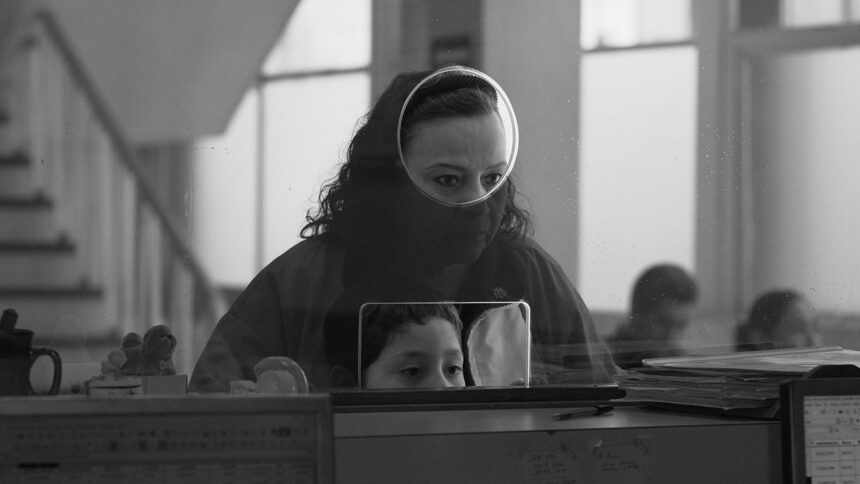
Fernando Empke’s fifth feature Flies (Flies), opens with a loose series of vignettes. Teresita Sanchez – Winner of the 2022 Sundance Special Jury Prize for her film Two seasonsAlso known for her roles in Lila Avilés. the maid and Totem – You play Olga, a weary-looking middle-aged woman who wakes up to the buzzing of one of the insects that introduces the title, gets out of bed with a disgruntled sense of purpose, and sets about trying to flush the pest out the window, or better yet, kill it. When her initial efforts failed, she resorted to pesticides, and nearly suffocated in a toxic cloud of her own making.
No sooner has the buzzing stopped than her ears tune in to another disturbance, the upstairs neighbors, in the midst of what sounds like vigorous sex. Which conflicts with her usual hobby of playing Sudoku on her old, boxy desktop. Olga turns on her TV to drown out the noise and soon goes back to sleep, this time on the sofa.
Flies
Bottom line Small is beautiful.
place: Berlin Film Festival (Competition)
He slanders: Teresita Sanchez, Bastian Escobar, Hugo Ramírez, Enrique Arreola
exit: Fernando Empke
Screenwriters: Vanessa Garnica, Fernando Empke
1 hour and 39 minutes
This kind of simple observational comedy and precise definition of character is what Mexican director Empke does best, giving the impression that he might have flourished as a filmmaker in the era of silent cinema. In many ways it harkens back to the first engaging film about teenage boredom that put him on the map in 2004, Duck seasonnot least its unadulterated black-and-white aesthetic.
like that movie, Flies He prefers short scenes that unfold in still shots (Maria Secco served as DP), with very selective use of tracking sequences. It’s a film whose relatively simple communications give it a direct emotional tone.
It’s very clear that Olga is not living her best life. She’s unfriendly with the neighbors, borderline rude to the woman who runs her local restaurant, and is extremely upset when the elevator in the brutalist, concrete-slab apartment building where she lives in Mexico City becomes dysfunctional again, forcing her up several flights of stairs. When the podiatrist tells her that she needs a minor surgery that will cost her 3,000 pesos, an amount she does not have, Olga puts up a notice titled “Room for Rent” like many other residents in the building.
The balance between zany humor and melancholy varies, but there is nonetheless a kinship here with the neorealist films of Vittorio De Sica, especially when 9-year-old Christian (Bastian Escobar) enters to share hero duties with Olga. But it’s also there in the burdened faces and not-so-fine clothes of the people who stream into the massive hospital complex across the street to visit sick family members every day. The fact that many live outside the city explains that there is a market for short-term rentals nearby.
The economy of Embke’s storytelling means that he does not need to push the angle of down-on-his-luck humanity to paint a vivid picture describing the social and economic reality of this sea of people.
Two of those people are Christian and his loving father Tulio (Hugo Ramírez), who does his best to mitigate the severity of the situation for his son. The boy is reluctant to accept that children will not be allowed into the hospital ward where his mother is being treated. His father’s long absence during visiting hours gives him plenty of time to kill.
Tullio responds to Olga’s notice of hire and is undeterred by her sour manner when she tells him she doesn’t want to hear about her sick relatives. Since it’s a single-occupancy arrangement, Tullio has to sneak Christian in after Olga goes to sleep at night and then get out before she wakes up in the morning.
The screenplay, penned by Vanessa Garnica (who co-wrote the director’s latest film, Elm) and Eimbcke, seem keenly aware that its setting suggests predictable developments – that Christian’s secret existence will be discovered; His combination of naivety and cheek will inevitably crack Olga’s hard shell. But there is a lot of depth of feeling Flies Never to feel contrived or bland. Empke does not shy away from emotion, but the emotional honesty and impeccable light touch in his work keep it from becoming saccharine.
When Olga sees Tullio with Christian in the restaurant, she immediately puts two and two together, her suspicions verified by a quick search in her tenant’s bag. She gave them two days to find another place to stay. But Tulio is forced to accept a job to pay for his wife’s medications. This leaves Christian alone with Olga for long periods, ignoring his father’s strict instructions that his movements must be restricted between the room and dinner.
Empke’s films have always been characterized by his strong work with children and teenagers, but Escobar is a real revelation. He conveys the incomprehensible sadness and frustration of a child separated from his mother, his skill at finding a way around people and his short attention span, allowing for distraction. The most common is a video game called Cosmic Defenders outside a convenience store (a thinly disguised version of Space Invaders); Pulsating electronic sounds provide the closest thing Flies It has incidental music.
There’s gentle humor with poignant undertones in Christian’s tireless efforts to talk his way past the staff at the hospital’s visitor check-in window, and in the friendship he forms with easygoing orderly Isaac (Enrique Arreola, unforgettable as the pizza delivery man in Duck season), whose attempt to infiltrate the child costs him. In the end, Christian dresses Olga until she agrees to pose as one of his relatives and accompany him on the visit. But that plan falls apart when they learn that the boy’s mother has been transferred.
The contents of the locked closet in Olga’s apartment point to an earlier time when she was not alone there, a contributing factor to her closed off nature and a reason she may either keep her distance from Christian or become involuntarily drawn to him.
Sanchez’s skillfully modulated performance requires no grand displays of emotion to reveal the reasons for Olga’s slow transformation from whiner to friend with protective maternal instincts. But the subtlety with which she hints at the news Christian doesn’t want to hear and his angry reaction to it makes for a poignant conclusion, pulling at the heartstrings without needing to be aggressive about it.
Even better is a late touch of magical realism involving the Cosmic Defenders, an odd-looking decoration that’s also a tender acknowledgment of the strange ways children process grief.