
Instrumentation laboratories
- This post originally appeared in the Business Insider Today newsletter.
- You can subscribe to Business Insider’s daily newsletter is here.
The U.S. manufacturing industry is at a crossroads: catch the leaders where they are or outpace them where the industry is headed.
Edward Mehr sits firmly in the second camp. The premise of his robotics manufacturing startup, Machina Labs, is that bringing manufacturing back to America needs distribution and flexibility. Trying to build the traditional centralized factories that China has mastered is a lost cause.
“It would be a miracle you catch up if you want to replicate what they have,” Mehr told me.
“It’s not the right chess move. We need to try to see if we can jump in and then do the next generation.”
We are still in the early stages of using robots in factories. Mehr said the industry is still five years away from a major ChatGPT-like breakthrough. But there’s no shortage of companies trying it, including giants like Tesla and Amazon.
The opportunity is huge, as the manufacturing industry represents trillions of dollars. It’s also a brutal act to break into. If a bot doesn’t immediately help you reduce costs or improve efficiency, there’s no need to pursue it any further. (Example: Amazon’s recent Blue Jay warehouse robot.)
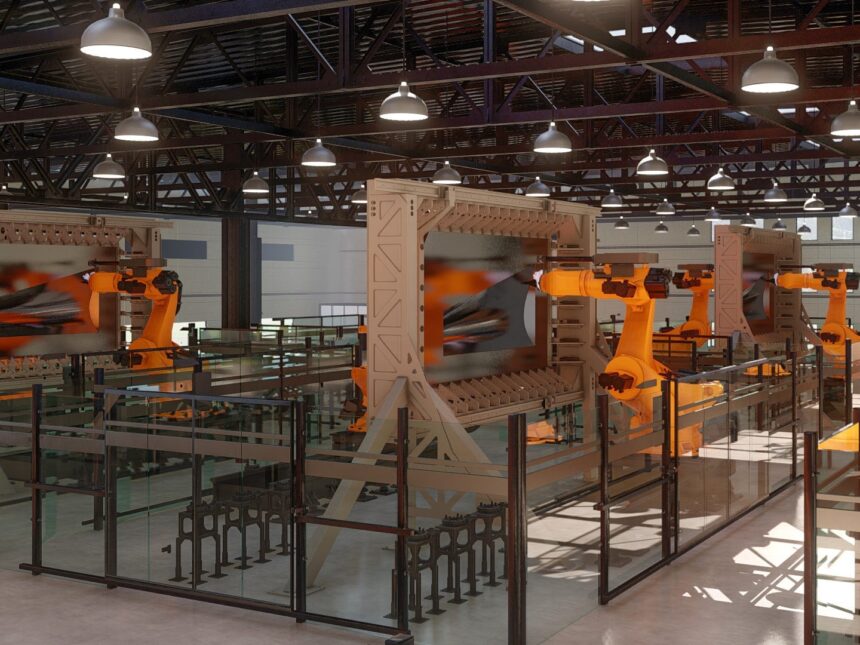
Machina Labs, which specializes in producing complex metal structures for the defense, aerospace and automotive industries, sees its added value on two fronts. Its robots can switch between different manufacturing processes, saving time it would take to retool a factory to produce a new product. They are also portable, meaning there is no need to design custom plants for specific productions.
The space is crowded, and Mehr acknowledged that competitors are also seeking portability or flexibility, but usually not both.
“We’re almost rethinking a lot of our manufacturing processes from scratch,” he said. “If you go to our factory, you’ll find that things are built in a way that you can’t see anywhere else.”
Like many robotics companies, Machina Labs now needs to prove its thesis on a large scale.
The company raised a $124 million Series C round earlier this month from investors including Lockheed Martin Ventures and Toyota’s venture arm. These funds will be used to build a new 200,000 square foot factory.
The plant will contain 50 robots and will initially serve Lockheed Martin. The goal is to produce a few thousand structures each year. This is a significant step up from its current factory, which operates 10 robots and has an annual production of a few hundred.
But what about humans? Tensions are already high over the impact of artificial intelligence on white-collar jobs. Are blue-collar workers headed for a similar fate?
The new Machina Labs factory will have about 150 human workers, roughly equal to the number of humans who would work in a robot-free factory. The work is different, but no one seems to complain.
Mehr said that a recent internal survey showed that the level of employee interest in the job was exceptionally high. (So much AI fatigue!)
“You’re working with robots. You’re working with software. And compared to before, you had these instructions. You followed them every day, over and over again,” he said. “Now, it almost feels like you’re playing a game.”