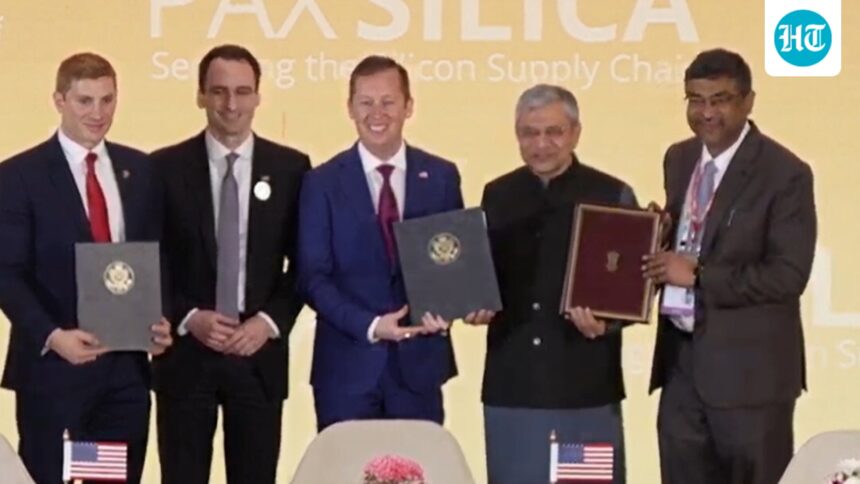
India joins US-led Pax Silica alliance, signs joint statement on AI partnership Joining the US-led Pax Silica initiative to secure global supply chains for AI and semiconductor technology, strengthening the bilateral technology partnership and reflecting improving relations after a year of tensions over the Trump administration’s trade policies.

New Delhi was left out when Washington launched the initiative last December to build resilient supply chains for semiconductors, advanced manufacturing and biotechnologies amid intensifying geopolitical competition with China. India became a signatory of the Pax Celica Declaration at an event on the sidelines of the AI Impact Summit, and also signed a joint statement on the ‘Indo-US AI Opportunities Partnership’.
The Ministry of External Affairs said technology cooperation is a key pillar of the bilateral comprehensive global strategic partnership, and India’s participation in Pax Celica is an “important step forward” that strengthens the shared commitment to reliable supply chains.
The documents were signed by Minister of Electronics and Information Technology S. Krishnan, US Ambassador Sergio Gore, and Under Secretary of State for Economic Growth and Energy Jacob Helberg, in the presence of Minister of Electronics and Information Technology Ashwini Vaishnau and White House Director of Science and Technology Policy Michael Kratsios.
Besides reducing over-concentration in global supply chains and preventing economic coercion, this development signaled a reset in India-US relations after friction over tariffs and energy trade. This also came in the wake of an understanding on a trade agreement, which led to President Donald Trump reducing customs duties on Indian exports to 18% from 50%.