Pakistan’s armed forces continue to hunt down separatists in its militancy-torn Balochistan province after Islamabad tries to contain India. New Delhi has denied the allegations. So far, more than 190 people including militants, civilians and security forces have been killed in two days.
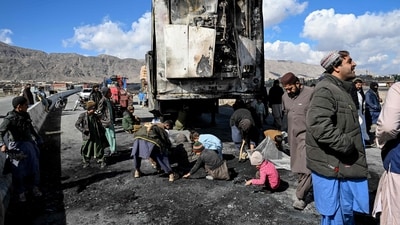
TOPSHOT – People gather as others collect recyclables next to a burnt vehicle on the side of a road on the outskirts of Quetta on February 1, 2026, a day after an attack by Baloch separatists. Pakistani forces were hunting separatists behind a series of coordinated attacks in restive Balochistan province on February 1, with the government vowing retaliation after more than 190 people were killed in two days. (Photo Banaras Khan/AFP) (AFP)Soldiers were seen combing large areas a day after militants attacked banks, jails, police stations and military installations, killing at least 31 civilians and 17 security personnel, according to the chief minister of Balochistan province.
He said at least 145 attackers were also killed. The figure includes more than 40 militants that security forces said were killed on Friday.
News agency AFP reported that mobile internet services were jammed across the province for the past two days. Road traffic is disrupted and train services are suspended.
“Anyone who leaves home has no guarantee of safe return. There is constant fear,” Hamdullah, a 39-year-old shopkeeper, told AFP in Quetta.
More Read

Normally bustling Quetta, the provincial capital, was quiet after the blast rocked it, with main streets and businesses deserted and people staying indoors in fear.
The Baloch separatist insurgency has been going on for decades, when Pakistan emerged after the British partitioned India before the end of their colonial rule. Baloch groups claim that their culture, language and ethnicity are not respected in Punjabi-dominated Pakistan.
These groups carry out frequent armed attacks on security forces and sometimes on foreign nationals and non-local Pakistanis in the mineral-rich provinces bordering Afghanistan and Iran.
More Read

Pakistan’s poorest province and largest by land area, Balochistan lags behind the rest of the country in almost every indicator, including education, employment and economic development.
CM Sarfaraz Bugti told a press conference in Quetta that all districts affected by Sunday’s attack have been cleared.
“We’re chasing them, we’re not going to let them go that easily,” he said.
The Baloch Liberation Army (BLA), the most active separatist group, claimed responsibility for the attack in a statement sent to AFP.
The group, designated a terrorist organization by the United States, has said it has targeted military installations as well as police and civil administration officials in gun attacks and suicide bombings.
Pakistan’s Interior Minister Mohsin Naqvi, who flew to Quetta late Saturday night to attend the funeral, claimed the attackers were backed by India – without providing any evidence. This is what Defense Minister Khawaja Asif has claimed.
India responded: “We categorically reject the baseless allegations made by Pakistan, which are nothing more than a natural ploy to divert attention from its own internal failings.”
India’s foreign ministry statement added: “Instead of making frivolous claims every time violence occurs, it would be better to focus on the long-standing claims of its people in the region. Its record of repression, brutality and human rights abuses is well known.”
Baloch separatists accuse the Pakistani government of exploiting the province’s natural gas and abundant mineral resources without benefiting the local population.
The BLA has intensified attacks on Pakistani as well as foreign energy companies operating in the region in recent years.
Last year, separatists attacked a train carrying 450 passengers, sparking a deadly two-day blockade.