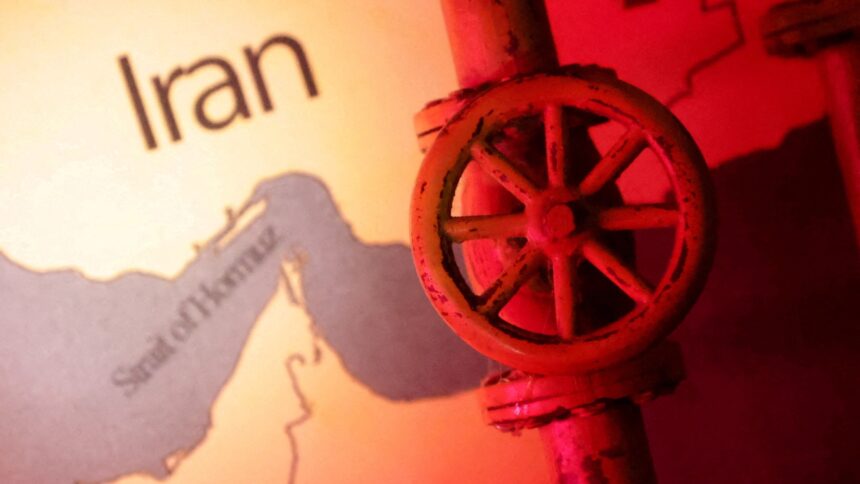
Tension has returned to the narrow mouth of the Persian Gulf, the Strait of Hormuz, as Iran gets ready to start a military drill that could result in the closure of a vital route for international shipping.
Throughout history the Strait of Hormuz has been important for trade, with ceramics, ivory, silk and textiles passing through the region from China. (Reuters/Representative photo) Iran has alerted ships that it will hold a live fire drill in the strait on Sunday and Monday. A fifth of all oil trade passes through the narrow passage between the Islamic Republic and Oman.
America. Early on Saturday, the military’s Central Command warned Tehran that “any unsafe and unprofessional behavior toward U.S. Conflict, escalation, and instability are more likely when forces, regional allies, or commercial vessels are involved.
What you should know about the exercise, the US warning, the reasons behind the tension, and potential future developments in the Strait of Hormuz.
The Strait of Hormuz, a crucial waterway for international trade, resembles a curve when viewed from space. It is only 33 kilometers (21 miles) wide at its narrowest point. It travels to the Gulf of Oman from the Persian Gulf. The ships can then travel to the rest of the world. Its territorial waters in the Straits of Iran and Oman are regarded as an international waterway that is open to all ships. The waterway is also near the United Arab Emirates, which is home to the skyscraper city of Dubai.
The Strait of Hormuz has long been significant for trade, with textiles, silk, ivory, and ceramics traveling through the area from China. The narrow strait proved to be deep and wide enough for oil to flow through in the current era of supertankers. The US Energy Information Administration claims that “most volumes that transit the strait have no alternative means of exiting the region,” despite the fact that pipelines in Saudi Arabia and the United Arab Emirates avoid the passage. Asian markets receive the great majority of the gas and oil that cross the strait. Global energy prices have skyrocketed due to threats to the route, including during Israel’s 12-day war against Iran in June of last year.
Iran is preparing to launch “naval fire” into the Strait of Hormuz on Sunday and Monday, according to a notice radioed to sailors on Thursday. These drills could compromise trade routes. The message’s coordinates may place the drill in a traffic separation scheme, which is a two-lane, 3.2-kilometer (2-mile) wide system that directs ships heading north into the Persian Gulf and southward out of the Gulf of Oman. The coordinates of the drill include that north lane. Iran’s paramilitary Revolutionary Guard is probably involved in the exercise, despite the fact that the country has not disclosed any additional information about it. The Guard frequently engages in tense encounters with the US Navy while operating a fleet of small fast-attack ships in the Straits.
The US military’s Central Command issued a strong warning to Iran and the Revolutionary Guard regarding the drill early on Saturday. It acknowledged Iran’s “right to operate professionally in international airspace and waters,” but cautioned against endangering or interfering with US commercial or military ships. The command, which oversees the US Navy’s Bahrain-based 5th Fleet, said it would not “tolerate unsafe (guard) operations” in which its aircraft or ships could get too close to or point weapons at American warships. According to the command, “the US military has the most highly trained and lethal force in the world.”
Iran’s bloody crackdown on protests across the nation has prompted US President Donald Trump to threaten military action against Iran, raising tensions over the country’s nuclear program. He established two red lines: the wave of massacres of Iranian detainees and the murder of nonviolent protestors. He has also mentioned the future of Iran’s nuclear program in recent days. Now in the Arabian Sea, the USS Abraham Lincoln aircraft carrier and accompanying guided-missile destroyers are ready to strike if Trump calls for it. Iran has issued a warning that it may carry out its own planned attacks or target American interests in Israel and the Middle East. Iran launched ballistic missiles during the 12-day conflict, and Israel targeted its stockpiles. As a result, Tehran has an arsenal of short- and medium-range missiles that can hit neighboring Gulf Arab states.