In the women’s health scenario in India, cervical cancer positions itself as one of the most significant health challenges: the country accounts fornearly one-third of global cervical cancer deaths and reports over 1.22 lakh new cases every year. Epidemiological evidence shows that one woman in India dies of cervical cancer every few minutes, underscoring the scale of the problem.
Cancer is an outcome of the interaction between genetic predisposition, agent, and environmental factors. Cervical cancer is one of the few cancers that can easily be prevented through vaccination, and, if diagnosed early, it is very treatable. Despite this, people continue to perceive cervical cancer as a concern specific only to elderly women. This, however, is not the reality of this disease. Understanding how prevention efforts for cervical cancer can vary depending on a woman’s age and how these efforts can be utilised throughout a woman’s life, is crucial.
Also Read: Keep it wholesome: On shaping a national cervical cancer control programme
Burden in India
High-risk Human Papillomavirus (HPV) strains are the primary risk factors for cervical cancer, which ranks as the second-most common cancer type among women, accounting for 6-29% of all cancers in women and for about 17% of cancer-related deaths among women between 30 and 69 years of age. Over a lifetime, approximately one in 53 Indian women is at risk of developing cervical cancer, compared to one in 100 women in more developed regions.
The National Health Mission, through its population-based screening programme, has screened over 10.18 crore women falling under the 30 to 65 years age group across the country.

Age is not a simple risk marker
It is a commonly-held belief that only older women are at risk of developing cervical cancer. Unfortunately, misinformation like this can impede early detection and screening. Cervical cancer is usually caused by an HPV virus, with which young individuals become infected shortly after the onset of sexual activity, and it then develops gradually. Factors such as unhygienic menstrual practices, inadequate genital hygiene, and lack of awareness can further facilitate HPV persistence in the cervix. Nearly 75% of sexually active adults are likely to acquire at least one HPV infection during their lifetime, although fewer than 1% progress to cancer. The majority of HPV infections are temporary in nature; however, if a woman becomes infected with a high-risk HPV strain and the infection persists, she may develop a precancerous injury, which typically will transform into invasive cervical cancer over time.
As the illness progresses gradually, it is essential to begin preventative measures early, rather than when symptoms manifest or at an advanced age.

Prevention through vaccination
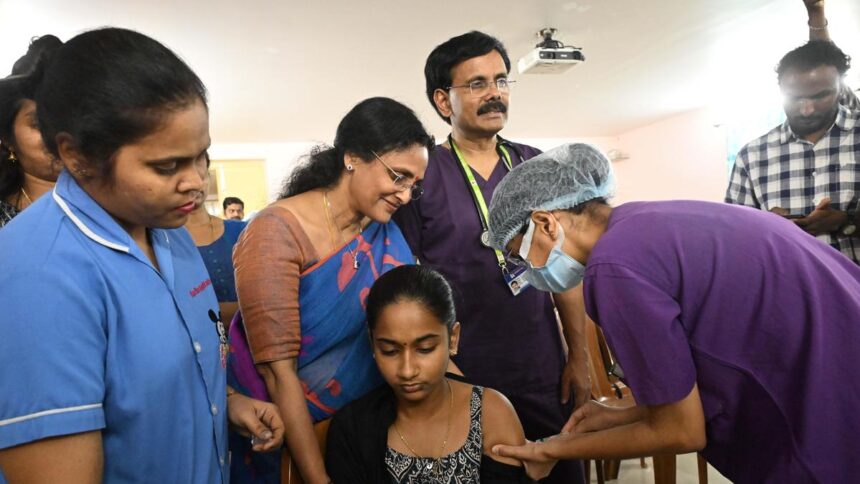
Vaccination against HPV through primary prevention is considered one of the most effective ways to prevent cervical cancer. HPV vaccines protect against types 16 and 18, which are responsible for nearly 80 to 85% of cervical cancer cases in India. Vaccination for girls and young women in the age group of 9 to 15 years, with catch-up vaccination up to 26 years, ideally before they are sexually active, is recommended.
Research has shown that vaccinated males also have a lower likelihood of transmitting the HPV virus and thus indirectly provide more protection to females by decreasing the total community infection rate. While HPV vaccination is currently not included in the Universal Immunisation Programme (UIP), there is substantial evidence demonstrating that it has substantial long-term cancer preventive benefit.

Detecting early changes
Regular screening of sexually active women is critical for secondary prevention.Most cervical cancer patients in India are diagnosed at an advanced stage, with 75% of all patients presenting with regional spread that adversely affects overall survival rates. The estimated five-year post-diagnosis survival rate for patients with cervical cancer in India is approximately 46%, which is lower than the five-year post-diagnosis survival rates for many other Asia-Pacific nations.
Precancerous changes can be identified through screening, including visual examination, Pap smear tests, LBC (liquid-based cytology) tests, and HPV evaluations, which provide an opportunity for treatment prior to the development of cancer. Simple visual inspection-based screening can be delivered at the primary care level and allows early treatment during the same visit, making it particularly relevant in resource-constrained settings.

Awareness across ages
Understanding cervical cancer risk requires moving beyond simplistic age assumptions. Prevention must follow a life course approach. Vaccination in adolescence, attention to hygiene and sexual health in early adulthood, and regular screening from the recommended ages, together, offer the strongest defence against cervical cancer.
Cervical cancer is preventable. With informed choices, timely prevention, and sustained awareness, India has the opportunity to significantly reduce the burden of this disease and protect women across generations.
(Dr. Vinod K. Ramani is consultant, preventive oncology, Sammprada Hospital, Bangalore. vinodramani77@gmail.com)