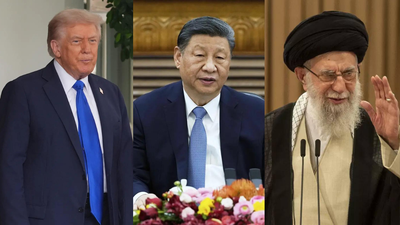
For many years, China has tried to do both in the Middle East. It wanted access to cheap Iranian oil without the burden of involvement with the Ayatollah’s regime. It wanted Gulf investment, Gulf markets, and Gulf goodwill, while maintaining relations with Tehran.
It wanted to tie America into endless regional crises, but without the kind of chaos that would drive up energy prices. Most importantly, Xi Jinping wanted to build China’s image as a rising, benevolent great power that plays by the rules while the United States oversteps its bounds.The war launched by US President Donald Trump against Iran revealed the fragility of that strategy.
Russia and China intervene: Has Iran become their proxy in the war?
Why it matters: “Hard power is king”
Trump’s war in Iran is not just a crisis in the Middle East. It is also a strategic shock for Beijing.
For Xi, the conflict is bad in the near term, ugly in what it reveals about China’s borders, and likely only good if the United States gets trapped in another long regional war.The basic problem for China is simple: Iran has never been just another partner. It has been a supplier of energy, a useful spoiler against US power, and a symbolic part of Xi’s broader effort to build a world less dominated by Washington. Now Trump’s use of force has weakened those assets, exposed Beijing’s inability to protect them, and reinforced Xi’s deep conviction that hard power still ultimately prevails.
As David Pearson wrote in the New York Times: “The surprise and furious attacks on Iran by US and Israeli forces last week, including the killing of the country’s supreme leader, underscore Xi Jinping’s worldview that hard power is king.”In a way, this may seem like a vindication for President Xi, who has spent more than a decade modernizing the People’s Liberation Army and warning that the United States remains the most enduring threat to China.
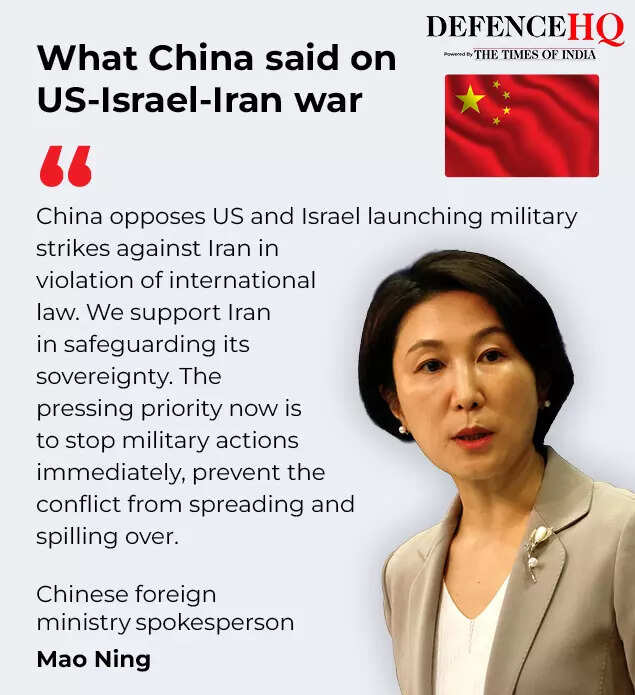
But it is also humiliating.The same war that demonstrates Xi’s obsession with military power also reminds Beijing of a harsher truth: China is still not the power that can decisively shape events across distant theaters. The United States is. When Washington chooses to act forcefully, it can arrest a president, kill leaders, threaten regimes, and rearrange strategic calculations overnight. Beijing can condemn the situation and hedge.
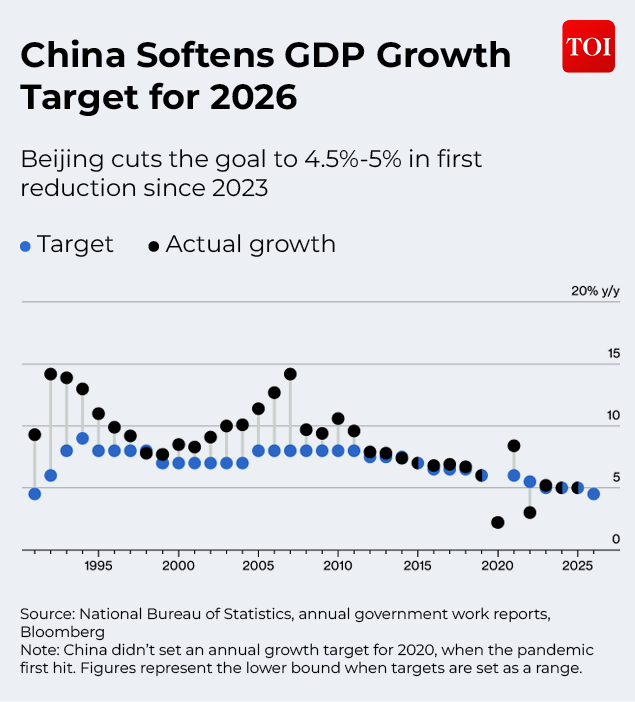
But she can’t stop him.This contrast is critical as Xi Jinping prepares for a high-stakes meeting with Trump in Beijing later this month.Moreover, the Trump-Xi summit comes at a time when the Chinese economy is experiencing a downward spiral. For the first time since 1991, China set a GDP growth target of between 4.5 and 5%, the lowest rate in decades.
The summit was supposed to demonstrate China’s strength. Instead, the shadow over it is much larger: Trump will arrive not just as a tariff warrior, but as a president who has proven that American coercive power still extends far beyond the economy.
The big picture
Iran is beneficial to China in many ways.Beijing buys large quantities of Iranian oil at a discount. It benefits from Washington’s restrictions in the Middle East due to the thorny Iranian nuclear issue. It also saw value in Iran’s “axis of power.”” The pivotal actors – Hamas, Hezbollah, and the Houthis – are hostile to the US-led regime. It complicates US strategy and consumes US attention in the Middle East.“Xi Jinping’s decade-long project to build an alternative to the US-led order died with” Ayatollah Ali Khamenei, Geoffrey Cain wrote in the Spectator.
This is too sweeping of course. China’s broader ambitions are far from dead. But the broader point is that one of Beijing’s cheapest and most convenient strategic assets has been severely damaged.Iran gave China influence without forcing China to pay much for it. This has helped keep the United States engaged in a turbulent region. It sold Chinese oil at reasonable prices. It formed part of the geopolitical noise that made it difficult for Washington to fully focus on Asia.Now this equation seems more fragile.
Between the lines: The war is a setback for China in three main ways
The first is energy
China still relies heavily on imported oil, with a very large amount of oil coming from the Gulf. Any prolonged disruption in the Strait of Hormuz would hit the Chinese economy at a bad moment, as Beijing is already grappling with falling consumption, declining real estate, and domestic debt pressures.
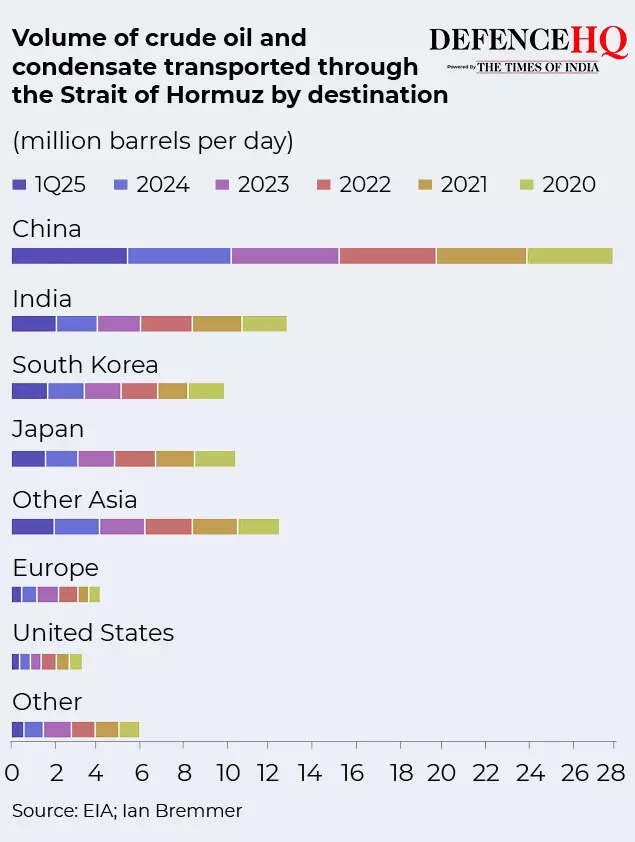
Cheap Iranian crude was not only convenient. This was part of China’s economic protectionism.
If this supply is jeopardized, rising energy prices will pose another impediment to growth.
The second is strategic positioning
James Palmer writes in Foreign Policy that Chinese strategists quietly assume that a distracted United States is good for China. Alternatively, if Trump’s strikes weaken Iran and its network of proxies without dragging the United States into another endless occupation or regional quagmire, China will lose one of the mechanisms that helped drain American bandwidth in the first place.
Tehran was useful because it forced Washington to spend time, weapons, and political attention outside the Indo-Pacific region.
If this source of disruption is reduced, Beijing’s strategic benefit diminishes with it.
The third is prestige and credibility
China wants to be seen as a rising great power and a responsible alternative to the United States. But when key partners face existential pressures, Beijing continues to display the same pattern: rhetorical condemnation, almost no direct intervention, and cautious self-protection.Palmer describes China as a “disengaged great power” in foreign policy – a power that prefers distance over commitment. This has clear benefits. China avoids the traps of alliance and military expansion that have burdened the United States. But in moments like these, it also reveals a glaring weakness: Beijing appears less as a provider of security than as a very big spectator.As Philip Shetler-Jones of the Royal United Services Institute told the BBC, the United States is demonstrating “what it really means to be a great power, which is the ability to force outcomes in theaters around the world.”
He added that China “is not equipped to protect its friends from this type of behavior, even if it wanted to.”
Zoom in: There’s also a Taiwanese angle hanging over all of this
One of the deeper assumptions behind Xi’s strategy was that China could build enough economic resilience, diplomatic access, and external partnerships to withstand the punishment that would follow any move on Taiwan. Iran and Russia were important in that regard In the broader picture, not because they were fighting for China, but because they were part of a more resilient ecosystem that could help Beijing weather sanctions, secure energy, and complicate US-led alliances.If Iran is weakened, further isolated, or destabilized, this ecosystem becomes less reliable.There is another lesson in Taiwan as well. From Beijing’s perspective, the strikes reinforce a bleak outcome: If Trump’s United States thinks the target is important enough, it will use force first and explain it later. This does not mean that China believes that Washington will strike it in the same way. But this means that Xi will see more reasons to accelerate deterrence and prepare for surprise.
The good, the bad, and the ugly: For China, the ledger is mixed – but skewed to the negative
From Beijing’s perspective, the good is conditional: If the war drags on, depletes American ammunition, divides Western allies, and delays American focus on Asia, China may regain some strategic advantages. Beijing may also use the crisis to portray itself as the more stable global player, condemning the war while selling itself as a champion of sovereignty and stability.The bad thing is immediate: exposure to energy sources, a weak partner, increased uncertainty ahead of Trump’s visit, and another blow to China’s image as a rising power capable of protecting its interests.The ugly is what war reveals. China has economic heft, diplomatic capacity, and growing military power, but it still lacks the ability, or perhaps the will, to defend its key partners when they are hit hard.
Xi wants a world in which China can shape the system. What this war shows is that the United States, for now, still has a greater ability to break it.
What’s the next step?
Beijing is likely to respond in familiar ways: stronger rhetoric against American “hegemony,” faster military modernization, tighter attention to energy security, and more cautious diplomacy with Gulf states that China cannot afford to alienate.Xi will also enter his expected talks with Trump in Beijing with less confidence that trade diplomacy can be separated from raw power.China may find opportunity in prolonged American overexpansion. But for now, Trump’s war against Iran looks less like a gift to Xi Jinping than a warning — and a setback.