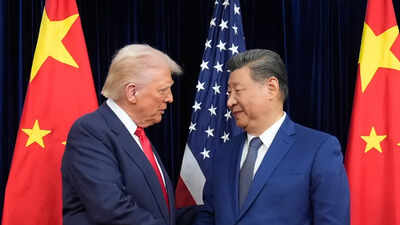
US President Donald Trump with Chinese President Xi Jinping
Beijing confirmed on Monday that Chinese President Xi Jinping sent a congratulatory message to US President Donald Trump on the occasion of the 250th Independence Day. This comes as an unusual public gesture on a holiday that China usually passes in silence.“This year marks the 250th anniversary of the independence of the United States. President Xi Jinping, on behalf of the Chinese government and the Chinese people, sent a congratulatory message to US President Trump,” Foreign Ministry spokeswoman Mao Ning told reporters in Beijing.China does not usually publish leader-to-leader greetings during the American holiday. In past years, Beijing’s participation has been limited to sending its deputy foreign minister to a reception at the US embassy, a pattern repeated this year and last, with Deputy Foreign Minister Ma Zhaoxu once again representing China at the embassy event.
This shift in messaging comes after months of efforts by the two governments to stabilize a relationship that has tensed sharply in the past year. At a Beijing summit in May, Xi told Trump that “the common interests between China and the United States are greater than our differences,” and he pressed both sides to move beyond what he called the “Thucydides trap,” the idea that war becomes more likely when a rising power threatens an established power.This diplomatic improvement contrasts with the tone adopted by Trump himself heading into the weekend.
Speaking Friday at Mount Rushmore, Trump delivered a speech that departed from the traditionally unifying, apolitical tenor of previous Independence Day remarks, warning that “communism poses a deadly threat to American freedom” and calling it “the greatest threat to our country, including World War I, World War II, Pearl Harbor or even 9/11.”
The speech, delivered before the midterm elections in November, also touched on immigration and took aim at what Trump described as the “communist menace” within the United States itself.This contradiction highlights the fluctuations that have characterized relations between the two countries over the past year. Last September, Trump launched a violent attack on social media after watching footage of Xi hosting Russian President Vladimir Putin and North Korean leader Kim Jong Un at a military parade in Beijing. He sarcastically told Xi: “I extend my warmest regards” to the two leaders “while you conspire against the United States of America.”As for the official anniversary congratulations between one state and another, Beijing reserves it for a narrow circle of partners.
Putin and Xi routinely exchange messages on their countries’ national holidays, reflecting what the two governments call a “comprehensive strategic partnership,” and Xi sent similar greetings this month to Belarusian President Alexander Lukashenko. Xi also sent a message to Ukrainian President Volodymyr Zelensky on the occasion of Ukraine’s Independence Day last August, the first such gesture toward Kiev since the 2022 Russian invasion.The precedent for Fourth of July messages to the United States is weak. The last similar example was in 2001, when then-President Jiang Zemin congratulated George W. Bush by phone. More recent exchanges between Chinese and American leaders have tended to mark shared diplomatic milestones rather than the American holiday itself: Xi sent a letter in April to mark the 55th anniversary of “Ping Pong Diplomacy,” and he and then-President Joe Biden exchanged letters in January 2024 to mark the 45th anniversary of official US-China relations.There was no response to Xi’s letter from the White House or State Department as of Monday.