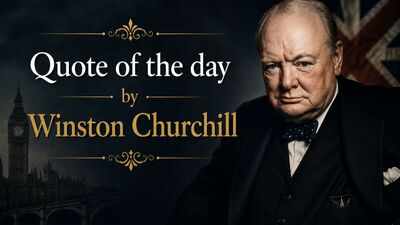
Winston Churchill Quote of the Day (Image generated by AI)
Almost everyone enjoys the idea of learning something new. Far fewer people enjoy the moment when someone actually corrects them. Winston Churchill spotted exactly that gap in a speech in the House of Commons in November 1952.
“Personally, I am always ready to learn, even though I don’t always like learning,” he said. It was picked up and replicated in the Observer within days, and has been in circulation ever since, because almost everyone recognizes the feeling being described. Coming from a man in his late 70s, still serving as Prime Minister for the second time, this line sounds less like a passing joke and more like an honest confession from someone who has spent his entire career being forced to learn things he would rather not have to learn.
Quote of the day by Winston Churchill
“Personally, I’m always ready to learn, even though I don’t always like learning.”
The deeper meaning of Winston Churchill’s quote
This line sounds like a joke, and it is one, but there’s a real note buried underneath it. The phrase “always-on learning” describes curiosity, the fun part of acquiring new knowledge that expands what you understand and what you can do.“Don’t always like to learn” describes something else entirely. Learning usually means having someone else point out mistakes you’ve made, which requires acknowledging a gap in your understanding.
Churchill separates the pleasant part of growth from the uncomfortable part, and admits that, like everyone else, he prefers the former to the latter even when he needs both.
Why did Churchill value learning throughout his long and demanding life?
Churchill is remembered primarily for leading Britain during World War II, but his life extended beyond politics. He worked as a soldier, journalist, and historian, and won the Nobel Prize in Literature in 1953 for his historical writings.He made this very remark in 1952, while serving as prime minister for the second time, after decades of a career that had already required him to adapt repeatedly, through military campaigns, political defeats, and periods completely out of office. A person with such accumulated experience still openly admits that he hates debugging. This recognition carries more weight than it does for someone who has much less to learn from over the course of a lifetime.
Why people naturally resist learning
Correction may seem like a challenge to someone’s competence, especially when it occurs overtly or unexpectedly. Psychologists sometimes describe this as a form of ego protection, that is, the instinct to defend a positive view of your abilities even when feedback is accurate and helpful.People who continue to improve over their long careers tend to handle this differently. Athletes study their coaches’ feedback rather than dismiss it.
Musicians are actively looking for more experienced teachers. The discomfort doesn’t go away for them. They simply don’t let him stop learning.
The best teaching rarely confirms what you already believe
Good teaching tends to challenge assumptions rather than reinforce them. A helpful mentor points out a particular weakness rather than simply praising what worked, and this type of feedback is rarely good in the moment even when it leads to real improvement later.History is full of people who made progress only after accepting correction they didn’t particularly enjoy, scientists revising theories after new evidence, and writers reworking drafts after harsh but careful feedback.
In each case, discomfort comes first and improvement comes afterward.
Curiosity and humility work best together
Curiosity makes a person interested in a new topic. Humility is what allows them to accept that someone else actually understands it better. No one does much good without the other. Curiosity without humility tends to produce a person who explores widely but never improves, because improvement requires accepting correction along the way.Churchill’s quote acts as a nudge toward asking a better question when feedback arrives. Instead of “why should I listen to this,” the question suggests “what’s actually useful here,” even when the answer hurts a little along the way.
Other famous quotes by Winston Churchill
- “Success is not final, and failure is not fatal, but it is the courage to continue that matters.”
- “Improving means changing; being perfect means changing often.”
- “We make a living by what we get, but we make a life by what we give.”
Why Churchill’s words still matter today
Information has never been more accessible than it is now, with online courses, digital libraries and endless materials available within seconds. Access to information in and of itself has never been the equivalent of wisdom.True learning still requires accepting feedback that may sometimes be unwelcome, and honestly reflecting on shortcomings in your understanding. The Churchill quote continues because he names that tension very clearly. Curiosity gets people started. Humility is what actually allows them to continue once the lesson becomes uncomfortable.