

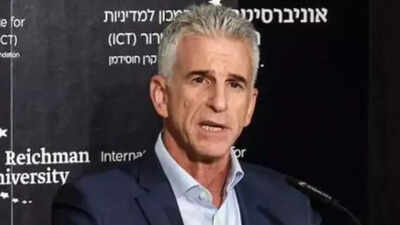
File photo: Mossad chief David Barnea
Mossad chief David Barnea reportedly told the Israeli cabinet before the war with Iran that regime change in Tehran was possible, but would likely take about a year, not just days or weeks, a recent report said.According to the Jerusalem Post, Barnea presented multiple scenarios to Israeli leaders on the eve of the war, with some suggesting a few months, but a one-year time frame was considered the most likely estimate.The report said that this more cautious assessment had been obscured by recent attacks by anonymous individuals, which accused it of exaggerating the chances of a rapid collapse of the Iranian regime.
A qualified assessment, not a foolproof prediction
The main point that emerges from the report is that Parnia’s position was more qualified than some subsequent portrayals suggested.
According to The Jerusalem Post, he did not present regime change as inevitable, but rather as a possibility that would depend on several conditions and would likely take a long time. The report added that Barnea was known to attach warnings to key intelligence assessments and that any presentation made to Israeli Prime Minister Benjamin Netanyahu or US officials would have been closely monitored and framed within a broader government strategy.
However, this contradicts previous reports that claimed that Mossad expected a quick uprising.According to a New York Times report, Barnea told Netanyahu and senior Trump administration officials in mid-January that within days of the start of the war, Mossad would likely help galvanize the Iranian opposition, leading to riots and rebellions that might even lead to the collapse of the government. However, the report also noted that three weeks into the war, no such uprising had materialized, and US-Israeli intelligence assessments concluded that the Iranian regime was weak but still intact.The Times of Israel, citing Channel 12, similarly reported that Barnea had assessed that it would be possible to overthrow the Iranian regime if key military objectives were achieved first, including decapitating the leadership, damaging the regime’s institutions and weakening its ability to repress citizens. But she stressed that he also provided a “disclaimer of responsibility and qualifications,” noting that the situation is fluid and that achieving such an outcome may take a long time.Publicly, both Netanyahu and US President Donald Trump initially hinted that military action could create the conditions for regime change, but both also said that the Iranian people themselves must act. Since then, messaging has become more restrictive. US Director of National Intelligence Tulsi Gabbard said on Thursday that the US intelligence community assesses that the Iranian regime “appears healthy, but is largely deteriorated.”Netanyahu also stopped short of predicting an imminent collapse. He said that Israel was working to “create the conditions” for the regime’s fall, but added: “It may survive, or it may not. And if it survives, it will be much weaker.”