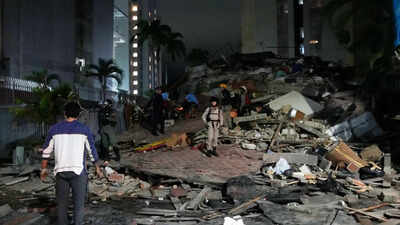
The two powerful earthquakes that struck Venezuela’s northern coast on Wednesday, killing more than 180 people, were part of a seismic phenomenon known as a “double.” The two earthquakes represent the strongest earthquakes Venezuela has witnessed in more than a century and left the country grappling with widespread devastation.That’s why the damage was so fast and severe.When two earthquakes strike in one earthquakeA double earthquake occurs when two earthquakes of the same magnitude strike the same general area within a short period of time. On Wednesday evening, a 7.2 magnitude earthquake struck first. Just 39 seconds later, an even stronger 7.5-magnitude earthquake followed, according to the USGS.The successive shocks left almost no time for people to react.
Buildings collapsed in the capital, Caracas, and its surrounding areas. More than 1,500 people were injured and thousands were missing. The La Guaira coastal strip north of Caracas suffered some of the worst casualties and structural damage, officials said.Most earthquakes follow a more familiar pattern: one dominant shock followed by a series of weaker aftershocks. Binaries are less common and behave differently, although they can occur anywhere in the world, Christine Goulet, director of the USGS Earthquake Science Center in California, told The Associated Press.
A fault line with a violent historyThe duo points to a geologically complex fault structure beneath Venezuela. The Pocono Fault, which runs about 500 kilometers along the Venezuelan Andes, has a long record of seismic activity. In September 2025, a 6.2- and 6.3-magnitude earthquake shook western Caracas, killing at least one person and injuring more than 100 others.This week’s earthquakes were caused by movement along the border where the Caribbean and South American tectonic plates meet.
The Caribbean plate, north of Venezuela, is moving eastward overtaking the South American plate at a rate of about two centimeters per year.“It is a major displacement,” Goulet said, according to what was reported by the Associated Press. “It’s something to do with the San Andreas fault.”The rupture was a shallow strike-slip fault, meaning that two blocks of rock slid horizontally over each other rather than one moving over the other. Goulet pointed out that this type of movement is not automatically more destructive.
“More vertical movement can be more damaging,” she said, adding that factors such as the length of the tear also play a major role in determining the extent of damage.David Naar, associate dean at the University of South Florida’s College of Marine Sciences, said the South American-Caribbean plate boundary is seeing relatively little activity. USGS records show that only seven earthquakes of magnitude 6 or higher have struck the vicinity during the past century.The area is no stranger to earthquakesAt least five earthquakes of magnitude 7 or greater have struck northern or coastal Venezuela since 1900. The most recent major earthquake in living memory was a magnitude 6.6 event in July 1967, which killed hundreds.Jose Vitriago, a resident of Caracas who was only two years old at the time, still remembers the devastation. “Our house has collapsed,” he told state radio Venezuela de Television.
He said Wednesday’s duet “was terrible and terrible.”The deadliest earthquake in Venezuelan recorded history occurred in March 1812 along the Pocono Fault System itself. It is estimated that he killed about 30,000 people.Earthquakes are still impossible to predict, but the risk of aftershocks remains. The USGS estimated the probability of at least one magnitude 4 aftershock occurring within the next week at 99%, with a 24% chance of a magnitude 6 event.Venezuela does not have an earthquake early warning system, which uses ground sensors to detect initial seismic waves and alert residents before the strongest tremors arrive. On Wednesday, the double tremors occurred almost without warning.“It is very sad that there was no time to evacuate,” Goulet said. “This is very unfortunate.”