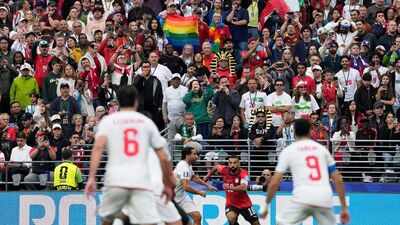
Two of the most repressive countries end up playing a FIFA “Pride Match”.
Rainbow flags were seen waving among the sea of Iranian and Egyptian banners at Seattle’s World Cup stadium on Friday, as teams from two of the most repressive countries for LGBTQ+ people took to the field in a match that became an unlikely symbol of inclusivity.It was just a coincidence that the city’s “Pride Match” ended in a high-stakes match between Iran and Egypt, with qualification from Group G yet to be decided, and the move came with a lot of opposition from both countries. But Seattle officials and its soccer community said the special pairing was an opportunity to highlight the city’s inclusivity.
“I don’t think there is a sport that has a global event that creates unity, diversity and bringing together so many cultures like the World Cup,” said Jess Fishlock, captain of the Seattle Reign in the National Women’s Soccer League.
“I think we’ll see that firsthand at the Pride Match.”
Iran and Egypt objected to Pride celebrations
Same-sex relations are illegal in Iran, where gay men have been executed on sodomy charges, while Egypt has prosecuted gay people and suppressed outward expressions of gay pride, including rainbow flags.These countries complained to FIFA last December about the “Pride Match” and requested that the celebrations be cancelled. The Iranian Federation said in a statement that it had clarified its position to FIFA in multiple letters and meetings, and was assured that “no celebrations or promotional activities related to this issue will be held inside the stadium or as part of the official match program.”
The Iranian Federation said, “Iran and Egypt are two Islamic countries with deep cultural and religious commonalities, and the views expressed by the two federations reflect the common values and beliefs of the peoples of the two countries.”
In a major shift from the 2022 tournament, FIFA now treats the rainbow flag as a human rights statement and allows fans to wave it inside the stadium, according to Hanna Tadesse, a spokeswoman for the Seattle World Cup organizing committee. FIFA confirmed that “rainbow flags and other flags representing sexual orientation and gender identity are permitted under the Code of Conduct for the 2026 World Cup stadiums.”
The Pride Match brand has sparked backlash
The brand was selected by Seattle organizers for the “Pride Match” ahead of the World Cup draw in December. When the group stage schedule was confirmed, the Seattle committee found itself in a pride celebration as shoulder programming for a match involving two states that criminalize same-sex relations.
FIFA president Gianni Infantino tried to downplay the Pride Match brand in a January interview, saying: “I must make it clear that there will be no Pride Match at the World Cup.
There will be a FIFA World Cup match in Seattle, and on the same day, events organized by external organizations will be held in the city. But this has nothing to do with the match itself.”The Human Dignity Foundation says that the Iranian state criminalizes homosexuals and imposes a maximum penalty of death under the penal code. It also says Egypt bans same-sex sexual activity, with prison sentences and fines.
Seattle embraces inclusivity
Stacy Harbor, who works for an LGBTQ+ nonprofit at the invitation of the local organizing committee, brought 20 young people to the game, handing them “gift bags” filled with face paint, flags and headbands.
“There are groups of people living here in Seattle who are of Egyptian and Iranian descent,” she said. “This is their opportunity to represent their intersectional identities.” “This is an opportunity to show the world what Seattle is all about.
Seattle is an inclusive city. “We always have been, and we always will be.”
Ilona Lohry, president and CEO of the Greater Seattle Business Association, an LGBTQ+ chamber of commerce, called Seattle one of the most inclusive cities in the country.“I think it gives us an opportunity to show who we are as a city, who we are as a people and how diversity makes us stronger,” Lohrey said.With inputs from AP and The Athletic