

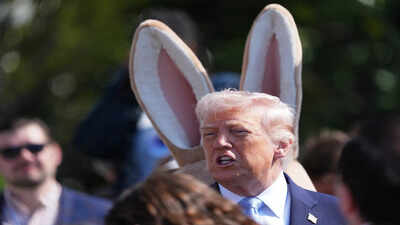
President Donald Trump takes part in the White House Easter Egg Roll on the South Lawn of the White House, Monday, April 6, 2026, in Washington. (AP Photo/Mark Schiefelbein)
“It’s not rocket science” is a common phrase used to describe something that is not particularly difficult. This is because rocket science – of all sciences – has the least room for error, as said error can lead to horrific deaths.
But as Sheldon Cooper points out, rocket science is perhaps less difficult to understand than quantum mechanics. One of the most enduring memes in quantum mechanics is Schrödinger’s Cat, a cat whose state of fatal uncertainty gave rise to one of the greatest thought experiments.For those who aren’t familiar with physics — or those who haven’t watched The Big Bang Theory — Schrödinger’s Cat refers to a famous thought experiment in which said cat is supposed to be dead and alive at the same time until the box it is locked in is opened.
Invented by physicist Erwin Schrödinger in discussion with Albert Einstein, the cat state is one of a quantum superposition of two possibilities, which is only resolved once the box is opened.Since then, Schrödinger’s term “XYZ” has slipped into the modern lexicon to describe any situation of uncertainty, and it certainly fits the description of the current complex situation in the Middle East.
He watches
The Big Bang Theory – Schrödinger’s Cat
At the time of writing, “ceasefire” is, to borrow a phrase from a garrulous Indian politician, an interesting mixture of distortions as precise in its terminology as the Holy Roman Empire, the United States of America, and income tax returns.
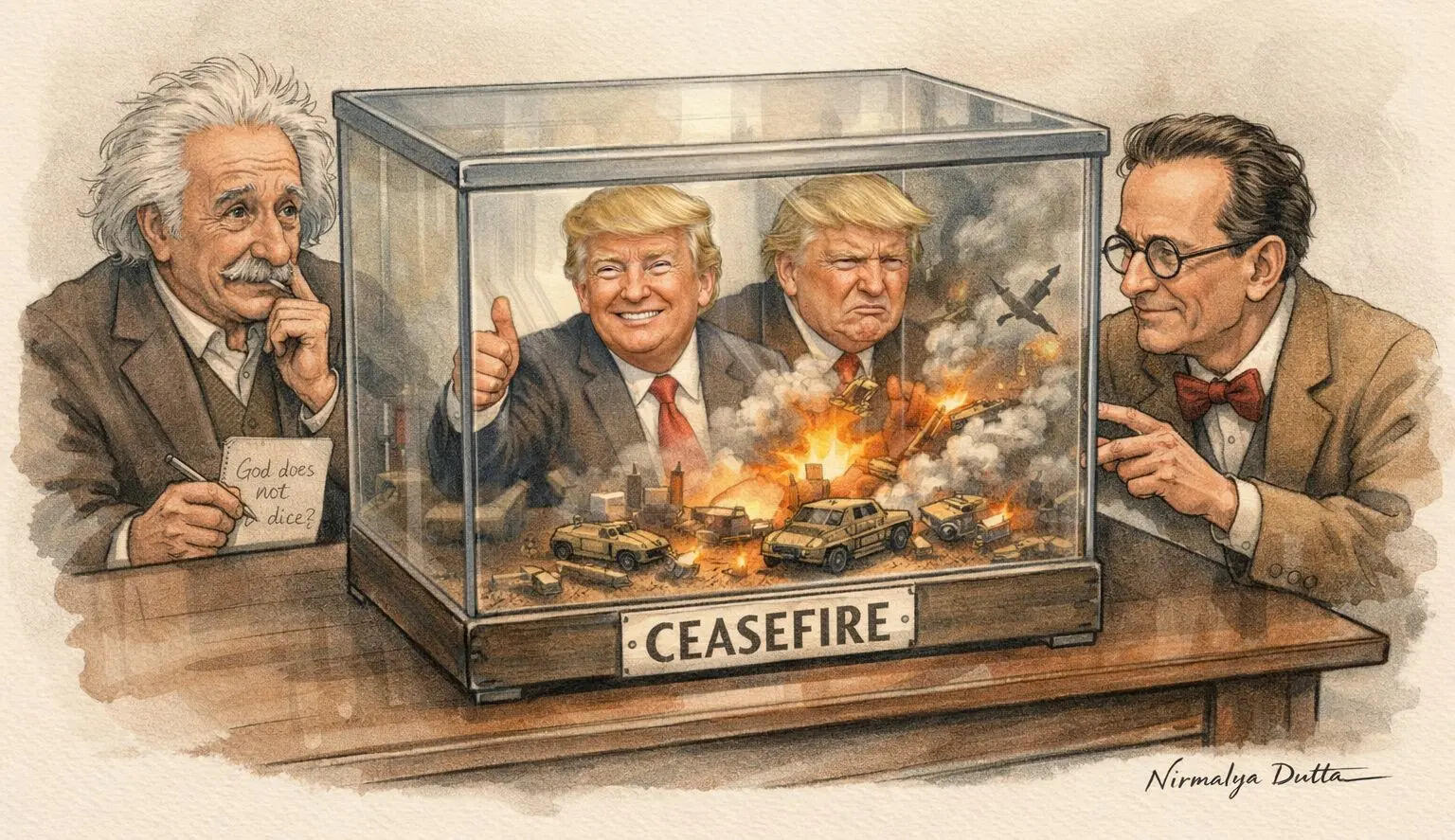
Schrödinger’s ceasefire — which includes drafts ostensibly drafted in the White House and demonstrates the dangers of X’s (formerly Twitter) editing feature — came on the day Trump threatened to “end civilization.”
But like the cat, we are forced to ask whether there will be a ceasefire if people don’t stop shooting.Even those monitoring the situation are not entirely clear, so let’s take this opportunity to give us the lowdown.
What did he promise?
The “ceasefire” is not so much a single agreement as a pile of competing press releases. Trump framed it as a two-week pause conditional on the reopening of the Strait of Hormuz, with “no enrichment” as the nuclear minimum.Iran said the United States had accepted a 10-point “framework” that included enrichment, comprehensive sanctions relief, continued Iranian control over Hormuz, and a regional cessation of hostilities, including in Lebanon.Meanwhile, Pakistan, shining in its role as mediator/craftsman extraordinaire, presented the truce as broader than Washington acknowledged, including Lebanon.In a normal treaty, there will be different confirmations of the same agreement. But like a Bob Dylan song with masses, the conventions here are very different.
Because beneath the language of diplomacy lie various differences.
Fictional advertiser Don Draper used to say: If you don’t like what they’re saying, change the conversation. Here everyone has their own.The United States believes it has been given a pause on its terms and a face-saving exit.Iran assumes that it has secured recognition of its resolve to confront the mighty Satan.Pakistan believes it has brokered something historic.Israel believes that it can continue to do whatever it wants outside of Iran.The European Union believes that its point of view is important.Essentially, at this moment of ceasefire, there is no consensus, as everyone agrees to disagree – publicly, simultaneously, and with great threat.
What the players say
Washington has spent the last two days quietly reducing the size of the ceasefire. She insists that Lebanon was never part of the deal. Enrichment is off the table. Hormuz must be reopened without conditions. Even Trump’s musings about “joint ventures” to collect fees quickly fell away, as if the idea had come from an entirely different conversation.
J.D. Vance’s description of Lebanon as a “legitimate misunderstanding” is perhaps the truest statement that can be extracted from the entire exercise.But Tehran did the opposite. It expanded the ceasefire into something much more ambitious. It claimed that the ceasefire is a structured framework for non-aggression, relief from sanctions, continued control over Hormuz, and the right to enrichment, and that the ceasefire extends across all theaters of the conflict, including Lebanon.Pakistan has chosen Penglossian optimism. As a mediator, it presented the ceasefire as broad, regional, and consequential — a diplomatic success big enough to include Lebanon, even if Washington would rather it not do so.At the same time, Israel dispensed with simultaneous translation completely. As for Jerusalem, the ceasefire applies to Iran and Iran only. Hezbollah represents a separate problem, and continues to be dealt with as such.
The strikes in Lebanon have continued, not as a violation of the ceasefire, but as a reminder that Israel never agreed to the version everyone seems to be discussing.
What is not hashed?
They say the devil is in the details, and there are very few of them in this particular hellish playground. The nuclear issue is still up in the air. The United States says that enrichment is zero; Iran claims the right to enrichment. The same applies to penalties. Iran talks about mitigation, retreat, and even compensation.
The United States says nothing to do.The same applies to Hormuz. In fact, it will remain as Iran wants it to be, allowing only friendly ships to pass.Lebanon is where the ambiguity turns deadly: Iran says it is part of the same theater, the United States does not, and Israel has continued to bomb it.When Neville Chamberlain returned with Hitler’s version of peace, he at least had a piece of paper promising peace for our time. There is no common text, no neutral arbiter, and no agreed upon definition of what constitutes a violation.
Which means that each action can be compatible and incompatible, depending on who is doing the explaining. Finally, implementation – or lack thereof. At this point the ceasefire ceases to appear incomplete and begins to appear deliberate.All of this brings us back to the proverbial cat, whose fate we can only ascertain after opening the box. Until then, we just have to assume that the ceasefire will remain in a state of overlay until the clarity of time clears the outside of the box.
He watches
Man of the moment. Albert Einstein told Oppenheimer
In the past, Einstein, the greatest mind of all time, could not come to terms with the uncertainty, contradiction and probabilities of quantum mechanics, insisting that God does not play dice. But if he were alive today, the great pacifist would be tormented by a war waged by men playing dice, where ceasefires are declared and denied, where multiple versions of the truth exist simultaneously, where war is both paused and unstoppable, and refuses to collapse into a single observable truth.Unfortunately for us, we are all like the cat, facing a moral hazard, stuck in a box now, and only the passage of time will tell whether we will survive or not.