

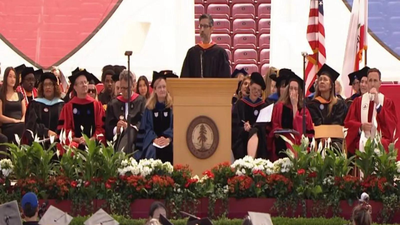
TOI correspondent from Washington: When Sundar Pichai was studying at Stanford University in the 1990s, he once skipped class to go to Las Vegas. When he returned to Stanford University to deliver his commencement speech on Sunday, some students passed Sundar Pichai.It was a remarkable graduation party in Silicon Valley: the CEO of Google, one of the most powerful companies on Earth, addressing some of America’s brightest young minds — only to discover that some had clicked “unsubscribe.”When Pichai took the stage, an estimated 100 to 200 graduates stood and walked out chanting, “Free, free Palestine.” Some carried signs reading “ICE Spies Using Google AI” and others waved Palestinian flags.
There were whistles, boos and shouts of “shame on you” because nothing says “Congratulations, Class of 2026” like heckling the man whose company may have handled the email invitations and broadcast of the protest.
The protests, organized by Students for Justice in Palestine and No Technology Apartheid, targeted the Silicon Valley giant’s contracts with the Israeli government, with recent graduates reportedly angry over Project Nimbus, Google’s $1.2 billion cloud computing partnership with Israel, as well as alleged uses of artificial intelligence in surveillance and immigration enforcement.
Speakers at this year’s graduation ceremony discovered that mentioning artificial intelligence before graduation can trigger reactions typically associated with airline baggage fees. Last month, former Google CEO Eric Schmidt learned this lesson at the University of Arizona, where alumni booed after he declared that “AI will touch everything.”Pichai, having updated his software, apparently avoided the topic almost entirely.
Instead, he gave a garden-variety speech featuring stories of setbacks, detours and self-discovery. He spoke of his arrival in California from India and wondered what everyone found so attractive about a landscape that seemed suspiciously brown to him. He recalled abandoning his plans to obtain a Ph.D., and the uncertainty of his early years at Google.Then came the discovery that instantly made him the coolest Indian uncle in Silicon Valley.
As a student at Stanford University, Pichai admitted that he once played an obsessive role to visit Sin City. “This is the first time my parents have heard about this,” he said amid laughter.But the dissidents have already moved. For the second year in a row, student protesters hosted their own “People’s Commencement,” with an alternate keynote speaker. This year’s featured guest was activist Mahmoud Khalil, who became nationally known after immigration authorities arrested him for his pro-Palestinian activism.However, not everyone liked extracurricular scheduling. Venture capitalist Vinod Khosla, also a Stanford University alumnus, criticized the protesters as “biased, stupid, short-sighted and extremely selfish.” He said that artificial intelligence represents humanity’s greatest opportunity to improve the lives of billions of people and accused the students of narrowly focusing on their own interests.But the strike highlighted an increasingly embarrassing reality for Silicon Valley’s giants. Leaders of industry once visited elite universities as conquering heroes — tech rock stars dispensing wisdom to adoring students eager to become the next Mark Zuckerberg. Now they arrive as complex and controversial figures: admired for their innovations, scrutinized for their companies’ influence, and sometimes treated like villains at their own fan conventions.