

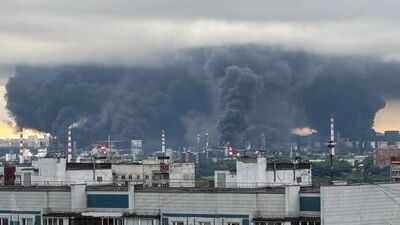
Ukrainian attacks on Russian oil refineries caused fuel shortages and led to rationing of supplies.
Ukrainian missile and drone attacks on Russian oil refineries have caused a worsening fuel crisis across Russia, with restrictions on gasoline purchases now in place in 53 regions, and motorists facing long lines and rationing, the Wall Street Journal reports.The Moscow oil refinery was bombed twice in one week. The International Energy Agency said the attacks destroyed an estimated 20 percent of Russia’s oil refining capacity, describing the disruption as “unprecedented in the history of the Russian-Ukrainian conflict.”
The Moscow refinery was damaged twice in one week
Ukraine struck the Moscow refinery on June 16 and again on June 18, in what may be the largest attack on the Russian capital since the start of the all-out invasion in 2022.
Video footage showed several fireballs and black smoke above the facility in the Kapotnya region, which produces more than a third of the fuel supplies for Moscow and the surrounding region.According to industry sources cited by Reuters, the June 18 strike damaged the Euro+ crude oil processing complex, which was commissioned in 2020 as part of the refinery’s modernization program. The unit includes a crude distillation section with a nominal capacity of about 140,000 barrels per day, or approximately 47% of the refinery’s total processing capacity.
A previous strike on June 16 had already damaged another major crude distillation unit responsible for approximately 53% of the refinery’s processing capacity.
Satellite images published by Exilenova+ show a severely damaged tank with its roof blown off, as well as clear traces of firefighting activity in several key processing areas.
Fuel rationing It spreads throughout Russia
Restrictions on fuel purchases extended to 53 regions in Russia and the occupied territories, according to the independent Russian newspaper The Bell.
Drivers are often limited to no more than one tank of fuel to prevent hoarding. In 18 regions, motorists may purchase no more than 50 liters or one full tank of petrol per customer. Oil producer Tatneft imposed nationwide restrictions on hundreds of its stations, with one location south of Moscow limiting sales to 20 liters of gasoline per car.In Crimea, the situation is particularly acute. Ukrainian forces bombed fuel tankers and trucks transporting fuel to the peninsula, leading to rationing as early as late May.
Motorists reported waiting up to three hours to refuel. Local authorities have imposed a QR code rationing system that drivers must present to receive their allotted fuel ration.
A strategic shift in war
“Ukrainian attacks that force Russia to ration fuel consumption” demonstrated Kiev’s ability to reach targets hundreds of kilometers inside Russian territory, according to the Wall Street Journal. The strikes led to the complete or partial closure of many facilities, temporarily disrupting more than 20% of Russia’s primary refining capacity.Vladimir Milov, Russia’s former deputy energy minister, said the strikes became more effective because Ukraine targeted Russia’s largest and most modern refineries, which use Western equipment that is difficult to replace.“The 10 to 15 oil refineries are a very narrow and vulnerable target. Simply attacking them will lead to a crisis,” Milov said.Following the strikes, Russian Railways established a special task force to ensure the “uninterrupted supply” of fuel to the regions.
The Russian government has also banned aviation fuel exports and expanded provisions allowing refiners to sell domestically produced fuel that does not meet Euro-5 quality standards.Despite the escalating crisis, Russian state television has downplayed the shortages, with one prominent pro-Kremlin host describing Russians who post photos of empty gas stations as “hysterical.” Moscow imposed fines for publishing photos of the aftermath of the Ukrainian strikes.