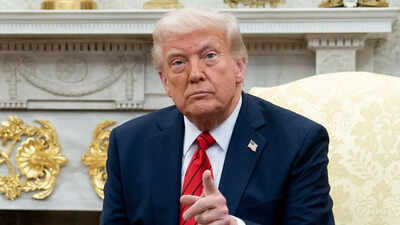
The Trump administration maintains that the United States is not at war with Iran, despite the looming 60-day deadline for a war powers resolution. House Speaker Mike Johnson echoed this, stating that no congressional authorization was needed with active hostilities at a halt. But that position faces challenges from Democrats who say the deadline is still binding.
The administration of US President Donald Trump has confirmed that the United States is “not at war” with Iran, even as the conflict reaches a critical legal threshold under the War Powers Resolution, setting the stage for a potential confrontation between the White House and Congress.House Speaker Mike Johnson said Thursday that congressional authorization is not needed at this point, arguing that the United States is not engaged in active hostilities.“I don’t think we have active military bombing or shooting or anything like that. Right now, we’re trying to broker peace,” Johnson told NBC News at the Capitol.When pressed about the 60-day deadline under the 1973 War Powers Resolution, which falls on Friday, he was emphatic.
“We are not at war.”
60-day deadline for war powers raises legal controversy
The comments come as the military conflict with Iran approaches the 60-day limit set by the 1973 War Powers Resolution, which states that the president must withdraw US forces from hostilities within 60 days unless Congress authorizes such action.Trump formally notified Congress of the military campaign on March 2, making May 1 a key deadline. With no mandate yet approved, the situation raises the possibility of a constitutional confrontation.
The law allows presidents to seek a 30-day extension, although it remains unclear whether Trump intends to activate the provision.A senior White House official said administration leaders and lawmakers are having “active conversations” about how to move forward, adding that any lawmakers who oppose the authorization “will only undermine the U.S. military abroad.”
Demanding a ceasefire is the focus of the administration’s argument
At the heart of the administration’s position lies the claim that the ceasefire with Iran effectively stops the clock of war powers.Defense Secretary Pete Hegseth told lawmakers during a Senate hearing that stopping the fighting changes the legal calculus.“I will defer to the White House and White House advisors on that. However, we are in a ceasefire right now, which means, from our understanding, the 60-day ceasefire clock has stopped or stopped,” Hegseth said.However, that interpretation has been challenged by Democrats, who say the law does not support postponing the deadline.“I don’t think the statute would support that,” Sen. Tim Kaine responded.“I think the 60 days expire maybe tomorrow, and that will raise a really important legal question for the administration there,” he added.
Trump’s position on “war” has changed.
Even as his administration insists that the United States is not officially at war, Trump himself has used different language to describe the conflict since its inception.On February 28, while announcing the initial strikes, he said: “The lives of brave American heroes may be lost, and we may have casualties.
This often happens in war.”On March 9, he said: “I think the war is pretty much over.” Days later, he described the operation as a “war” and a “little journey.”Later in March, Trump indicated that he might avoid calling it a war because “it’s supposed to get approval” from Congress.Despite this, he said in mid-April, “I had to go to war.”In a Thursday interview with Newsmax, he again reflected on this ambiguity, saying: “The stock market has now reached a new high during a war, or military operation, whatever you want to call it.”
Background of conflict and high costs
The current conflict began on February 28, when the United States and Israel launched coordinated strikes on Iran, targeting Tehran and other locations. Iran responded by attacking US bases in the region and Israeli targets, while also disrupting shipping through the Strait of Hormuz, sending global oil prices sharply higher.The fighting has already taken a heavy toll. Acting Pentagon Comptroller Jules Hurst III told the House Armed Services Committee that the war has cost $25 billion so far, and the administration plans to seek additional funding from Congress.Military commanders who testified before the committee did not indicate that operations would end soon, suggesting that US intervention may continue despite the ceasefire.
Democrats back down and warn of a legal violation
Democrats have raised growing concerns that the administration is on shaky legal footing and could violate the War Powers Resolution if hostilities are not ended or formally authorized.“Some of my colleagues have indicated that the 60-day period of the War Powers Act is the moment at which they might join our efforts to end this war,” said Senator Adam Schiff, who introduced a resolution to limit the conflict.
“That time has come.”He added: “After two months of war, in which the lives of thirteen military service members were lost, and billions of dollars were wasted, it is time to realize that the price we have paid is very high indeed.”Despite these efforts, any attempt to prevent the administration’s actions faces significant obstacles. Even if the resolution passes the Senate, it would require approval by the Republican-controlled House of Representatives, and Trump could eventually veto it.
An uncertain road ahead
The War Powers Resolution has historically had difficulty constraining presidential military action, as courts have often avoided intervening and resolving disputes through political negotiations.For now, the Trump administration appears intent on relying on its interpretation that the ceasefire temporarily stops the legal clock, even as critics claim the deadline is still binding.With the May 1 threshold reached and no clear solution in sight, the question of whether or not the United States is officially at war with Iran is likely to remain at the center of intense legal and political debate.