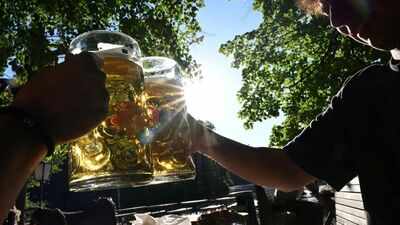
How the European heat wave affected alcohol consumption in Europe (Image source: Reuters)
The European heatwave tests the assumption that hot summers mean a proportional increase in alcohol sales. Studies show that drinkers are less likely to drink a chilled beer or cocktail when temperatures are very high.Researchers from UCLA, ETH Zurich and North Carolina State University found that alcohol sales rise on average as temperatures rise to just above 32°C, after which the positive effect becomes less. The effect varies depending on geography and was less pronounced in already warm areas, according to a March paper.“Warm weather in general is good for consumption. But there is also an upper limit, beyond which it is uncomfortably hot,” said Martin Ludwigx, head of beverage market research firm IWSR, adding that this reverses the trend for some drinkers.
Heatwave forces change drinking habits
Europe’s summer heatwave, which began on June 20, was the most severe on record on the continent, causing thousands of excess deaths, overwhelming healthcare systems, disrupting power generation, and damaging infrastructure. European health authorities said that people should avoid alcohol, which increases dehydration and body temperature. Its consumption and sale in stores was briefly banned in Paris.“There is an important difference between warm weather and extreme heat,” said Christian Henningsen, global director of public affairs at Carlsberg, adding that extreme heat can prompt people to stay inside instead of going out for a drink.
The Danish brewery is focusing on offering drinkers more options, such as low- or no-alcohol beers or soft drinks, partly to adapt to such changes.
Mixed effects of the beverage trade
Spyros Malandrakis, director of global alcohol insights at Euromonitor International, said more extreme heat could have mixed effects on those working in the drinks trade. In addition to causing some to drink less alcohol, heatwaves can harm economies and purchasing power and harm agriculture, increasing the costs of alcohol production.He also predicted that some people will drink more in a world that “feels like it’s on fire.”The European Union’s Copernicus Climate Change Service said heatwaves would become more frequent and intense, while scientists said a heatwave in Europe would be virtually impossible without human-caused climate change, which is warming at a faster rate than any other continent.
Paris imposes a ban on drinking in public places
Paris imposed a temporary ban on drinking alcohol in public places to ease pressure on hospitals after cases of cardiac arrest quadrupled in 24 hours, with police patrolling the banks of the Seine to enforce it.Health experts say that alcohol poses a risk during a heat wave. It is a diuretic and causes dehydration, and combined with the heat it puts enormous pressure on the heart.People sweat more in hot weather, causing blood volume to decrease, while blood vessels near the skin expand to help blood lose heat. Alcohol increases this effect, causing blood vessels to dilate more, resulting in lower blood pressure. If the heart cannot meet the demand, people can feel dizzy and collapse.Despite the risks, for some the heat is still the perfect excuse to have a drink. Theresa Angell, 57, who works as a bill support worker in London, said: “There is something about the sunlight that makes you want to pour yourself a glass of wine.”