

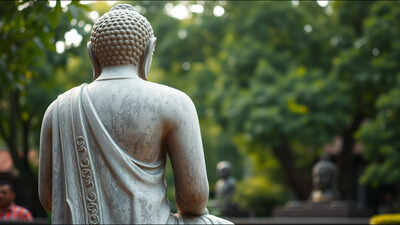
This Thai proverb reminds us that good work should be done without attracting attention.
The ultimate act of kindness is doing something noble when no one is watching. Such acts of kindness done in the shadows do not require attention or reward. This timeless Thai proverb conjures a religious image as it refers to the process of attaching gold leaf to the back of a Buddha statue.
The literal meaning of the proverb is actually a practice in Thai culture where people offer a gold leaf to Buddha but instead of keeping it in front of him, they stick it in the back – signifying something that was done without any expectation.The picture is simple, but its lesson is profound. He talks about doing good without asking for praise, performing acts of generosity that will never attract applause, and measuring virtue by intention rather than appearance.
Origin or proverb: A practice rooted in Thai Buddhism
The proverb cannot be understood without appreciating the habit from which it emerged. In Thai Buddhist temples, worshipers often purchase small squares of gold leaf and carefully press them onto images of Buddha. The law is not intended to decorate the statue for aesthetic reasons only. It is an expression of faith, gratitude and reverence. Many believe it generates merit, a central concept in Theravada Buddhism that refers to beneficial actions that are believed to bring about positive spiritual consequences.
As countless devotees participate over many years, older Buddha statues often acquire thick, uneven layers of gold. Their surfaces have become ornate with generations of dedication.However, the choice to place gold leaf on the back of the statue changes the meaning of the act. The display remains completely honest, but any visitor is unlikely to notice it. The donor receives no admiration from others. All that remains is the action itself, and perhaps one’s conscience.
Goodness that does not need an audience
In essence, the proverb encourages people to do good even when no one is watching.Humans often enjoy recognition. Whether through praise, awards, promotions, or public recognition, recognition satisfies a natural desire to get attention for our efforts. The proverb gently questions this motive. If an act of kindness loses its value once no one sees it, was it really an act of kindness in the first place?Pasting gold leaves on the hidden side of the Buddha statue symbolizes the action done without expectation of reward.
The donor knows that strangers will never point to the back of the statue and admire their contribution. However, they make the offering because they believe it is worthwhile.This distinction between visible generosity and real generosity lies at the heart of the proverb.
Humility to confess
Thai culture has traditionally valued humility and self-control. Open displays of self-promotion are often viewed with suspicion, especially when linked to charity.
The proverb reflects this cultural preference. He points out that the most important contributions are sometimes the least obvious.While the proverb encourages us to do good, and stay in the shadows, it reminds us of those who always remain in the background and keep the world running.
Driving lesson
The proverb also holds wisdom for leaders. Some leaders seek constant recognition. They announce every decision, announce every charitable donation, and attach their names to every accomplishment.
Others drive more quietly. They create opportunities for others, solve problems before they become crises, and allow their teams to receive praise. The second method resembles the proverbial image. Like the gold on the invisible side of a Buddha statue, its impact may not be noticed by the public, but its value is undeniable.Such leadership often builds deeper trust because it is motivated not by reputation but by responsibility.
Relevance in the age of social media
This proverb seems especially relevant today as social media encourages people to document almost everything. Charities are often featured alongside photos, videos and carefully written captions. Donations become advertisements. Volunteering becomes content.Sharing positive actions can certainly inspire others, and public campaigns often raise awareness of important issues. But the proverb raises a deeper question: Would you still do the same good deed if no one could photograph it?Her answer suggests that pure generosity remains even in complete anonymity.
The hidden gold leaf is just as important as the visible leaf.
The message of the proverb goes beyond charity
Although the proverb is often associated with generosity, it applies to many areas of life. A scientist who spends years conducting meticulous research may receive little public attention, but future discoveries depend on this meticulous work. The archivist who preserves historical documents rarely appears in history books, even though generations of historians rely on those archived records.
A software engineer who fixes security flaws before anyone notices them prevents countless problems in the future.Their work is like the gold leaf on the back of a statue: essential but largely invisible.
Connections to Buddhist Thought
This proverb also reflects important Buddhist principles.Buddhism emphasizes intention as much as action. Decent work that is motivated solely by pride is spiritually different from work that is motivated by compassion. Fixation on praise is often viewed as another form of craving, something that can distract individuals from true inner development.
The hidden offer becomes a practical exercise in letting go of the desire for recognition.Instead of asking: “Will people notice what I did?” The practitioner asks: “Was this the right thing to do?” This subtle transformation turns generosity into a form of personal discipline.
Similar examples all over the world
Many cultures express similar values: English speakers sometimes quote the proverb: “Do good and throw it overboard,” meaning that kindness should not depend on gratitude.Another familiar expression is “Character is what you do when no one is watching.”In religious traditions around the world, anonymous giving is often viewed as a particularly virtuous act because it minimizes pride while maximizing devotion.The Thai proverb distinguishes itself through its vivid temple imagery. Rather than presenting an abstract moral lesson, he invites listeners to imagine a congregant quietly placing a fragile square of gold where almost no one will see it.
That image remains unforgettable.The proverb does not discourage public acts of generosity. Visible kindness can encourage others to help and can draw attention to worthy causes. Instead, it reminds us that recognition should never become the primary goal. Its enduring message is that integrity reveals itself most clearly when external rewards disappear.Whether we are caring for an elderly parent, mentoring a struggling colleague, returning an ancient manuscript, planting trees whose shade we may never have, or anonymously helping a stranger, we are, in a sense, putting gold leaf on Buddha’s back.The contribution may remain invisible. Its value is not.In a world increasingly preoccupied with visibility, standards, and public approval, this ancient Thai proverb offers a refreshing measure of character. The best works are not always those that are remembered by history or applauded by audiences. Sometimes it’s those quiet acts that make the world a little better without leaving any trace of the person who did them.Like the nugget of gold hidden behind a statue, true goodness shines through even when no one is looking.