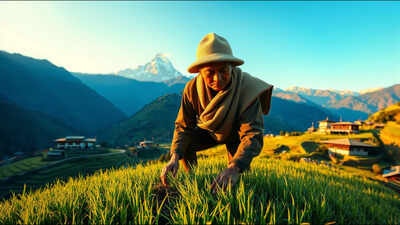
Today’s Bhutanese proverb about happiness and sadness.
Bhutan is one of the happiest countries in the world and it is no surprise that a Bhutanese proverb reveals the secret of their happiness. It says that everything exists in the mind – whether joy or sorrow, and there are no external factors to be credited or blamed for.
The Bhutanese proverb: “Whatever happiness you seek, you can achieve by yourself, and whatever misery you seek, you can find by yourself,” sums up this worldview perfectly. It is a stark reminder of absolute personal responsibility. It eliminates the excuses we often make for our emotional states and puts the steering wheel of our lives firmly back in our hands.
Buddhist philosophy of happiness
In Buddhist psychology, the mind is considered the creator of all truths.
The Dhammapada, a collection of ancient sayings, begins by declaring that “the mind precedes all mental states.”The Bhutanese proverb operates on exactly this frequency. He points out that external conditions – whether wealth, poverty, praise or blame – are merely raw materials. The mind is the craftsman who sculpts these materials into either joy or misery.We often live under the illusion that an external event is the cause of our internal state.
We think, “This person made me angry” or “This promotion will make me happy.” The truth is that these external stimuli are neutral. The joy or misery that follows is a direct product of your perceptions, desires, and associations.
How to choose joy
When the saying goes that happiness can be achieved on your own, it does not call for a life of isolation. Instead, it redefines what happiness actually is. In a consumer-driven world, we’re conditioned to believe that happiness is something we accumulate—a better car, a perfect partner, a flawless vacation.
But the Bhutanese perspective views joy as something you cultivate.If your joy depends on everything going perfect around you, your happiness will always be fragile. The weather will change, people will disappoint you, and plans will fail. By associating joy with external circumstances, you give away your power.Achieving happiness “on your own” means finding a sense of peace that does not require permission from the outside world. It comes from:Develop mindfulness, which allows you to enjoy the present moment without worrying about the next.Accepting impermanence frees you from the fear of losing what you love.When you realize that the capacity for joy is an internal resource, you stop begging the world to make you happy. Become your source of warmth.
How People Create Misery: The Engineering of Self-Sabotage
The second half of the proverb is perhaps more challenging: “Whatever you seek in misery, you will find.” At first glance, this seems counterintuitive. No one wakes up and thinks: “I want to be miserable today.”
However, unconsciously, we search for misery all the time. The human brain has a well-documented negativity bias, an evolutionary trait that causes us to scan our environment for threats, flaws, and problems.We find misery not because we desire pain, but because we indulge in habits of mind that ensure it. We seek misery when: We replay past resentments over and over in our heads, effectively poisoning our present moment; comparing our lives to the glossy, curated versions of others on social media; clinging to expectations about how others should behave, ensuring we are constantly let down; Adopt a victim mentality, believing that life happens to us and not to us.The proverb uses the word “ask” intentionally. It means active searching. If you look at the world through the lens of grievance, you will always find evidence to justify your bad mood. You will find the rude driver, the late flight, or the unappreciative boss, and you will use them to build your own prison of misery.
Our takeaways
Bhutanese do not view happiness as a lottery ticket that you win by luck. They look at it as a muscle you train. This proverb acts as a mirror, forcing us to look at where we place our emotional investments. It reminds us that our hearts and minds are sovereign territories. The world can bring chaos to your doorstep, but whether you turn that chaos into a storm of misery or a moment of joyful resilience is entirely up to you.
You are the architect, guardian, and inhabitant of your inner landscape.