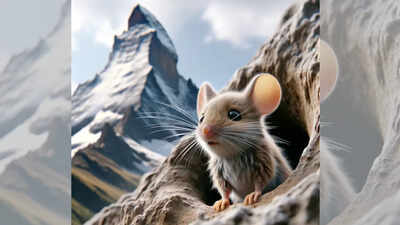
“The mountain went into labor and gave birth to a mouse.”
“Imagine an entire village gathered in anticipation. The ground is shaking. The mountain seems to be splitting apart. Surely something wonderful is about to emerge. But after all the noise and excitement, out comes… a mouse.“That stunning image is the heart of one of the most memorable Arabic proverbs:The mountain churned and produced a desertThe mountain swayed giving birth to two branches“The mountain came and gave birth to a mouse.”Few proverbs depict disappointment in such vivid images. In just a few words, he describes an experience familiar across cultures: tremendous anticipation followed by a disappointing outcome. Whether it’s a hyped product launch, a big political promise, or a project that consumes months of effort only to produce little value, this old adage remains surprisingly relevant.
Mount in action
Action Tamakhkhada It literally refers to the pains of birth. Applying it to the mountain creates a deliberately absurd image. Mountains are symbols of permanence, greatness and power. Birth means the coming of a new life. Together they suggest that something extraordinary is about to happen.Instead, the mountain only spares a mouse.The humor lies in the contradiction. This proverb not only describes failure, but also mocks exaggerated expectations.
The bigger the promise, the smaller the outcome in comparison.That’s why this saying has persisted for centuries. He reminds listeners to judge accomplishments by the results, not the spectacle.
Where did the proverb come from?
Although the proverb is widely known in Arabic today, scholars generally agree that the image is much older than Arabic literature itself.Her earliest known literary appearance was in Ars Poetica (“The Art of Poetry”) by the Roman poet Horacewritten around the first century BC. Horace opens part of his work with the famous phrase:“The mountains will be in labor, and a silly mouse will be born.”He used the image to criticize writers who began their works with big, dramatic openings but failed to provide equally substantive conclusions. The lesson was intended for poets, but it also applies to everyone whose ambitions exceed implementation.From the classical Mediterranean world, this metaphor has traveled widely. It appears in later European literature, medieval saying collections, and eventually became established in the Arabic language The mountain churned and produced a desert. Like many proverbs that have crossed linguistic boundaries, its survival is due not so much to its origin as to its universal truth.
More than just a joke
At first glance, the proverb seems funny. But beneath the intelligence lies a practical lesson about human behavior.People are often impressed by the size. Grand speeches, detailed plans, and dramatic announcements naturally raise expectations. The proverb warns against confusing appearance with essence.Her message is simple:
- Great promises must lead to great results.
- Excessive hype often leads to inevitable disappointment.
- True achievement rarely needs a theatrical presentation.
For this reason, this proverb has traditionally been used after events in which the excitement greatly outweighs the accomplishment.
It’s less insulting than commenting on misplaced expectations.
Why The image still works today
Although this proverb goes back centuries, it seems as if it was tailor-made for the modern world.Marketing campaigns sometimes promise products that “change everything” before offering only minor improvements.Election campaigns are often characterized by sweeping announcements that translate into modest policy changes.Corporate announcements, movie trailers, technology launches, and even sporting events can generate overwhelming expectations that are difficult to match reality.Consider the smartphone’s long-awaited anniversary release. The most popular rumours, leaks and promotions create huge excitement. If the final product offers only marginal upgrades, critics often describe it in terms equivalent to “the mountain gave birth to a mouse.”The proverb remains because human psychology has not changed. Expectations continue to shape satisfaction as much as they influence the results themselves.
A lesson in managing expectations
Modern psychology recognizes something that the proverb has long understood: disappointment often arises because of the gap between expectations and reality.When expectations rise beyond what results can reasonably satisfy, even objectively good results may seem inadequate.Therefore, the proverb teaches two complementary lessons.For those who make promises, it encourages self-control. It is wiser to promise carefully and exceed expectations than to promise too much and disappoint.For the public, it encourages doubt. Major claims deserve patience until the evidence emerges.In both cases, the ideal favors substance over performance.
Why did it last so long?
Many old sayings disappear because they depend on customs or situations that no longer exist.This has held up because it relies on a memorable visual metaphor.Anyone can instantly envision a giant mountain trembling before producing something small and insignificant.
No historical knowledge is needed. The humor delivers the lesson almost immediately.Economy of language is one of the reasons why proverbs have always held a special place in Arab culture. groups like Optimal complex By an eleventh century scholar The field He treasured hundreds of proverbs because they summarized complex observations about human behavior in memorable images. Scholars of Arabic literature have long viewed such collections as valuable windows into daily life, social values, and ways of expression.
Enduring wisdom
The world has changed dramatically since this proverb first entered literary tradition. Mountains were no longer mysterious, and communication now occurred instantly across continents. However, people still overpromise, audiences still expect miracles, and reality still has a habit of arriving at mediocre performances.This is why The mountain churned and produced a desert It continues to echo.It’s not just a witty observation about disappointment. It’s a reminder that true achievement is measured by results, not noise. Grand approaches may attract attention, but only meaningful outcomes deserve lasting respect.Sometimes, older proverbs survive because they describe the latest headlines as accurately as they described life centuries ago.