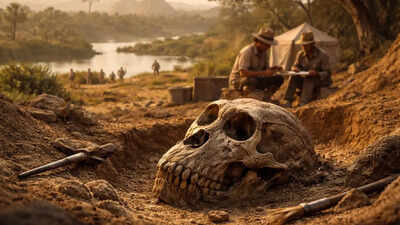
The theory that East Africa was the most likely birthplace of humans has persisted for many years. However, a new discovery from a part of Egypt that has not been extensively studied before raises doubts about this theory.
New evidence shows that early human ancestors may have evolved over a broader geographic area than previously assumed.Such a discovery is important because it sheds light on North Africa, a region that has been largely ignored in research on human origins.
The discovery of fossils in Egypt changes the theory of human origin
The latest discovery comes from a less explored area of Egypt. This discovery is important due to its age and characteristics that link it to primate species that may be related to human evolution.According to a study titled “An Early Miocene Ape from the African-Eurasian Hominin Biogeographic Crossroads,” published in the journal Science, the fossil provides evidence that early ape evolution may not have been limited to East Africa.The fossil suggests that early evolutionary events occurred not only in East Africa, but that regions such as Egypt may also have been responsible for our early history as humans.
Why do scientists say we were looking in the wrong place for human origins?
For years, most research has been done in regions of East Africa, such as Ethiopia and Kenya, where many fossils have been found.
Therefore, one can assume that human evolution occurred in these regions.However, this result shows that studying these regions alone may cause researchers to miss other important regions. Human evolution may have occurred in North Africa, as in Egypt.
What the Egyptian fossil reveals about early human ancestors
The Egyptian fossil bears some features that indicate its relationship to the early primates from which humans descended. The fossil is important because it helps researchers understand evolution and adaptation between different species.The fossil is considered an indicator of movement and migration, as early primates were able to migrate from one place to another.
Forgotten regions like Egypt are now essential to human evolution research
This finding highlights the importance of research in less well-known areas. Places that have not been studied much before may be hiding important information regarding the origin of humanity.Researchers began to venture into other fields to conduct their studies.
Why is this Egyptian discovery important for understanding human evolution?
Beyond simply expanding the fossil record, this discovery changes the way we think about human evolution.
Development is not limited to one area. Rather, it is a complex process that takes into account many different environmental factors.It may change the course of future studies, prompting researchers to explore other areas that have not yet been adequately studied.
A definitive look at human origins and fossil discoveries in Egypt
This result from Egypt shows us that scientific knowledge is constantly evolving. What was once thought to be true can easily become false as more information comes to light.By looking outside the natural places in which humans originated, science gives us a better and more complete understanding of our beginnings.