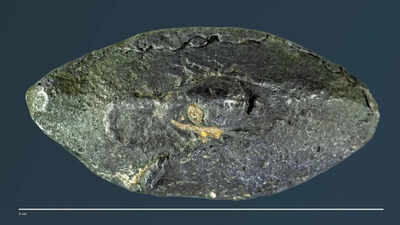
PC: Armstrong Institute for Biblical Archaeology
A small lead projectile discovered in northern Israel offers archaeologists an unexpectedly human glimpse into ancient warfare. The piece itself is small and easy to overlook, but the message engraved on it caught the world’s attention.
Researchers recently revealed that a 2,100-year-old slingshot discovered in the ancient city of Hippos bears the Greek word “learn,” which experts believe was intended to deliver a satirical message targeting enemy forces during a siege.The discovery dates back to the second century BC during the Hellenistic period, a period characterized by wars, the change of kingdoms, and the expansion of Greek influence across the eastern Mediterranean.
Archaeologists say engraved sling bullets are indeed rare finds, but this particular example appears to be one of a kind. Ancient wars are usually remembered for violence and destruction, yet this artifact suggests that soldiers also used humor and sarcasm to taunt their enemies even more than two millennia later, and the message still seems surprisingly modern.
How was the 2,100-year-old bullet found in ancient hippos?
As Fox News Digital reported, the ancient projectile was discovered at Hippos, an archaeological site overlooking the Sea of Galilee in present-day Israel.
During the Hellenistic era, the city was known as Susetta and is said to have served as an important regional settlement before later becoming a major Byzantine centre.Researchers from the University of Haifa examined the artifact after it was discovered near an ancient road beneath the city’s fortifications. Archaeologist Michael Eisenberg, who participated in publishing the findings, explained that the site strongly indicates that the bullet was fired during a military siege.The lead projectile is about 3.2 cm long and currently weighs about 38 grams. Experts believe it originally weighed closer to 45 grams before sustaining impact damage. Visible marks on the surface seem to support the idea that it was actively used in combat rather than simply stored or disposed of.According to researchers, sling bullets like these were considered inexpensive but highly effective weapons during ancient battles.
Soldiers could produce them relatively quickly using stone molds, making them practical ammunition during military campaigns.
A sarcastic message engraved in a 2,100-year-old bullet
The Greek word is said to translate to “learn,” which archaeologists interpret as a sarcastic warning or sarcastic challenge directed at enemy forces.Eisenberg reportedly believes that hippopotamus advocates may have intended the message to mean something similar to “learn your lesson.”
Researchers say this reflects a form of battlefield humor rarely documented with such clarity in archaeology. Although engraved ejector bullets have been discovered before, they are considered uncommon. Some ancient projectiles bore the names of military leaders, cities, or symbolic images intended to intimidate enemies.
Others reportedly offered phrases resembling sarcasm or modern insults.However, experts say this exact wording has never before been found on a slingshot bullet anywhere in the world.
Evidence points to an ancient siege battle
The discovery site provides archaeologists with important clues about the historical context surrounding the shell. The slingshot bullet was discovered near the city’s main old road just below the defensive walls, which researchers say strongly indicates it was fired toward advancing enemy forces.Experts believe that defenders positioned on the fortifications would likely fire shots at the besieging forces approaching the city below. Impact damage visible on the projectile is said to support the reconstruction of the events. These small details are partly why this artifact has attracted so much attention. Historians often study ancient warfare through large events, military campaigns, and political leaders.
However, such discoveries offer a glimpse into the personalities of ordinary people who lived those moments.
Hippos continue to uncover ancient secrets
The archaeological site of Hippos has produced several major discoveries in recent years. Excavations continue there to uncover evidence from various civilisations, including the Hellenistic, Roman and Byzantine periods.