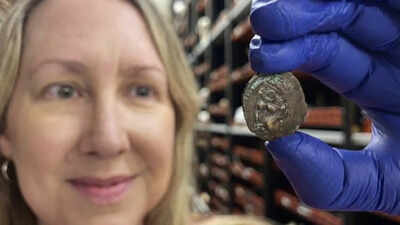
It has now been proven that the small bronze coin that was used to pay for a bus journey in Leeds a few decades ago has a history far deeper than anyone could have imagined. The thing that was initially considered a rather strange item in an employee’s cash desk, in fact turned into a means of payment belonging to an ancient civilization that lived more than two thousand years ago.
This coin was able to remain unnoticed by its owner until it was discovered after being passed from generation to generation within the same family.
Collecting bus fare at Leeds Transport reveals unusual coins
According to the BBC, in the 1950s, James Edwards worked as treasurer for Leeds Transport. His role included collecting fares from bus and tram drivers around the city. However, during these tours, he reportedly found coins that did not belong to him. Instead of throwing them away, keep them aside.
Over time, these coins were passed on to his grandson Peter. For more than 70 years, the collection has remained within the family, quietly maintained without much formal study.
Peter, now 77, eventually became curious about a particular special coin. The signs point to something older, something unfamiliar.His interest led him to investigate its origin. What he discovered was unexpected. The currency was not modern foreign currency at all.
It was associated with the Carthaginians, an ancient civilization with roots in the Phoenician world, and was minted at Cadiz, a historic city in what is now Spain, around the first century BC.
Melqart’s imagery and the cross-cultural design of the coin
Perhaps the most impressive aspect of this coin is the design. The front of the coin shows the face of Melqart, a god who is depicted much like the Greek mythological Heracles, wearing his distinctive lion skin.It seems that such a mixture was not a coincidence. During those times, coins minted in the Phoenician region sometimes used symbols associated with Greek culture to ensure greater appeal among merchants.
The design would have helped determine the origin of the coin in question. Realizing the importance of the find, Peter contacted Leeds Museums and Galleries. The museum has accepted this discovery into its archives for future reference.As the BBC reported, the coin is set to be placed at the Leeds Discovery Centre, where researchers and visitors can learn from it.Peter reportedly felt it was the right decision. He stated that returning the currency to an institution where it could be properly studied gave it a more important future than having it remain in private hands.