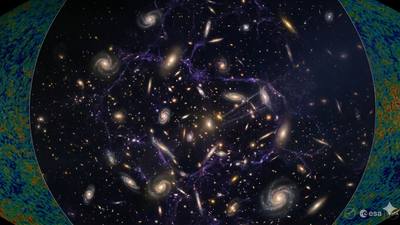
Not only is the universe expanding, but its expansion is actually occurring at a faster speed than was thought until recently. For many years, physicists have been trying to determine the speed of a galaxy’s motion through the Hubble constant.
But the different measurement results have presented a dilemma for modern physics, and there appears to be a contradiction somewhere within our universe. The problem awaiting physicists is known as the Hubble tensor problem, and despite recent discoveries and more detailed observations, it still lacks an explanation.
The secret of the rapid expansion of the universe: observations of scientists
The theory of the expanding universe was first observed in 1929 by Edwin Hubble; However, recent results revealed something else.
The cosmic microwave background from the early universe appears to show a lower expansion rate compared to observations made from nearby galaxies, which showed a higher expansion rate.As mentioned in the article, “Comprehensive Measurement of the Local Value of the Hubble Constant with an Uncertainty of 1 km s-1 Mpc-1 from the Hubble Space Telescope and the SH0ES Team” in Astrophysics, Hubble Space Telescope astronomers report that:“The Hubble constant is now specified with an uncertainty of less than 2.4%, yet discrepancies with early universe predictions persist.”This difference is not small. In fact, the difference between these results is so large that scientists cannot explain this discrepancy through observational error alone.
Why is expansion accelerating?
Dark energy is one such phenomenon, which, according to popular belief, makes up about 68% of the universe and causes the acceleration of the expanding universe. But the exact nature of this entity remains a mystery. The true nature of dark energy is arguably the most important open question in cosmology.It is possible that dark energy depends on time. This theory would solve the puzzle of different expansion rates.
It has been suggested that this invokes some as yet unknown physics.
He could New physics Solve the puzzle?
The conflict between measurements has led scientists to explore ambitious hypotheses. This could include revising Einstein’s general theory of relativity or even the existence of undiscovered matter or forces.Another study in 2020 titled “Planck’s Evidence for a Closed Universe and a Possible Crisis for Cosmology” by Natural Astronomy reported:“If this tension is not due to systematic uncertainties, it could represent a case for new physics beyond the standard cosmological model.”Such ideas have sparked much debate within the scientific community.
There have been attempts to study whether early dark energy or interactions between cosmic elements could solve the problem.However, scientists can use next-generation telescopes and space missions to obtain more accurate data. Projects like the James Webb Space Telescope and future observations can help improve calculations and bring new ideas to the test.In the meantime, the answer to the question remains open. What makes the universe expand so quickly? This question can radically change our perception of the nature of reality.