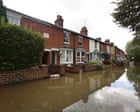
One in nine new homes built in England between 2022 and 2024 will now be built in areas at risk of flooding, according to new data.
Statistics show that the number of homes being built in vulnerable areas is increasing – a previous analysis found that between 2013 and 2022 one in 13 new homes will be in flood prone zones.
The research comes amid huge pressure on the government to provide new affordable housing, amid signs that climate destruction is accelerating.
Data published by insurer Aviva reveals that between 2022 and 2024, 396,602 new homes were registered by Ordinance Survey in England. 43,937 are in medium or high flood risk areas, while 26% of new homes are at risk of flooding.
Emma Howard Boyd, former chairman of the Environment Agency, which advises Aviva on climate policy, said the government’s target of 1.5m homes in this parliament would put pressure to build in areas at high risk of flooding.
She said: “We don’t want to build today’s homes in areas that are at risk of flooding.Defra [the Department for Environment Food and Rural Affairs] And the Ministry of Housing must work together to ensure that our housing targets do not prevent what we know is necessary to protect future and existing homes from flood levels.
Aviva’s data also shows that by 2050, seven (15%) of homes built between 2022 and 2024 will face moderate or high flood risk, and nearly a third (30%) will face flood risk as more intense rainfall is predicted as a result of climate disruption.
Although disputed by Aviva, the government said the analysis did not factor into the flood defenses already in place.
For example, London’s flood defenses urgently need to be updated to protect the city, experts said.
The research comes after a Guardian investigation last year found millions of homes in England, Scotland and Wales were facing catastrophic flooding, and some towns had to be abandoned as the weather breakdown left many areas uninsured.
The analysis revealed the extent of concern in the insurance sector as large areas of housing and commercial property are at high risk.
Aviva’s analysis, which cross-referenced new homes address data and the Environment Agency’s latest assessment of flood risk at constituency level, found that Greater London and Essex had the highest proportion (32%) of properties at new risk. Lincolnshire, East Yorkshire, West and North West are at 13%. The East of England had the lowest proportion of new at-risk homes at 2%.
Some parts of the UK are at risk of being abandoned due to flood risk, with terrace dwellers in Ynysybwl, Wales having their homes bought by the council due to constant flooding. Even the town of Tenbury Wells is slowly being abandoned by its residents as it cannot afford flood insurance.
People living in new buildings have a harder time getting flood insurance. Homes built since 2009 are exempt from the government-backed Flood Reinsurance Scheme, which provides homeowners with affordability and access to flood insurance.
Jason Stora, Chief Executive of UK and Ireland General Insurance at Aviva, said: “As our analysis shows, most new homes are built in high-risk areas. This trend has increased in recent years, just as housebuilding has accelerated.
“Importantly, these homes are not protected by the Flood Re scheme, which excludes homes built after 2009 to prevent more new homes from being put at risk. Sadly, as the study shows, this is not the case.”
Aviva is calling on the government to tighten planning rules to prevent new unsafe homes from being built in flood zones.
Storah added: “We believe planning rules should include a presumption against new developments in high-risk areas, along with mandatory flood resilience measures in building regulations for new homes in at-risk areas. This is particularly important in areas where surface water flooding is prevalent, which is difficult to predict and protect against.”
“In some areas, it’s not a case of when a house will flood.”
Government spokesman said.. “These figures are misleading because the research does not even factor in flood defences. We will build 1.5 million homes without compromising safety and our planning proposals will ensure that development does not take place where it is unsafe due to flood risk. It will invest a record £10.5 billion and almost £20.5 billion in assets for flood projects by 2090.
The new data coincides with calls from the UK’s main insurance trade body for the government to take urgent action amid rising flood claims and payments to homeowners devastated by rising waters.
The latest data for 2025 is given by P Published by the Association of British Insurers, the cost of domestic flood claims rose by 38% last year to £312m. Meanwhile, the average flood payment for a home owner has risen by 60%, hitting £30,000.
Overall, over the year, insurers paid £1.2bn in weather-related property claims: an increase of 14% (£142m) in 2024.
Chris Bose, director of general insurance policy at ABI, said: “Government action is essential to protect communities from the increasing impact of extreme weather. This includes stronger planning rules to stop building in high-risk flood areas and design homes with resilience in mind.”
Additional reporting by Rupert Jones