

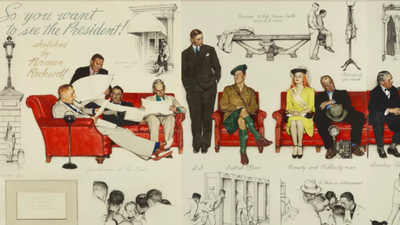
Norman Rockwell’s 1943 masterpiece, so you want to see the President! Now on public display in Washington, DC
One of Norman Rockwell’s most iconic works is presented to the public for the first time, bringing together a fascinating blend of American history, courtroom drama, and unlikely wartime romance.
The four-panel painting, So Want to See the President!, was created in 1943 to depict life inside the White House during World War II. For decades, it hung in a private home and then inside the White House, before becoming the center of a long dispute over ownership. After being purchased for a record $7.25 million in 2025, the artwork is now on display at The People’s House: A White House Experience in Washington, DC.
Where visitors can view it until June 2027.
The story behind Norman Rockwell’s painting of the White House
Norman Rockwell created So You Want to See the President! for The Saturday Evening Post in November 1943 after receiving a commission from President Franklin D. Roosevelt’s longtime press secretary, Stephen T. Early. Instead of making Roosevelt the main focus, Rockwell photographed the diverse crowd waiting outside the Oval Office, including journalists, military officers, Secret Service agents, Miss America, and ordinary citizens.
Roosevelt appears only in a small sketch in the final panel, reinforcing the message that he remained accessible to the American public even in wartime.Before completing the final painting, Rockwell spent some time inside the West Wing observing visitors and making detailed drawings. However, disaster struck in May 1943 when a fire destroyed his studio in Vermont, erasing almost all of his drawings and reference photographs for the project.
Rockwell wrote to the White House requesting permission to return and repeat the operation. The request was granted, allowing him to recreate the artwork from scratch before eventually publishing it later that year.
War details hidden throughout the painting
The artwork offers a unique glimpse into the atmosphere inside the White House during World War II. Among its many carefully observed details is a gas mask hanging next to a coat rack labeled “President’s Gas Mask,” reflecting the security concerns of the era.
Rockwell’s distinctive attention to everyday moments and human expression helped transform The Waiting Room into a vivid snapshot of America during one of its most challenging periods.
The mystery surrounding Miss America
One of the most controversial figures in the painting is Miss America. The White House Historical Association identifies the woman as Rosemary Laplanche, who won the title of Miss America in 1941. However, the family of Miss Washington Mary McIntyre says Rockwell used her as a model for the character.
According to her son, Rockwell changed several details in the finished artwork, changing her hand-patterned dress to yellow and her blonde hair to red, demonstrating the artist’s creative license rather than producing an accurate image.
How the painting inspired a World War II romance
Illustration also played an unexpected role in creating a lifelong love story. Among the people who appeared was Navy WAVES member Eloise English, although Rockwell changed the color of her uniform from navy blue to white in the final panel.
After the artwork appeared in The Saturday Evening Post, fighter pilot Thomas Davies discovered Eloise in the magazine while serving during World War II. Determined to find her after returning home, he eventually did, and they married.
Their marriage lasted 46 years, making Rockwell’s drawing the unlikely beginning of a true love story.
A property dispute that ended in court
Rockwell gifted the original paintings to Stephen T. Early, the White House press secretary who commissioned them.
After Early’s death, the artwork remained with his family for decades and was displayed inside the White House from 1978 until 2022. However, disputes over ownership eventually led to a legal battle between family members. In 2025, a federal appeals court upheld a ruling declaring Early’s grandson, William Elam III, the sole owner of the paintings, ending the long dispute.After gaining legal ownership, William Elam III decided to sell the paintings at public auction.
In November 2025, the White House Historical Association acquired the four-panel artwork for $7.25 million through Heritage Auctions. This became the most expensive acquisition in the association’s history, ensuring that the historical paintings remain accessible to the public rather than disappearing into a private collection.
Where can you see it now?
The paintings are now on display at The People’s House: A White House Experience, an interactive museum located just one block from the White House in Washington, D.C. The exhibit opened on June 25, 2026, and is scheduled to run until June 2027 as part of the celebrations of America’s 250th anniversary. Visitors can view Rockwell’s rare masterpiece for free, although advance reservations are recommended.