

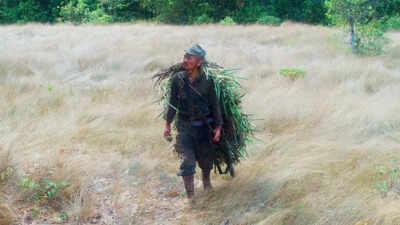
War does not always end when history says it does. In some cases, it remains in the minds of those still fighting it. Deep in the jungles of the Philippines, a Japanese soldier continued a war that had officially ended decades earlier.
His name was Hiroo Onoda, and his story remains one of the strangest and most controversial legacies of World War II.For nearly 30 years, Onoda remained hidden on Lubang Island, convinced that the war was not over. Despite repeated attempts to inform him, he believes it is all a scam. His experience continues to raise questions about loyalty, faith, and how far a person can go when they refuse to accept reality.
Hiroo Onoda’s mission to Lubang Island during World War II
Onoda was sent to Lubang Island in December 1944 during the final phase of the war.
He was trained in guerrilla tactics and intelligence work, which made him different from many other soldiers. His orders were clear and unusual. He was told not to surrender and not to kill himself under any circumstances.His mission included destroying the island’s airport and port facilities to disrupt enemy operations. However, he failed to achieve these goals before American forces took control of the island.
As the situation worsened, Onoda and a few of his fellow soldiers retreated into the forest, where they would remain long after the war officially ended.
Why did Hiroo Onoda believe that World War II would never end?
When Japan surrendered in August 1945, leaflets were dropped across Lubang Island to inform any remaining soldiers. Onoda saw these messages but dismissed them as enemy propaganda. He believed that the United States was trying to trick him into surrendering. Over time, this disbelief turned into a fixed mindset.
Reports indicate that even the newspapers and family photos sent to impress him were considered fake.
Planes flying overhead during the Korean War were interpreted as signs that Japan was still fighting. Onoda seems to gradually become trapped in his own interpretation of reality, unable to accept anything that contradicts his original orders.
Hiroo Onoda’s survival in the forest and the controversy surrounding his actions
Living in the jungle was an extremely difficult experience for Onoda and his men, as they lived on bananas, coconuts, and rice, which they obtained by raiding local villages.
As a result, they always had to move to avoid capture, which also led to constant fear. Gradually, the group became smaller, with Onoda’s companion surrendering in 1950, while other members were killed in battles with local residents or died due to their difficult lifestyle.
However, throughout his time in the forest, there were violent confrontations with local communities, with Onoda and his fellow soldiers apparently killing at least 30 people over the years.
How Hiroo Onoda finally surrendered after 30 years in hiding
In 1974, a young Japanese adventurer named Norio Suzuki traveled to Lubang Island in search of Onoda. Surprisingly, he was able to find him and talk to him directly. Suzuki explained that the war had long ended, but Onoda refused to surrender. He insisted that he would only follow the orders of his original commander.Suzuki returned to Japan and found that officer, who then traveled to Lubang Island.
On March 9, 1974, nearly 30 years after the war’s end, Onoda finally received the order to step down. Only then did he give up.
Hiroo Onoda’s return to Japan and debate over his legacy
When Onoda returned to Japan, he received a hero’s welcome from many people who admired his dedication and loyalty. Onoda’s book became very popular, and his story reached a global audience.On the other hand, there is controversy over Onoda’s legacy as well. While some people believe that Onoda was just another victim of military propaganda, others see him as an example of fanatical nationalism. There is also criticism regarding the violence committed by Onoda and his followers while they were hiding on Lubang Island.