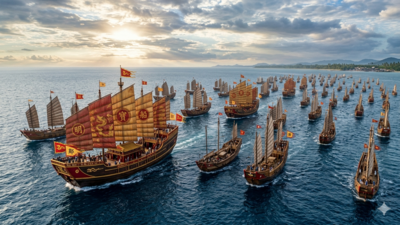
By the beginning of the fifteenth century, China had the most powerful navy ever. This fleet, known as the Treasure Fleet, was under the command of Admiral Zheng He and made voyages to the Indian Ocean, traveling to East Africa and even the Middle East.
It was a clear indication of the Chinese dominance of technology, economics and international relations before the emergence of European empires. However, by the beginning of the 16th century, around 1525, the treasure fleet had been disbanded, and the Chinese began to look inward.
rise Chinese treasure fleet
The treasure fleet of the Ming Dynasty was impressive both technologically and in terms of organization. Between 1405 and 1433, Admiral Zheng He led seven expeditions involving hundreds of ships and tens of thousands of sailors.
The Chinese fleet includes the largest wooden ships ever built.These campaigns were not aimed at conquest but at diplomacy, trade, and expanding influence. Dr. Sam Willis, on the Marine Research Society podcast with Professor Tim Brook, a historian of China at the University of British Columbia:“Zheng He’s sea voyages confirmed China’s superiority at sea.”By then, China was perhaps the most powerful country in terms of naval power and economy, surpassing contemporary European countries.
Why was the treasure fleet abandoned?
Despite the fleet’s success, it ended suddenly. Politics in the Ming court became an influential factor. Confucian bureaucrats felt that such explorations were frivolous and immoral and preferred to focus on agricultural stability rather than trade.After Zheng He’s death, expeditions were considered extravagant and unnecessary and support for them quickly faded.By the 1620s, China severely restricted maritime trade, reduced shipbuilding, and even destroyed documents relating to voyages.
In this way, China has distanced itself from global affairs. At the same time, Europe actively expanded the seas.
A historical mistake that changed world power
According to many historians, China’s abandonment of treasure fleets opened the way for European dominance in exploration and trade. According to Kenneth Pomeranz in his book The Big Difference:“The halting of Chinese naval expansion has offered potential advantages that European powers will soon benefit from.”While China was withdrawing from the sea, other countries such as Portugal and Spain were expanding, ultimately transforming global trade relations. It is very important because it was only a few decades before European explorers formed their own overseas empire.The Ming’s decision not to undertake further extensive naval expeditions led to the reduction of the naval prominence in the Indian Ocean. By continuing the Treasure Fleet, China will be able to control global exploration, transform trade, colonization, and cultural exchange around the world.
Lessons from the Chinese treasure fleet
The story of the Chinese Treasure Fleet is much more than just the voyage itself; It is a story of missed opportunities. In an era when China was leading the way as a world superpower, it decided to isolate rather than grow. This shift changed the course of history by giving others the opportunity to take the lead where China had failed.Contemporary scholars now recognize this event as a valuable case study for future decision-making processes. Ostracizing innovation and the rest of the world can have long-term repercussions.