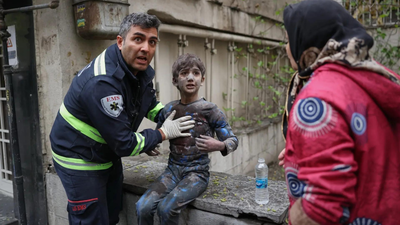
A medic helps an injured boy following a strike that hit an apartment building amid the US-Israeli military campaign in Tehran, Iran, Saturday (AP)
With no end in sight, Yemen’s Houthis, the latest participants in the US-Israel war with Iran, carried out a “second military operation” against Israel on Sunday, as part of the “battle of holy jihad”.A statement by the military spokesman for the Houthis, Yahya Saree, said: “The forces carried out the second military operation in the ‘Battle of Holy Jihad’ with a barrage of cruise missiles and drones targeting a number of vital and military sites belonging to the Zionist enemy in southern occupied Palestine. This operation coincided with the military operations carried out by our mujahideen brothers in Iran and Hezbollah in Lebanon, and it successfully achieved its goals, thanks to God.”
He watches
“Nuclear alert…”: The Houthis join the Iran war, and fire a missile at an Israeli nuclear site in the first fatal strike
This came just one day after the Iran-backed group officially entered the regional conflict. It said in the statement that it carried out its first military strike on Israeli military targets using a barrage of ballistic missiles, adding that the attack was carried out in coordination with allied forces in Iran and Lebanon.Their participation indicates the scope of the conflict is expanding beyond the direct confrontation between Iran, the United States and Israel, raising fears of a multi-front war extending across the Middle East.
The Houthis pledged to continue operations until what they describe as “aggression” on all fronts ends, indicating a continued escalation rather than a one-time intervention.At the same time, the United States is strengthening its military presence in the region. Thousands of Marines have already begun arriving, and additional forces are expected to be deployed, including troops from the 82nd Airborne Division. While US Secretary of State Marco Rubio said Washington hopes to end operations within weeks and can achieve its goals without a ground war, the buildup is intended to provide maximum strategic flexibility – highlighting uncertainty about how the conflict will develop.Diplomatic efforts appear to be struggling to keep pace with military developments. Iranian President Masoud Pezeshkian has participated in regional outreach, including holding talks with Pakistani Prime Minister Shahbaz Sharif, while Islamabad is scheduled to host talks with the Turkish and Saudi foreign ministers aimed at easing tensions. However, there is little sign of an imminent breakthrough.The war, sparked by US and Israeli strikes on Iran in late February, has already spread across the region, causing massive casualties and severely disrupting global energy supplies.