
The El Niño phenomenon is expected to intensify (AFP)
The World Meteorological Organization warned, in a press release on Friday, that the El Niño phenomenon has officially developed in the tropical Pacific region, and is expected to intensify rapidly over the next few months.According to the United Nations weather and climate agency, El Niño will intensify into a strong event between July and September 2026, with sea surface temperatures in the central and eastern tropical Pacific Ocean expected to exceed 2 degrees Celsius above average in key observing areas.High risk of heat waves, drought and heavy rainsWMO Secretary-General Celeste Saulo warned that the emerging El Niño phenomenon is likely to exacerbate extreme weather events in many regions.
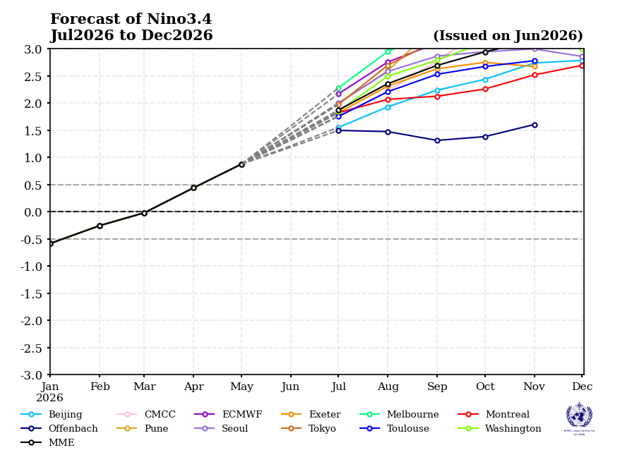
The El Niño phenomenon is expected to intensify (World Meteorological Organization)
He added: “This will intensify the chances of drought and heavy rainfall and increase the risk of heat waves on land and sea in many regions of the world.”The organization said it has launched a coordinated global effort involving UN agencies, governments, humanitarian organizations and climate-sensitive sectors such as agriculture and health to strengthen seasonal forecasts, climate services and early warning systems.
What areas could be affected?Agency forecasts:
- Below normal rainfall in parts of the Indian subcontinent, much of Australia and parts of the tropical Indian Ocean.
- Above normal rainfall over the central and eastern tropical Pacific Ocean and parts of the northern Gulf of Guinea in Africa.
- Increased chances of below-normal rainfall in the greater Horn of Africa, parts of Central America, the Caribbean, and northwest South America.
- There is a contrasting pattern in Europe, with conditions likely to be wetter than average in the south and drier conditions in the north, although confidence remains relatively low.
Meanwhile, ocean temperatures are also expected to be warmer than average across the Indian Ocean and tropical Atlantic Ocean.What is the El Niño phenomenon?El Niño is the warm phase of the El Niño-Southern Oscillation (ENSO), a naturally occurring weather pattern resulting from unusually warm sea surface temperatures in the central and eastern tropical Pacific Ocean. It usually develops every two to seven years, lasts nine to twelve months, and is one of the world’s strongest drivers of climate variability from year to year.Their impacts vary depending on their intensity and interaction with other climate systems, such as the Indian Ocean Dipole, meaning that not every region experiences the same impacts.