Portuguese voters will return to the polls on Sunday for the final round of a presidential election marked by a far-right candidate being shunned and cast in the shadows. Deadly storms shook the country In recent days.
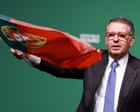
The right-wing candidate is Antonio José Seguro He won the first round of electionsheld on January 18, received 31.1% of the vote.
Andre Ventura, leader of the far-right party – now Second largest party in Parliament – With 23.5% of the vote, Jono Cotrim de Figueiredo of the conservative pro-business Liberal Initiative Party came third with 16% of the 11 candidates. Luis Marques Mendes, candidate of Portugal’s ruling Social Democratic Party (PSD), finished fifth with 11.3% of the vote.
Before the campaign was officially interrupted by two deadly and destructive hurricanes, some conservative figures in the country announced their support for Seguro in a rare show of apparent unity in an effort to thwart the far-right’s presidential bid. Others, including Portugal’s center-right Prime Minister Luis Montenegro, refused to throw their weight behind the socialist.
Polls show voters are also rallying around Seguro. According to a survey released late Tuesday by Cattolica University pollsters, the Socialist candidate has 67% to Ventura’s 33%.
If the polls prove accurate, Seguro will receive the highest result for a first-time presidential candidate in the five decades since Portugal ended its authoritarian rule.
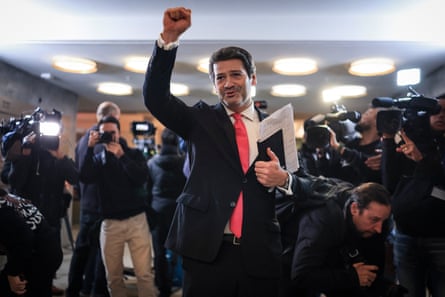
But if Ventura gets more than 32% of the vote, Chega could win a larger share of the vote than the ruling PSD. Last General Election. Analysts say that this will be the beginning of another political waterfall. “Andre Ventura’s percentage and his ability to mobilize right-wing voters is an ongoing problem,” said Antonio Costa Pinto, a political scientist at Lisbon University’s Institute of Social Sciences.
“The important thing to watch on Sunday night is whether Chega’s leader can overcome Montenegro’s vote share. If so – and as polls suggest – Ventura will strengthen his project to cannibalize Portugal’s right-wing space.”
Among those who announced their support for Seguro were two centrist politicians – former president and prime minister Anibal Cavaco Silva and former deputy prime minister Paulo Portas.
Politicians, former ministers, public intellectuals and others who identify themselves as “non-socialists” signed an open letter endorsing Seguro with more than 6,600 signatures.
Other conservative figures who supported Seguro did so reluctantly. Carlos Moidas, Lisbon’s centre-right mayor, told Portuguese publication Expresso that he would cast his vote for Seguro because the Socialist candidate was “undividedly capable”. But he said his support was “encouraging”.
Liberal Initiative Party leader Mariana Leitao also said Seguro would “enthusiastically” get her vote.
Montenegro, who leads the PSD, has announced that he will not endorse any candidate for the runoff and that his party will stay out of the campaign.
Cotrim de Figueiredo, whose first-round performance exceeded expectations, refrained from clearly backing the center-left candidate, but said he would not vote for Ventura, abstain or cast a blank ballot.
Montenegro’s refusal to choose a side has been criticized by many political figures and commentators in Portugal. “In light of Ventura’s threat to the foundations of the regime, some social-democratic sectors see the prime ministership as cowardice,” said Miguel Carvalho, author of Por Dentro do Chega (Inside Chega).
He said the prime minister’s neutrality, tied to his government’s legislative concessions to Chega, would come back to haunt him: “Montenegro’s decision will remain a dark memory of the PSD and open the door to Ventura’s consolidation as a rightist leader in Portugal.”
But, as Carvalho also pointed out, Montenegro and Cotrim de Figueiredo may have held their own as they remembered that the “apparent unity” of conservatives around Seguro actually benefited Ventura. “This reinforces Ventura’s claim that he is an anti-establishment candidate,” he said.
Segu For all the media attention that Roque has received from conservatives, experts say it may not be of much consequence. “The truth is, those traditional names are not very important,” Costa Pinto said. “The current elites in the Social Democratic and Liberal Initiative parties know better, and they know that reality has changed. Chega virtually beheaded those historically recognizable figures.”
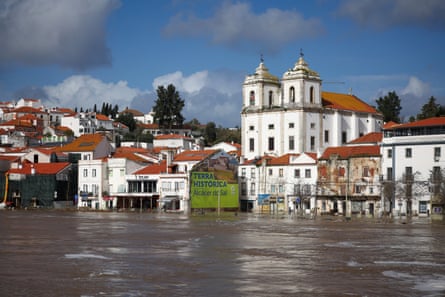
Campaigning for the second round of elections was cut short by two major storms, prompting a state of calamity declaration that was extended until February 15. Ventura called for the vote to be delayed by a week, calling it “equality among all Portuguese”.
The National Electoral Authority said voting would continue as scheduled: “A state of calamity, weather warnings or overall unfavorable conditions are not sufficient grounds for postponing voting in a town or region.”
However, the Electoral Act allows individual municipalities to postpone voting.
Although the storms caused a “devastating crisis”, Montenegro said barriers to voting could be overcome.