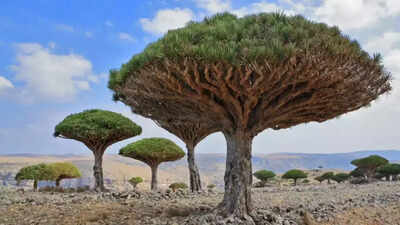
The Socotra Archipelago, located in the Indian Ocean, is referred to as the most unusual place on Earth due to its strange, long-lost and bizarre features. The Socotra Archipelago was separated from the African mainland 18 million years ago and has evolved into an evolutionary laboratory due to its isolation.
UNESCO reports that approximately 37 percent of its 825 flowering plants are endemic, meaning they are found only on Socotra and nowhere else in the world. The dragon’s blood tree is the most famous plant found in Socotra. This plant has an umbrella-shaped canopy that collects water from the fog that forms on mountain peaks. Hence, it is an evolutionary marvel. In addition to the unique biology of the Socotra Archipelago, the IUCN World Heritage Prospects state that Socotra is considered the “Galapagos Islands of the Indian Ocean” and is contrary to the natural norms of nature.
The reason why Socotra is called the most unusual place on earth
Socotra is called the most unusual place on Earth primarily because the geology of this island has undergone extreme changes over millions of years. The islands that make up Socotra today were originally part of the former supercontinent known as Gondwana. They separated from the supercontinent Gondwana during the Miocene epoch (about 18 million years ago), creating a biological time capsule in the Indian Ocean.
According to the paper published on the ResearchGate website, Socotra is a “continental part”, not an island formed as a result of a volcanic process, like most other islands, and has been a landmass separated from Africa for approximately eighteen million years. The millions of years that Socotra remained isolated from the African continent have demonstrated the power of new species. Since the island was effectively separated from the mainland by tectonic shifts, its flora and fauna were forced to adapt to Socotra’s unique limestone plateaus and semi-desert climate in complete isolation from their African ancestors.
What makes Socotra famous?
According to the World Heritage Data Sheet of the United Nations Environment Program and the World Conservation Monitoring Centre, trees are the most recognizable inhabitants of this island, which looks like something out of a science fiction novel. Dragon’s Blood Tree (Scientific name: Dracaena cinnabari): It has a unique canopy shape developed through evolution to provide shade to the roots while capturing moisture from mountain mist in a dry, dry climate.The Socotra bottle tree (scientific name: Adenium obesum subsp. socotranum): It is more commonly called the desert flower. They have large, swollen trunks that hold large amounts of water throughout the year.
As a result, it produces beautiful pink flowers at all times, even during periods of extreme drought.
“Galapagos Islands in the Indian Ocean”
Socotra Island is often likened to the Galapagos Islands by the International Union for Conservation of Nature (IUCN) and the United Nations Educational, Scientific and Cultural Organization (UNESCO) due to the great diversity and number of endemic species it supports.According to the World Heritage Data Sheet from the United Nations Environment Programme’s World Conservation Monitoring Centre, Socotra is home to an astonishing array of organisms found nowhere else: 37% of plants; 90% of reptiles; 95% of land snails.The Socotra starling and the Socotra sunbird are two species that serve as important biological indicators of the overall health of the island’s ecosystems.
What are the challenges of conservation?
Although the island seems strange, the threats it faces have a lot to do with this world. Climate change and changes in the way local people use their land threaten this ‘living museum’ of great ecological importance. Increasing amounts of heavy rainfall from cyclones in the Indian Ocean will have a devastating impact on the already slow-growing dragon’s blood forests.Organizations such as the International Union for Conservation of Nature (IUCN) work with local community members to help them continue to meet modern needs while ensuring that remaining elements of the UNESCO World Heritage Site, listed in 2008, are preserved.