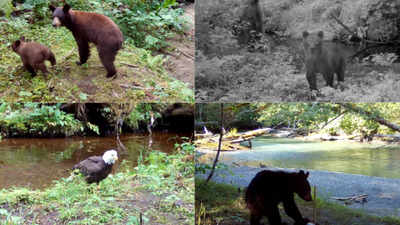
Caption: Top left: A cinnamon black bear and her cub running away. Above right: Brown bears on alert after hearing the sound of engines from a vehicle off the highway. Bottom left: A bald eagle eats a fresh meal from the nearby creek, ignoring the control sounds of the gull’s calls. Bottom right: The black bear continues to eat salmon, ignoring the sound of gull calls at the observation site.
Playing recorded human sounds near Alaska’s salmon streams sends bears and eagles on the run, disrupting the natural process that carries important marine nutrients deep into nearby forests.A series of experiments conducted by the Pacific Northwest Research Station in the Hin Latin Experimental Forest near Juneau, Alaska, found that even the sound of human activity changes when and where wildlife searches for food. As important predators help move nutrients through forest ecosystems, their response to human sounds changes as key nutrients such as nitrogen are left behind.This US research matches a large Canadian study published in the journal Ecology & Evolution.
Led by Dr. Megan Adams of the University of Victoria and the Raincoast Conservation Foundation, the Canadian team studied 226 grizzly bears across 22 watersheds in British Columbia. They found that human activity in river valleys significantly reduces the amount of salmon eaten by bears, even in areas with very limited industrial development.Together, the studies show that human activity can alter natural relationships that help maintain the health of temperate rainforests.
Alaska’s audio experience
To understand how human sounds affect wildlife, Philip Manlick, a research ecologist at the Pacific Northwest Research Station, placed motion-activated cameras and speakers along the banks of an Alaskan river. Speakers played recordings of off-road vehicles, people talking, and natural seabird sounds for comparison. The researchers also placed salmon nearby to attract predators.Cameras recorded hundreds of visits from bald eagles, crows, black bears and brown bears.
The results showed that the animals were more likely to flee from vehicle sounds off the highway compared to natural sounds. They were approximately ten times more likely to flee when they heard human voices.In places with human disturbance, predators change their behavior. They took fewer salmon from the streams and moved much of their feeding activity to night to avoid people.
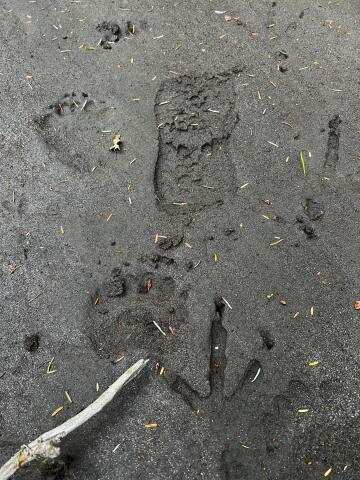
Footprints of bears, eagles and humans in the mud next to a stream in Hin Latini Experimental Forest, Alaska. Jungle (service photo by Philip Manelik)
In a healthy, quiet forest, bears catch salmon and carry them inland.
When salmon are abundant, bears eat only the rich parts of the fish, such as the brains, skin, and eggs, and leave the rest of the carcasses on the forest floor. These remains, along with bear droppings, decompose and release nitrogen, which acts as a natural fertilizer for trees and plants. By driving predators away from streams or forcing them to feed at night, human noise changes where and when these important nutrients enter the forest.
Impact on Canadian Grizzlies
Further south in British Columbia, Dr. Adams and her team have studied the long-term effects of human activity on this same relationship. Using chemical evidence from grizzly bear hair collected between 1995 and 2014, the researchers studied salmon consumption across an area of 88,000 square kilometres.They found that human structures and activities in river valleys, primarily linked to industrial resource development, had a stronger impact on the bears’ diet than the number of salmon available in the rivers.
When human activity was present near streams, female grizzly bears reduced their salmon intake by up to 59 percent.The researchers explained that bears avoid these important feeding areas when they feel that the risk of human activity is too high. Less food can have serious effects, including smaller litter sizes and fewer grizzly bears in the population. It also means fewer bears are available to carry salmon feeders into the forest.“Canyon bottoms are very important travel corridors and feeding areas for bears, but they are also places where human disturbance is often concentrated,” Adams said. “We need to consider how our activities, whether changing the landscape in the valley or reducing salmon populations in the ocean, impact the important relationship between bears and salmon.”
Protect forests while sharing land
The growth of industrial development since 2020 has increased pressure on wilderness areas.
Existing protections near watercourses do not completely prevent these disturbances, leading scientists to call for stronger land management.In British Columbia, researchers working with the Kitasoo Xai’xai Forest Stewardship are already using these findings to improve forest policies.“This is the first work to investigate the relationship between land disturbances and the relationship between bear and salmon in the Kitasu Chixis Territory and the Great Bear Rainforest,” the researchers said.
“Because bears are of great cultural and economic importance to the Kitasoo Xai’xai Nation, this research helps guide a more nuanced approach to land planning.”
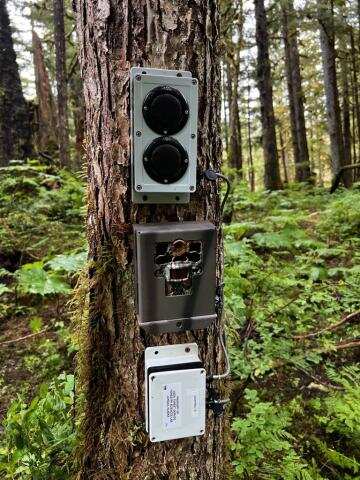
Acoustic camera system used to record animals’ reactions to various sounds in riparian areas of the Hin Latin Experimental Forest, Alaska (Forest Service photo by Philip Manlick)
Scientists say simple protection zones along rivers may not be enough. They recommend larger protected areas and seasonal restrictions, such as closing land routes during the peak salmon breeding season in the fall.According to Manelik, the goal is not to prevent people from entering forests completely, but to create a balance that allows ecosystems to remain healthy. Planning tourist routes and industrial areas while protecting quiet spaces can give wildlife the space they need to feed naturally. The goal is to protect local recreation and economies while preserving areas where bears “can be.”