

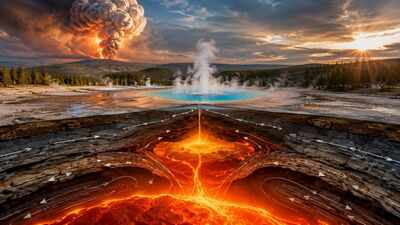
For decades, Yellowstone has been considered one of the clearest examples of a volcanic system fueled by a massive plume of hot rock rising from deep within the Earth. This image has shaped scientific thinking about why the region remains volcanically active and how its future might unfold.
But a recently published study offers a different explanation. Rather than relying primarily on the deep mantle plume, the research argues that movements within the Earth’s crust and the gradual reshaping of the North American continent may be responsible for much of the heavy lifting. While this debate has not yet been settled, the results add another layer to scientists’ understanding of one of the most closely monitored volcanic regions on the planet.
They also suggest that Yellowstone’s underground plumbing could be more closely linked to long-term tectonic forces than previously assumed.
Yellowstone Volcano: The Mystery Behind Its Hidden Magma System
Yellowstone National Park sits atop one of the largest active volcanic systems in the world. Beneath its forests, rivers and famous hot springs lies a vast network of molten or partially molten rock that has produced three massive eruptions over the past 2.1 million years. The study published in the journal Science, titled “The Tectonic Origin of Yellowstone’s Magma Plumbing System,” reveals the most recent of those events, about 631,000 years ago, which created the vast Yellowstone caldera, a depression extending about 50 kilometers.
Although the surface landscape has been studied for generations, the processes taking place deep within the Earth remain surprisingly uncertain. The central question has always been clear and straightforward: Where does the heat that sustains Yellowstone’s magma come from?Many geologists favored the idea of a mantle plume, describing it as a column of unusually hot material rising from great depths within the Earth.
Others have suggested that the answer lies much closer to the surface, where pressures within the crust and upper mantle provide enough energy to keep magma moving and accumulating.
How a 3D model reshaped scientists’ view of Yellowstone
Instead of starting with the assumption of a deep plume, the research team built a detailed 3D computer model that recreated millions of years of geological change across western North America. The model combines information about ancient plate movements, the current structure of the mantle beneath Yellowstone and the properties of the lithosphere, the planet’s solid outer shell that includes the crust and upper mantle.When these pieces were put together, a different picture emerged. Rather than acting as a simple vertical pipeline carrying hot material up from deep within the Earth, Yellowstone’s volcanic tubes appeared to be shaped by large-scale forces that stretched and bent the continent itself. According to the researchers, those tectonic forces could be enough to maintain magma reservoirs beneath Yellowstone without needing a classic mantle plume to provide heat.
How shifting tectonic plates could drive volcanic activity in Yellowstone
The proposed explanation centers on two separate geological processes occurring beneath North America. Parts of the lithosphere beneath Yellowstone vary in density. Some sections are heavier than others, creating pressures that slowly pull the outer crust westward toward the Pacific Rim. The movement occurs over enormous timescales and at speeds too slow for people to notice, yet it constantly changes the shape of the crust.
Meanwhile, remnants of the ancient Farallon tectonic plate continue to sink deep beneath the continent. When this ancient slab descends, it pulls down on the lower part of the lithosphere, subtly tilting the underground structure beneath Yellowstone.Instead of working together, these processes go in different directions. Their combined effect gradually opens pathways beneath Yellowstone that allow magma to ascend into the volcanic system, researchers say.
New research sheds light on Yellowstone’s hidden magma pathway
Independent volcanologists say this work provides a possible explanation for something that has puzzled scientists for years.Previous geophysical investigations have indicated that the magma feeding Yellowstone begins southwest of the volcanic complex within the upper mantle before migrating northeast below the caldera. What remains uncertain is why she followed this route instead of traveling elsewhere. New modeling suggests that the evolving shape of the lithosphere naturally directs magma along this path.
If this is correct, it links previous observations to a broader geological mechanism rather than treating magma movement as an isolated process.Scientists who were not involved in the research described the study as an important contribution, while also recognizing that the deep structure of Yellowstone Harbor remains an active area of investigation.
What it could mean for future volcanic activity
Understanding how magma moves beneath Yellowstone is more than just an academic exercise.
It affects how scientists model future volcanic behavior and interpret changes detected through monitoring earthquakes, ground deformation, and geothermal activity.If tectonic forces play a larger role than previously thought, future models of Yellowstone’s evolution will need to take into account the changing shape of the crust as well as the distribution of heat underground.The area itself continues to develop. Over millions of years, volcanic activity gradually moved across the landscape as the North American Plate moved. Geological evidence suggests that the volcanic system would eventually encounter cooler, thicker, and mechanically stronger crust to the east than the relatively warm and thin crust found beneath Yellowstone today.