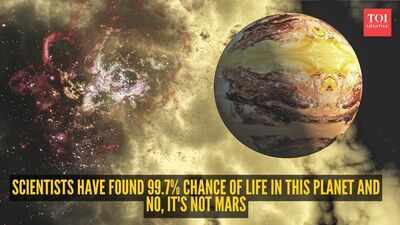
Representative image (Image: Canva)
Scientists have found perhaps the strongest hint yet that life could exist beyond Earth, and the focus is not on Mars but on a distant planet called K2-18b. Results from the 2025 James Webb Space Telescope indicate the presence of gases on Earth associated with biological activity, but the discovery is still preliminary and uncertain as life.
What was found
Researchers studying K2-18b’s atmosphere have reported signs of dimethyl sulfide, or DMS, and dimethyl disulfide, or DMDS. On land, these gases are associated with simple organisms, especially marine microbes such as phytoplankton. Professor Nico Madhusudan, the lead researcher, told the BBC: “This is the strongest evidence yet that life may exist there. I can realistically say that we can confirm this signal within one to two years.
The amount we estimate of this gas in the atmosphere is thousands of times higher than what we have on Earth. So, if the link to life is real, this planet would be teeming with life… If we confirm life on K2-18b, that should basically confirm that life is very common in the galaxy,” He told the BBC.But the signal was reported at a 99.7% confidence level, which is strong, but still not enough to claim a scientific discovery, according to reports.
The 99.7% figure sounds impressive, but it still leaves a 0.3% chance that the result is just statistical luck. Scientists want a much stronger threshold, often described as five sigma, before treating a result as certain. Even so, researchers say the presence of gases would not automatically prove life, because non-biological explanations remain possible.“They are produced on Earth by microorganisms in the ocean, but even with perfect data we cannot say for sure that this has a biological origin on an alien world because a lot of strange things happen in the universe and we do not know what other geological activity could be going on on this planet that might produce the molecules.” In 2025, Professor Catherine Heymans of the University of Edinburgh and Astronomer Royal Scotland, independent of the research team, told the BBC.
Why K2-18b matters
K2-18b is located about 124 light-years away in the constellation Leo, and is classified as an exoplanet of Neptune. It is much larger than Earth and orbits its star in the habitable zone, where liquid water likely exists. This makes it one of the most closely monitored planets in the search for alien life, according to reports.The planet has also been discussed as a possible Hessian world, a theoretical class of planets with a hydrogen-rich atmosphere and an ocean of liquid water underneath.
Webb’s previous observations had found methane and carbon dioxide, fueling interest in the planet as a habitable environment. Supporters of the new findings say the full set of observations is more consistent with a world that could support microbial life.
Why are scientists cautious?

Despite the excitement, independent scientists urge restraint. One reason is that astronomers read very faint signals of light passing through a distant atmosphere, making them difficult to interpret.
Another reason is that scientists still don’t know whether some non-living chemical processes can produce the same gases under K2-18b-like conditions.There is also controversy about the planet itself. Some researchers believe it may contain a vast ocean beneath its atmosphere, while others theorize it could be a world of molten rock or even a small gas giant without a surface. This means that the scientific argument is still about the atmosphere and the structure of the planet.
The biggest question
The most important story here is not the existence of a confirmed alien world full of life, but how far astronomy has come. For the first time, scientists are using existing space telescopes to search for potential biosignatures on distant planets, which some researchers describe as the beginning of a new era in astrobiology. This is why the result has attracted so much attention even though it is not final.In simple terms, the message is this: K2-18b is one of the most promising places so far in the search for extraterrestrial life, but it is not proof. The evidence is interesting, the debate is serious, and the next few observations could decide whether this becomes a historic achievement or just another failure.