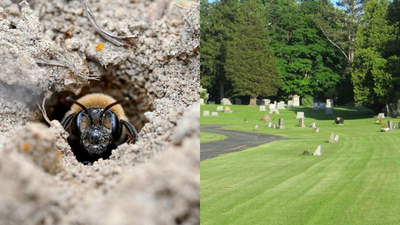
What appears to be an ordinary cemetery in upstate New York turns out to be home to one of the most notable pollinator discoveries in recent years. Researchers from Cornell University have discovered an estimated 5.5 million bees living under the East Lawn Cemetery in Ithaca, New York.
The massive population of native underground bees may have occupied the site for more than a century, surviving thanks to undisturbed soil and favorable nesting conditions. Scientists say this discovery highlights the importance of protecting overlooked habitats and could provide valuable evidence for conserving vulnerable pollinator populations that face increasing threats from habitat loss, pesticides and climate change.
The hidden city of bees under the New York cemetery
The discovery centers on the common mining bee (Andrena regularis), a native North American species that nests underground. Researchers estimate that between 3 million and 8 million bees inhabit the cemetery grounds, with 5.5 million bees representing the average estimate. The insects occupy approximately 1.5 acres below East Lawn Cemetery, creating what scientists believe may be one of the largest known populations of ground-nesting bees ever documented.
The discovery began when researchers at Cornell University noticed unusually large numbers of bees emerging from the cemetery each spring. Further investigation revealed a surprising concentration of underground nests hidden beneath the soil.Unlike honey bees, mining bees are solitary insects. Each female digs and maintains her own nest, lays eggs and stores pollen underground for her offspring. There is no queen and no cell structure.What makes the Ithaca site exceptional is not the presence of a giant colony, but the fact that millions of individual bees chose to nest in the same site. Scientists estimate that the population contains approximately as many bees as would be found in 140 to 200 honey bee hives.
A century-old haven for pollinators
Researchers believe the nesting population may have been around since the early 1900s. Historical records show that Andreina Regularis was enshrined in East Lawn Cemetery more than a century ago.The cemetery offers many conditions that make it an ideal habitat. The soil is well-drained and easy to dig, and exposure to pesticides is very limited. Unlike farmland or urban developments that are frequently altered, cemeteries often remain largely unchanged for generations.Scientists believe this stability has allowed countless generations of mining bees to return to the same nesting sites year after year.
The result is a pollinator refuge that may have gone unnoticed for more than 100 years.The importance of this discovery extends beyond a single tomb. Most people associate pollinators with honeybees, but the majority of wild bee species are solitary, and many nest underground. These native bees play a crucial role in pollinating wildflowers, trees and agricultural crops, but their habitats are little protected.The Ithaca collection demonstrates how important undisturbed nesting sites are to maintaining healthy bee populations. It also suggests that other important pollinator habitats may exist in neglected places such as cemeteries, gardens, grasslands and abandoned fields.For conservationists, the site provides a rare opportunity to study what happens when local bee populations are allowed to flourish for generations without significant human intervention.
An unexpected ally for local agriculture
The cemetery is located near Cornell Orchards, where apple trees and other fruit crops bloom every spring. Mining bees appear during the same period, making them particularly effective pollinators.Researchers believe the massive underground population may have been contributing to pollination in nearby orchards for decades. Native bees are often highly efficient pollinators because they can remain active in cold weather and transfer pollen more effectively than some other species.With growing concerns about declining pollinator populations around the world, understanding and protecting native bees is becoming increasingly important for food production and ecosystem health.
Increasing threats facing ground-nesting bees
Although the cemetery population appears healthy today, scientists warn that ground-nesting bees remain vulnerable in much of North America. Habitat destruction, urban development, intensive agriculture and pesticide use have reduced suitable nesting areas for many species.Unlike managed honeybees, solitary bees cannot simply be relocated if their habitat disappears. They depend on specific soil conditions and stable nesting sites. If land is paved over, poorly landscaped, or disturbed in any way, entire populations can be wiped out.Researchers note that the East Lawn cemetery pool may never have survived if the area had seen significant development over the past century.
Their survival highlights the importance of conserving habitats that may appear ordinary but support exceptional biodiversity.
Nature still has surprises to reveal
One of the most notable aspects of the discovery is where it occurred. The cemetery is located near a major university and has been visited by countless people over the years. However, one of the largest known native bee populations remained hidden beneath the surface.The discovery is a reminder that scientists still have a lot to learn about pollinators and the habitats they depend on.
It also shows that important ecological discoveries don’t always happen in remote rainforests or unexplored wilderness. Sometimes they are found in familiar places that people pass by every day without a second thought.
What scientists hope to learn next
Researchers continue to study the cluster to understand how it has remained stable for so long. They hope the site will reveal new insights into the nesting behavior, population dynamics, and habitat requirements of native bees.These lessons could be invaluable as conservationists work to reverse the trend of pollinator decline across North America. The discovery also raises the possibility that other large populations of bees may exist unnoticed elsewhere.For now, East Lawn Cemetery represents an unlikely conservation success story. Beneath its tranquil grounds lies an underground boomtown home to millions of bees that has lived for more than a century, offering a rare glimpse into how local pollinators thrive when given the habitat they need.