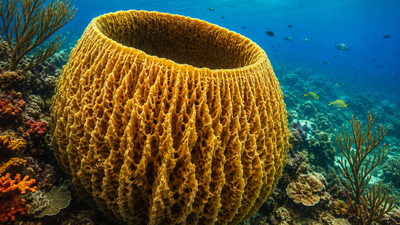
Imagine an animal that began life centuries before the Roman Empire reached its peak, and has quietly continued its daily routine ever since. According to recent reports, scientists have identified a giant Caribbean sponge that is believed to have lived for about 2,300 years, making it one of the oldest animals ever documented.
It is believed that the sponge settled on the sea floor in the form of a microscopic larvae at a time when the Carthaginian leader Hannibal had not yet crossed the Alps. If confirmed by further research, this discovery will provide fascinating insight into how some marine organisms survive for thousands of years while constantly filtering seawater, supporting coral reef ecosystems, and recording changes in Earth’s oceans over thousands of years.
A living animal that may have witnessed more than two thousand years of history
Sponges are among the oldest groups of multicellular animals on Earth, with fossil evidence indicating that their ancestors appeared more than 600 million years ago. Unlike most marine organisms, they remain fixed to the seafloor throughout their lives, drawing seawater through complex canal systems to extract microscopic food particles and oxygen.According to a paper titled “Reef Redwoods: Growth and Lifespan of the Giant Barrel Sponge Xestospongia muta in the Florida Keys,” the Caribbean specimen is reported to have survived for approximately 2,300 years.
If verified, it would mean that they were already established on the ocean floor long before many distinct historical events occurred, and have survived sea level changes, hurricanes, shifting ocean temperatures, and countless environmental disturbances.Scientists point out that giant barrel sponges are often described as the “redwoods of coral reefs” because of their enormous size, slow growth and exceptional longevity.
How do scientists estimate the age of ancient sponges?
Unlike trees, sponges do not produce annual growth rings that can be directly counted.
Instead, researchers estimate their ages by combining long-term growth measurements, mathematical growth models, and radiocarbon dating techniques developed for marine organisms.A recent study by Jamaluddin Jumba, Head of Faculty at the Faculty of Marine Sciences and Fisheries, Hasanuddin University, Indonesia, titled “Growth and longevity in giant barrel sponges: coral reef redwoods or Indo-Pacific pine?” It states that giant barrel sponges expand only a few millimeters to centimeters each year.
Their slow metabolism and remarkably stable body structure allow them to persist for centuries, with some previous scientific studies estimating the lifespan of the largest individuals at over 1,000 years.Further peer-reviewed analysis will be needed to independently confirm the 2,300-year age of the reported Caribbean specimen.
Why could this ancient marine animal change our understanding of ocean ecosystems and longevity?
In addition to their amazing lifespan, giant sponges perform a vital ecological function.
By continuously pumping and filtering thousands of liters of seawater, they remove bacteria, recycle nutrients and help maintain healthy coral reef ecosystems.Marine biologists also consider exceptionally ancient sponges to be valuable environmental archives. Because they survive for centuries or even millennia, they preserve chemical signatures that can help reconstruct past ocean temperatures, water chemistry, and long-term climate variability.As ocean temperatures continue to rise under climate change, understanding how these extraordinarily resilient animals withstand environmental stresses could provide important clues for preserving coral reefs and protecting marine biodiversity in the coming decades.