

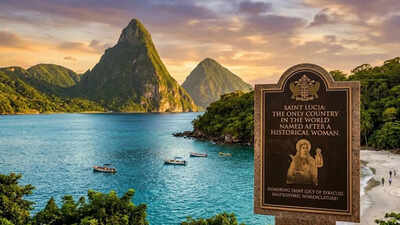
Saint Lucia, located in the eastern Caribbean Sea, is a very special island because it is the only independent country in the world named after a woman. Official records from the government of Saint Lucia confirm that the nation was named in honor of Saint Lucy of Syracuse, who was martyred in the 4th century.
Most countries are named after an abstract idea or male, but the island is so named due to its very detailed colonial history and is often called the “Helen of the West Indies” due to the changing back and forth between the British and French governments ruling the island. According to the records of the Saint Lucia National Trust, French sailors who were shipwrecked on the saint’s feast day, December 13, named the island after the saint and thus established the world’s only sovereign identity.
How did Saint Lucia become? The only country named after a woman
Saint Lucia has the distinction of being the only independent country in the world named after a historical woman, according to official records filed with the Saint Lucia government. Its namesake is Saint Lucy of Syracuse, a documented historical figure and 4th-century martyr.French sailors who were shipwrecked on the island named it “Saint Lucia” on December 13, 1502, coinciding with the liturgical feast of Saint Lucie, cementing the island’s unique nomenclature.
All other islands in the Caribbean, including St. Kitts (St. Christopher), St. Vincent, etc., derive their names from men; Saint Lucia is therefore the only island in the Caribbean with a matrilineal name.
Flight from Hewanorra to Saint Lucia
The Kalinago (Carib) were the indigenous people of the island and referred to the island as Hewanorra. The exact meaning of this name can be found in the archives of the National Trust of Saint Lucia, where it is stated to mean “Land of the Iguana”.
The transition from this original designation to the French-granted “Saint Lucia” provides an important case study of toponyms for historians analyzing colonial maritime expansion throughout the eastern Caribbean.
The duality of local and colonial names continues to underlie the nation’s culture and archaeological research today.
Title “Helen of the West Indies”
The title “Helen of the West Indies” of Saint Lucia is well known and has been recorded by the Commonwealth.
It developed as a result of the island being a desirable and scenic military outpost during the 18th and 19th centuries. The island was at war several times, like Helen of Troy, experiencing a geopolitical tug-of-war that saw power shift between Britain and France 14 times, seven times for each empire, before it was eventually awarded to Britain in 1814.
A UNESCO World Heritage : Famous Peyton
Saint Lucia’s identity is closely linked to the Pitons, two prominent volcanic towers that rise directly from the Caribbean Sea. to. Both pitons are classified as a World Heritage Site by UNESCO. UNESCO awarded the site this international designation for its “exceptional natural beauty” and “geothermal uniqueness.” This designation creates a framework for scholars and the cultural community to explain why Saint Lucia, named after the Saint of Light, remains the “jewel” of the Antilles, protected by international law for its geological importance.