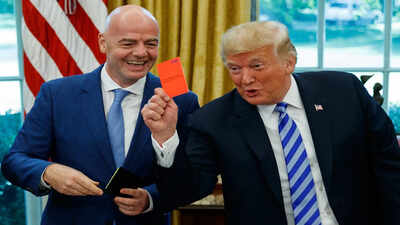
FILE – President Donald Trump holds a red card during a meeting with FIFA President Gianni Infantino in the Oval Office of the White House, Tuesday, August 28, 2018, in Washington. (AP Photo/Evan Vucci, File)
For a while, it was easy to forget that the World Cup was being held in Trump’s America. There were no clashes between ICE and fan groups. Fans chanting NSFW slogans about the president were not taken to detention centers.
People were really enjoying discovering an America that existed outside of the stereotypes they saw on sitcoms. Then came the postponement of the red card, reminding us that the World Cup takes place in somewhat turbulent times. Then came a phone call. But let’s start from the beginning.
The big picture
The 2026 World Cup was always going to be more than just football. It is the first edition to feature 48 teams, spread across the United States, Mexico and Canada, spanning over 104 matches and being sold as the largest, most massive and most lucrative tournament ever organized by FIFA. It’s also being played in the year that America celebrates its 250th anniversary, giving Donald Trump exactly the kind of backdrop he instinctively understands: flags, stadiums, anthems, cameras, a national stage and the possibility of a local team organizing the contest deeper into the month.
This is the context in which we should understand FIFA’s relationship with Trump. FIFA may own the World Cup, but it does not own America’s borders, airports, police forces, airspace, visa regulations, emergency protocols, or federal security services. Despite all its bravado in Zurich, the International Federation of Association Football (FIFA) cannot run a tournament of this size in the United States without the White House and the American state playing ball. Trump is thus much more than just a VIP in a box.
It is the president of the host country who controls much of the physical reality of the tournament.This is where Gianni Infantino’s FIFA enters more dangerous territory. Infantino has spent years transforming FIFA from soccer’s regulatory body into a mobile court of global power. He loves presidents, princes, prime ministers, and anyone else who can communicate stadiums, sponsors, television images, and silence.
Trump has called him the “King of Football,” which may seem absurd until one considers the extent to which modern FIFA has become a projection of Infantino’s authority.A New Yorker profile of Infantino sharply reflected this shift. One of his former UEFA colleagues said his vision was to expand “FIFA’s authority and its own authority”. Another former high-ranking FIFA official said there was “no major decision” in this tournament without Infantino’s direct involvement.
This is important because the Balogun case did not involve vaccination. This idea arrived through a relationship that already included Trump’s FIFA Peace Prize, the FIFA office in Trump Tower, the relocation of the World Cup draw to Washington, D.C. after Trump proposed the Kennedy Center, and the sight of Village residents performing “YMCA,” Trump’s unofficial anthem, at a FIFA event.So when the phone rang, FIFA wasn’t hearing from a random politician with an opinion on VAR.
She was listening to the host president, the anniversary director, the security gatekeeper, the waiting trophy presenter, and the man Infantino had spent months elevating onto the tournament stage.
Red card recovery
The football part of the story began in the United States’ win over Bosnia and Herzegovina in the round of 32, when Folarin Balogun was sent off for a foul on Tarik Muharimovic. Under the usual disciplinary rhythm of football, the path was simple enough.
A red card leads to an automatic one-match suspension, which means Balogun will miss the round of 16 against Belgium, American fans will be angry at the referee, pundits will argue over slow-motion replays, and ultimately everyone will discover a new anger at breakfast.Instead, Trump called Infantino and requested a review. Around that call came a broader campaign involving lawyers, officials and people close to US Soccer, all looking for a way to make Balogun available.
Ultimately, FIFA found its answer in Article 27 of its disciplinary code, which allows for the suspension of a penalty. The red card remained on Balogun’s record, but the punishment was deferred for a one-year probation period, meaning he could play against Belgium.
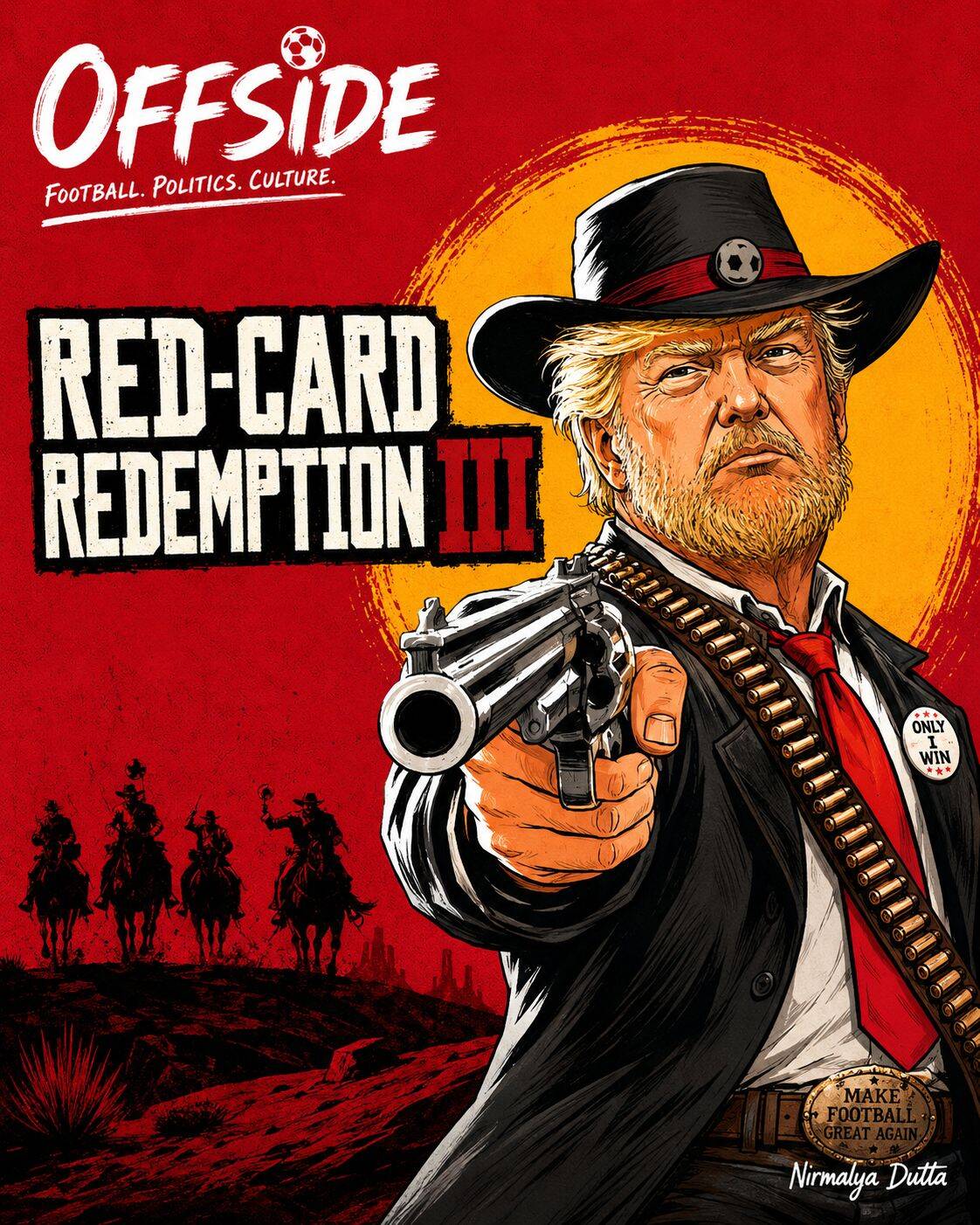
Trump celebrated the decision in his usual register, thanking FIFA “for doing the right thing and reversing a great injustice!” UEFA saw a completely different picture and described the decision as “unprecedented, incomprehensible and unjustified,” adding that FIFA had “crossed the red line.”
This phrase is important because it is no longer just a question of whether Balogun’s tackle deserves a red card or not. Even some critics of FIFA’s decision thought the original call was harsh.
The problem was that the supposed automatic penalty became flexible once the head of the host country decided it needed to be reconsidered.Article 27 is the kind of clause that lives quietly in disciplinary laws until the authority needs a door. Earlier this year, Cristiano Ronaldo was suspended for two of three matches after receiving a red card against Ireland, allowing him to play Portugal’s opening matches in the World Cup group stage.
Balogun has now used the same route, which is why this clause already sounds like the Ronaldo rule: the infraction stays on paper, the penalty is delayed in practice, and the spectacle gets the player it wants.Belgium realized the danger immediately. Its union said it was “astonished.” Belgium coach Rudi Garcia mocked the timing, saying, “I did not know that July 5 equals April 1 in FIFA.” Wayne Rooney described what happened as an “absolute disgrace” and said that Infantino “should be ashamed.”
Gary Neville said the decision “absolutely stinks”. Norway coach Stale Solbakken made the most lasting point when he warned that if the United States won, the decision would remain in the background.
This is what FIFA did here. It has given every future debate about the American campaign a second scoreboard, where goals matter and so does access to power.
Beyond the headlines
Balogun’s exemption becomes clearer when placed alongside Iran’s World Cup experience.
The Iranian tournament was plagued by visa and security complications, with members of its wider delegation having difficulty arriving and the team’s base moving from Tucson, Arizona, to Tijuana, Mexico. “We have to fight against everything here,” Iranian national team captain Mehdi Taremi said. This line stands out because it embodies the difference between playing in a World Cup and welcoming it.For Iran, the host country’s sovereignty has become a wall. For the United States, FIFA has found a door.
This contrast is the heart of the piece. FIFA promotes the World Cup as the great republic of football, a place where the ball is supposed to settle the hierarchy for 90 minutes. However, the tournament still lives on within the host nation’s political systems. Some teams face immigration queues, security concerns and uncertainties. The host nation receives a presidential phone call and a creative reading of the disciplinary code.
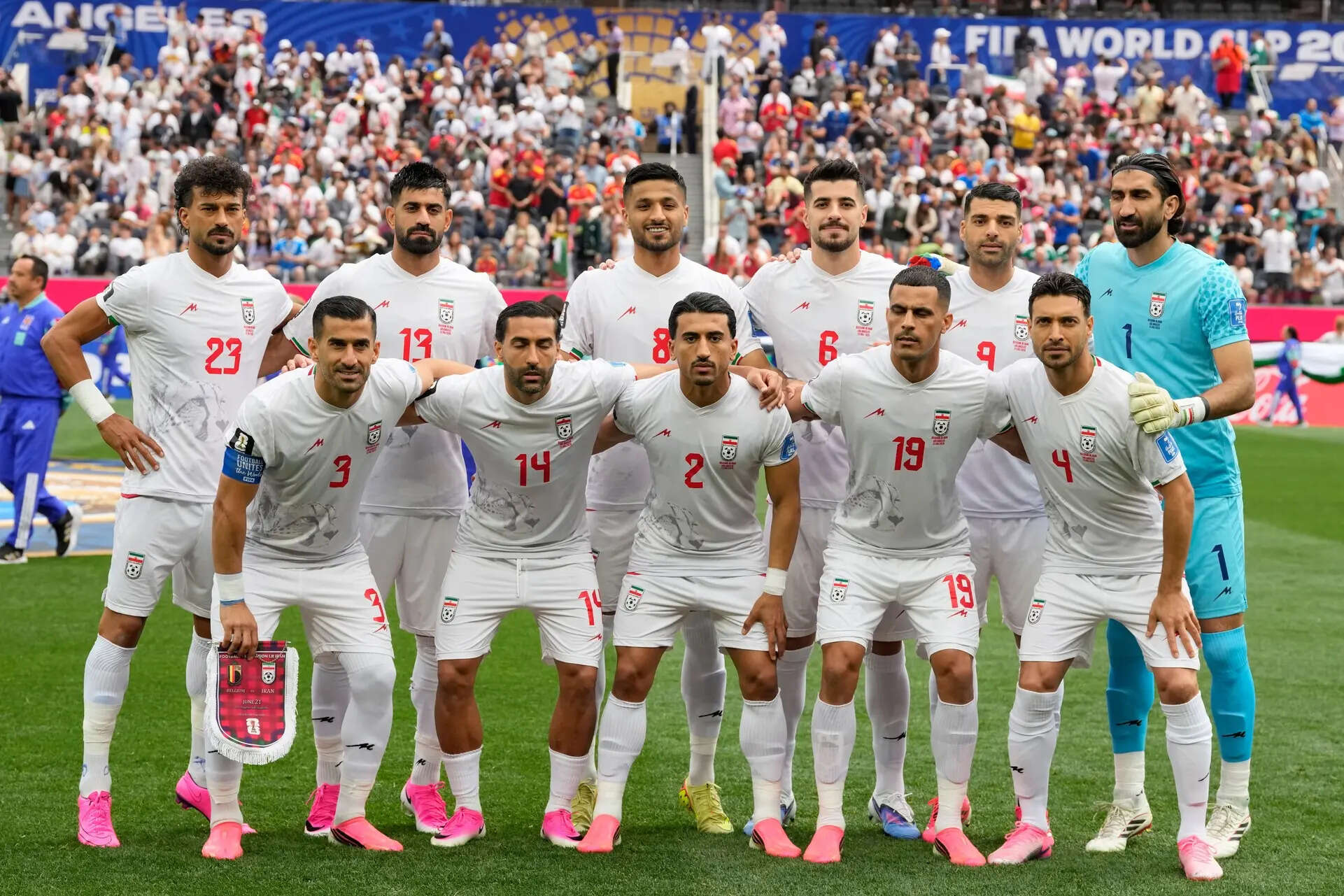
The Iranian national team takes a group photo before the FIFA World Cup Group G match between Belgium and Iran in Inglewood, California, near Los Angeles, Sunday, June 21, 2026. (AP Photo/Andre Penner)
Infantino’s defenders will argue that FIFA merely followed its own rules, and technically they may have documents to point to.
But FIFA’s problem no longer lies in the absence of rules; It is the suspicion that rules bend more easily when bending benefits the powerful. The same organization that insists on political neutrality does not find it difficult to stand by the authority when the authority brings stadiums, money, and global attention.Infantino himself helped create this impression. He awarded Trump the first FIFA Peace Prize, saying: “This is what we want from a leader.”
He publicly praised Trump, telling the crowd that he was “just doing what he said he was going to do,” and adding, “I think we should all support what he’s doing, because I think he’s doing a good job, right?” These are not the words of a distant sports administrator who carefully maintains institutional separation.
They are the words of a man who sees proximity to political power as part of FIFA’s natural environment.
No more dandruff
There is still one final photo waiting for this World Cup. Infantino said that Trump will present the trophy at the final match on July 19, explaining: “We will be with the president to enjoy the final match and hand the trophy to the winner, of course, together.” In that one sentence lies the entire tournament: Trump in the lottery, Trump with the prize, Trump on the phone, and Trump in the last photo.
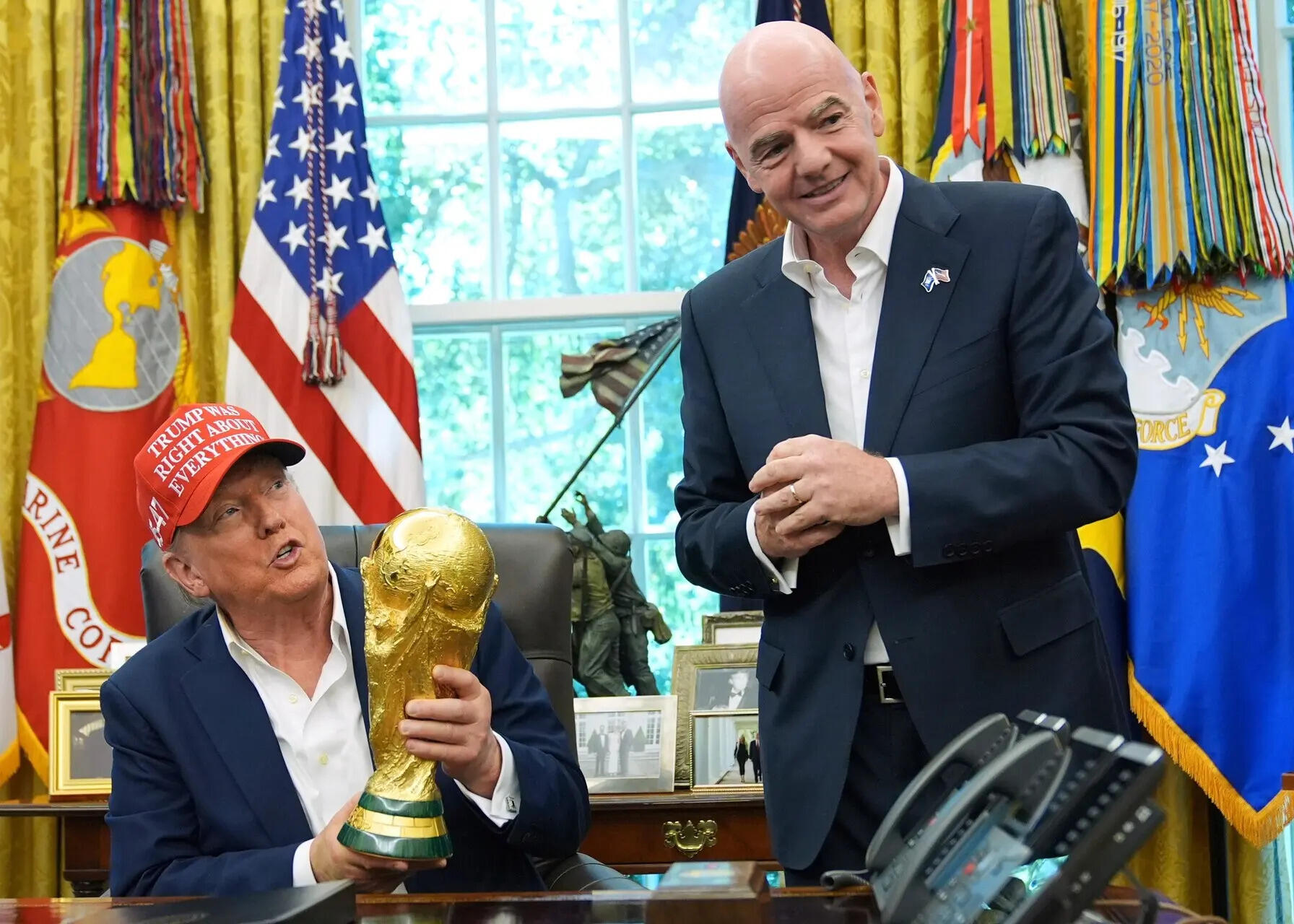
FILE – President Donald Trump holds the FIFA World Cup Winners’ Trophy as FIFA President Gianni Infantino looks on during an announcement in the Oval Office of the White House, Aug. 22, 2025, in Washington. (AP Photo/Jacqueline Martin, File)
Balogun’s dismissal did not create a problem for Trump at FIFA. She uncovered a relationship already hiding in plain sight. FIFA could cite committees, laws and Article 27, and every line of paper could be made to look respectable. But football is rarely damaged except by what is written in the rule book. It was damaged by what people believe happened behind the room where the rule book was read. The World Cup was supposed to be about the world putting aside all its differences.
Where we all put our geopolitical differences aside and worry more about seeing our team play football. This crust is completely gone now.