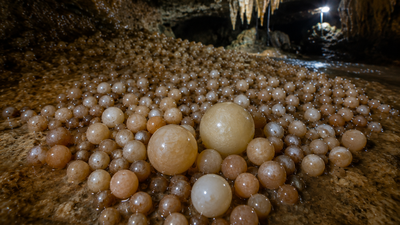
Deep in the limestone mountains of Phong Nha-Ki Bang National Park in Quang Tri Province, Vietnam, scientists have discovered a remarkable new cave that is already drawing attention for its geological importance.
The newly discovered cave, called Thang Cave (Cave of Victory), contains rare cave pearls and smooth spherical mineral formations that develop over thousands of years under very specific conditions. Along with its impressive chambers and complex rock formations, the discovery offers researchers valuable insights into the region’s ancient karst landscape and the geological processes that still shape it.
Located within one of the world’s most famous cave systems, Thang Cave adds another chapter to Vietnam’s reputation as home to some of the Earth’s most extraordinary subterranean wonders, highlighting how much of the underground landscape remains unexplored despite decades of scientific exploration and international research in the region.
What is Thang Cave and where was it discovered?
Thang Cave, which means “Cave of Victory,” was discovered by researchers who discovered karst limestone in Phong Nha-Ki Bang National Park in Quang Tri Province. This UNESCO World Heritage Site is famous for its extensive network of caves, underground rivers and dramatic karst formations, many of which have only been partially explored.
The newly identified cave features vast chambers, stalactites, stalagmites and other mineral deposits formed over millions of years, making it an important addition to the park’s growing catalog of geological treasures.
Why are the cave pearls found in Thang Cave so rare?
As reported by TV BRICS, among the most extraordinary finds at Thang Cave are the rare cave pearls, smooth, bright-white mineral formations found in unusually large clusters across the natural rock basins.
Cave pearls form over thousands of years, when mineral-rich water repeatedly deposits thin layers of calcium carbonate around tiny particles, creating nearly perfect spherical structures. Although cave pearls can be found in limestone caves around the world, experts involved in exploration note that such a high concentration is exceptionally uncommon, and even experienced cave surveying teams rarely encounter deposits of this size.Beyond their visual appeal, the cave pearls indicate that Thang Cave has maintained remarkably stable geological and hydrological conditions over long periods. The abundance of these rocks, along with the stalactites, stalagmites and towering limestone formations in the cave, make the newly discovered cave an important site for geological research and enhance the scientific value of Phong Nha-Ki Bang National Park, one of the most important karst landscapes in the world.
Why discovery is important for science and conservation
The discovery of Thang Cave highlights the scale of Vietnam’s underground landscape that remains unexplored despite decades of cave research. Each newly documented cave contributes valuable information about karst formation, groundwater systems, and the biodiversity that thrives in these isolated environments.Scientists believe further exploration could reveal additional geological features and previously unknown species adapted to life underground.
At the same time, this discovery underscores the importance of protecting the fragile ecosystems in caves, where even minor disturbances can damage mineral formations that took thousands of years to form. As research continues, Thang Cave is expected to become an important site for geological study while enhancing the global importance of Phong Nha-Ke Bang National Park.
Cave pearls that form over thousands of years in stable, undisturbed conditions are as much a record of geological continuity as they are mineral composition. Finding them in unusually high concentrations suggests that Thang Cave was largely unaffected by the surface disturbances that impeded their growth elsewhere, making the timing of their discovery, and the question of what happens next, genuinely dependent on what it contains.